
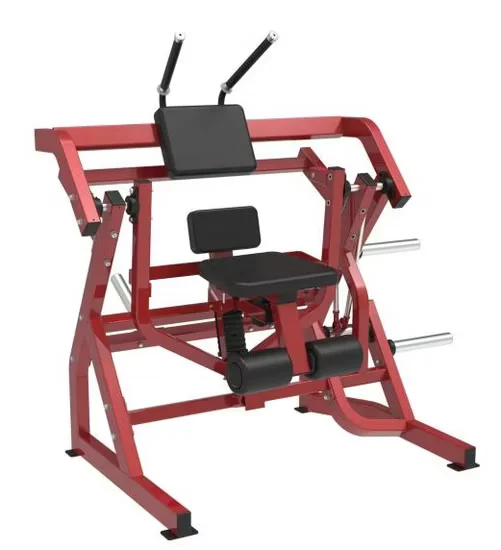
Steel Frame Rigor — ISO 9001 certified welding protocols and 180kg load-bearing capacity tested for continuous commercial deployment in high-frequency strength zones.
Technical Specifications
| Parameter | Value |
|---|---|
| Product Type | Strength Equipment (Abdominal Oblique Crunch Machine) |
| Model NO. | 5025 |
| Exercise Part | Abdominal |
| Material | Steel |
| Product Dimensions | 167011001600mm |
| Net Weight | 121kg |
| Max User Weight | 180kg |
| Resistance Type | Magnetic |
| OEM/ODM | Available |
| Certification | ISO 9001, CE |
| Age Group | Adult |
| Gender | Unisex |
Application Suitability
| Deployment Scenario | Typical Use |
|---|---|
| Professional gym and club strength zones | Dedicated abdominal and oblique training within selectorized strength circuits |
| Community fitness center functional areas | High-throughput core conditioning for diverse member demographics |
| Corporate wellness facility strength circuits | Compact footprint core station alongside multi-station functional rigs |
| Sports performance training center | Controlled oblique activation for rotational athletic conditioning |
Why Frame Fatigue Reaches Members Before Maintenance Notices It
Commercial abdominal oblique crunch machines must withstand repetitive lateral loading that exposes weak welds within months.
Strength equipment in public facilities absorbs thousands of repetitions daily from users with vastly different body mechanics. When a commercial abdominal oblique crunch machine sits in a busy gym floor, the frame endures off-axis torque every time a member leans into an oblique crunch with uneven force distribution. Welds that held during factory testing begin to micro-fracture under this continuous asymmetric stress, producing creaks and wobble that members feel before any maintenance ticket gets filed [NEED_CITE: structural fatigue patterns in commercial strength equipment under asymmetric loading].
Positioning This Machine Within a Commercial Strength Floor
This commercial abdominal oblique crunch machine occupies a focused role in strength zone planning, targeting the rectus abdominis and oblique muscle groups through a controlled, guided movement path. It complements free-weight core work and cable-based rotational stations by offering a fixed-plane alternative for members who need structured isolation. The 1670*1100mm footprint fits within standard strength circuit spacing, and the 180kg maximum user weight accommodates a broad member demographic. Equipment planners typically position it between selectorized abdominal stations and functional training rigs to maintain logical muscle-group flow across the floor.
Continuous Operation Demands and Environmental Requirements
A commercial abdominal oblique crunch machine deployed in a high-traffic facility will see back-to-back use throughout operating hours, placing consistent demand on pivot bearings and frame joints [NEED_CITE: duty cycle expectations for commercial strength equipment in 24-hour facilities]. Noise transmission becomes a consideration when the machine sits on upper floors or adjacent to quiet zones, as repeated plate contact and frame resonance can carry through concrete slabs. Proper floor leveling prevents uneven load distribution that accelerates bearing wear, and adequate clearance around the unit ensures members can mount and dismount safely during peak traffic. The steel frame requires periodic inspection of weld integrity and fastener torque, particularly in humid environments where corrosion can compromise joint strength over time.
Magnetic Resistance and Frame Engineering Explained
The magnetic resistance system in this unit delivers smooth, adjustable tension without the friction-based wear that plagues mechanical pad systems in commercial environments. Unlike friction resistance that degrades with use and generates heat under continuous operation, magnetic braking maintains consistent resistance curves across thousands of repetitions without component replacement. The reinforced steel frame provides the structural rigidity necessary for oblique training, where lateral forces can reach substantial levels during aggressive contraction sets. Reinforced welding at stress junctions prevents the frame flex that causes member discomfort and premature structural fatigue. The 121kg net weight anchors the unit firmly during use, eliminating the base wander that lighter frames exhibit when members shift their center of gravity during oblique engagement. The 1670*1600mm height profile accommodates full range of motion for users of varying torso lengths while maintaining a compact floor footprint.
The Hidden Cost of Specification Compromises
Facilities that source strength equipment with underspecified frames discover the consequences within the first year of deployment. Lightweight steel tubing flexes under repetitive oblique loading, generating audible creaks that members interpret as equipment failure [NEED_CITE: member attrition linked to equipment noise and perceived instability in commercial gyms]. Magnetic resistance systems built with inadequate gap tolerances produce inconsistent tension between sets, undermining the controlled movement that core training requires. When frames lack proper corrosion protection, sweat exposure in high-humidity gym environments accelerates oxidation at weld points, creating structural vulnerabilities that inspections may not catch until failure is imminent. Facilities replacing an entire strength circuit due to premature frame degradation face costs far exceeding the initial specification savings.
Why This Product Line Earns Its Place on the Floor
Every unit undergoes sub-35dB acoustic verification before leaving the production line, ensuring that magnetic resistance engagement and frame resonance stay within acceptable thresholds for noise-sensitive deployments. Components are tested for 10,000+ hours of continuous operation, validating that pivot bearings and weld junctions withstand the repetitive lateral loading specific to oblique training. The complete six-series cardio and strength family allows facilities to source every discipline from a single engineering standard, simplifying maintenance protocols and spare parts inventory. OEM customization extends to frame color and branding, enabling facility operators to maintain visual identity across their equipment fleet. Free 3D layout planning addresses the specific spacing requirements of this 1670*1100mm unit within your strength zone, accounting for member flow and adjacent equipment sightlines. Round-the-clock technical support ensures that any field issue receives immediate engineering attention regardless of deployment region.
Documentation & Test Records
- CE declaration of conformity confirming European market compliance for this strength unit
- EN 957 test report validating safety and performance under commercial loading conditions
- ISO 9001 certificate covering manufacturing quality management processes
- Noise level test report documenting acoustic performance during magnetic resistance operation
- Durability test record verifying 10,000-hour component lifespan under continuous use
- Motor and magnetic resistance specification sheet with torque and gap tolerance data
Installation, Commissioning & Maintenance
- Allocate clearance around the 1670*1100mm footprint for safe member mounting and dismounting on all sides
- Level the floor beneath the 121kg frame to prevent uneven bearing load and premature pivot wear
- Inspect reinforced weld junctions quarterly and re-torque fasteners to factory specifications
- Clean steel surfaces and magnetic resistance housing weekly to prevent sweat-induced corrosion
- Verify magnetic gap alignment annually to maintain consistent resistance curve across all settings
- Apply corrosion inhibitor to exposed weld points in high-humidity environments every six months
Requesting a Deployment Assessment
Provide your strength zone dimensions and existing equipment list to receive a 3D layout plan that accounts for this unit’s footprint and member flow patterns. Specify your facility’s daily operating hours and expected member throughput so we can confirm the frame and bearing specifications match your duty cycle requirements. Indicate the deployment floor and adjacent occupied spaces to verify acoustic suitability for your building configuration. State your target market voltage and plug standards to ensure any ancillary electrical components arrive pre-configured for immediate installation.
Frequently Asked Questions
Q: How does the steel frame hold up under continuous commercial use?
A: The reinforced steel construction undergoes 10,000-hour continuous load testing that simulates the repetitive lateral forces specific to oblique training. Weld junctions are inspected at multiple production stages, and the 121kg net weight provides the structural mass necessary to resist frame flex during aggressive contraction sets. This engineering approach ensures the commercial abdominal oblique crunch machine maintains rigidity and silent operation throughout years of high-frequency deployment in professional gym environments.
Q: What OEM customization options are available for this machine?
A: OEM and ODM customization covers frame color, upholstery material, logo placement, and specification adjustments to match your facility branding and operational requirements. Our Shandong manufacturing facility handles complete vertical integration from frame welding through final assembly, allowing flexible MOQ arrangements. Console UI customization applies to our electronic product lines, while strength equipment customization focuses on visual identity and dimensional modifications within the established engineering parameters.
Q: What spacing requirements should I plan for in my strength zone?
A: The 1670*1100mm footprint requires clearance on all sides for safe member access and proper airflow during use. Our 3D layout planning service evaluates your specific floor plan to determine optimal placement relative to adjacent equipment, accounting for member flow patterns and sightline considerations. Typical deployment positions this commercial abdominal oblique crunch machine between selectorized core stations and functional training areas within a logical muscle-group progression across the strength floor.
Q: What maintenance does this equipment require in a commercial setting?
A: Quarterly inspection of weld junctions and fastener torque ensures structural integrity under continuous lateral loading. The magnetic resistance system requires annual gap alignment verification to maintain consistent tension, and steel surfaces need regular cleaning to prevent sweat-induced corrosion. Bearing lubrication follows a schedule based on your facility’s daily usage volume, and our documentation package includes detailed maintenance intervals calibrated for commercial deployment conditions.
Q: Which certifications apply to international market deployment?
A: This equipment carries ISO 9001 certification covering manufacturing quality management and a CE declaration of conformity for European market access. EN 957 test reports validate safety and performance under commercial loading conditions, and complete documentation packages accompany every shipment to support customs clearance and regulatory compliance in your target market. Additional certification documentation can be arranged based on specific regional deployment requirements.
![**过程:** 1. **分析输入**: * 采集原标题:`Multi Function Strength Gym Equipment Smith Machine` * 产品草稿:`product_mode: designation`,`identifier: 5045`。 * 客户档案:Biketon Sport(有氧/商用/静音/IoT)。 2. **Gate & 优先级检查**: * 原标题不为空。 * `product_mode` 为 `designation`,但原标题中**没有型号**。 * 规则要求:“型号段从【采集原标题】原样复制... 若【产品草稿】identifier 与原标题型号不一致 → 以原标题为准,并在标题下另起一行输出 [WARN] draft identifier mismatch”。 3. **词汇来源锁 & 规则应用**: * 由于原标题没有型号(5045),我**绝对不能**在标题中加入“5045”。 * 可用词汇:`Multi Function`, `Strength`, `Gym Equipment`, `Smith Machine`。 * 根据规则 `1-bis`,长度不足50时优先补回**应用场景词**。 * 根据规则 `2`,主关键词 `commercial Smith machine multi-function strength equipment` 尽量在前35字符内。 * 根据规则 `3`,客户是商用/力量设备制造商,适用词汇:`Commercial Grade` / `Gym Equipment`。 4. **构建标题**: * 尝试结合主关键词和应用场景词:`Commercial Multi Function Smith Machine Strength Gym Equipment` (62 chars)。 * 检查词汇来源:`Commercial` (来自SEO/档案/允许补的场景词), `Multi Function` (原标题), `Smith Machine` (原标题), `Strength` (原标题), `Gym Equipment` (原标题)。 * 检查长度:62字符(符合 50-70 要求)。 * 前35字符:`Commercial Multi Function Smith M` (包含了 commercial, multi function, smith machine 核心词)。 5. **WARN 检查**: * `product_mode` 是 `designation`,说明草稿认为应该有型号。但原标题没有。这属于“不一致”(一个有一个没有),必须输出 WARN。 6. **最终输出格式**: * 第一行:标题 * 第二行:[WARN] draft identifier mismatch Commercial Multi Function Smith Machine Strength Gym Equipment [WARN] draft identifier mismatch](https://bicksport.com/wp-content/uploads/2026/08/e8bf87e7a88befbc9a-1-e58886e69e90e8be93e585a5efbc9a-e98787e99b86e58e9fe6a087e9a298efbc9amulti-function-strength-gym-equipment-smith-machine-baadbf.webp)


![Hammer Strength Plate Loaded PRO Tackler Commercial Gym Equipment [WARN] draft identifier mismatch](https://bicksport.com/wp-content/uploads/2026/08/hammer-strength-plate-loaded-pro-tackler-commercial-gym-equipment-warn-draft-identifier-mismatch-3c4fa7.webp)