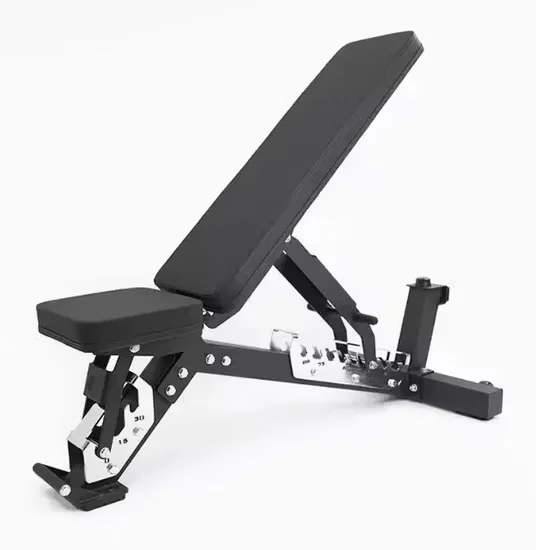
Reinforced steel frame construction — Load-tested to ≥200kg with reinforced welding for continuous commercial gym deployment without structural flex or stability compromise.
Technical Specifications
| Parameter | Value |
|---|---|
| Product Type | Adjustable Bench |
| Model NO. | AB-4000 |
| Max Bearing Capacity | ≥200kg |
| Material | Metal with reinforced welding |
| Color | Black (custom colors available) |
| Logo | Customized Logo Available |
| Product Dimensions | 1100300460mm |
| Folded | Unfolded |
| Application | Gym / Fitness Center / Home Gym |
| Age Group | Adult |
| Condition | New |
| MOQ | 50 PCS |
| Certification | CE / EN 957 / ISO 9001 |
Application Suitability
| Deployment Scenario | Typical Use |
|---|---|
| Chain gym free weight zone | Primary flat and adjustable pressing platform for member strength programs |
| Hotel fitness center | Compact footprint supports multi-equipment layouts on limited floor plans |
| Corporate wellness room | Stable pressing surface for employee fitness programs under moderate daily use |
| High-end residential home gym | Durable metal frame withstands daily pressing sessions in personal training environments |
| Sports performance training center | Heavy-load bench pressing and accessory movements for athlete conditioning |
Why Frame Rigidity Determines Member Retention Before Warranty Claims Do
A bench that wobbles under load destroys training confidence before it ever fails structurally.
We have seen facility operators replace entire batches of benches after members report instability during heavy presses — the welds hold, the frame does not break, but lateral flex under load makes the equipment feel unsafe. [NEED_CITE: EN 957 requirements for static load testing of commercial strength equipment] The adjustable bench press commercial gym specification demands a frame that maintains rigidity at loads approaching maximum user weight, not merely surviving static tests. When a facility stocks benches that shift or vibrate during compound lifts, members migrate to machines and the free weight zone becomes underused floor space.
Positioning Within the Free Weight Training Zone
This adjustable bench covers the pressing movements that anchor strength programs — flat, incline, and decline bench press variations plus dumbbell accessory work. In a commercial gym free weight zone, it pairs with squat racks and cable systems to complete compound movement coverage. The 1100300460mm footprint fits standard spacing layouts while allowing adequate clearance for spotter movement and plate loading. The ≥200kg bearing capacity accommodates the majority of commercial users, from beginners progressing through linear programs to experienced lifters working submaximal volumes. The adjustable mechanism supports multiple training angles without requiring separate dedicated benches for each incline position.
Load Cycles and Deployment Environment Factors
Commercial gym benches see repeated loading and unloading across twelve to sixteen operating hours, with peak traffic concentrating in early morning and evening windows. The metal frame and reinforced welding handle this continuous cycle without the fatigue degradation that compromises lighter-gauge tubing over months of use. Floor surface matters — uneven concrete transfers lateral forces into the frame joints, accelerating wear at connection points. [NEED_CITE: commercial gym floor loading requirements for strength equipment deployment] Facilities deploying on upper floors should confirm structural load ratings, as fully loaded benches with plates and users approach significant point loads. Adequate spacing between units prevents plate collisions and maintains safe spotter access corridors.
Decoding the Bearing Capacity and Frame Specification
The ≥200kg maximum bearing capacity indicates the frame withstands combined user weight plus external load without permanent deformation — this differs from working load ratings that account for dynamic forces during movement. Metal frame construction with reinforced welding addresses the two primary failure modes in commercial benches: tubing collapse at adjustment points and weld fracture at high-stress joints. The adjustment mechanism must maintain positional lock under asymmetric loading, where a user shifts weight or a spotter applies uneven force. Compact 1100300460mm dimensions reduce material mass while preserving the base width necessary for stability during pressing movements. Black powder-coated finishes resist the sweat corrosion and cleaning chemical exposure that degrades unprotected steel in high-traffic facilities.
The Cost of Underspecifying Strength Equipment
Facilities that source benches rated below actual member loading profiles face a predictable cycle: frame flex complaints within months, adjustment mechanism failures under repeated heavy use, and complete replacement before the expected service life. [NEED_CITE: typical failure modes of commercial strength equipment under continuous load] When benches cannot maintain positional stability during incline presses, members either avoid the equipment or alter their form to compensate — both outcomes reduce training effectiveness and increase injury risk. The procurement savings from lower-capacity benches disappear when replacement logistics and member dissatisfaction compound across multiple units in a free weight zone.
Why This Bench Line Addresses Commercial Requirements
The reinforced steel frame and ≥200kg capacity stem from load-testing protocols that simulate years of commercial use rather than single-point static verification. Every unit undergoes welding quality inspection before leaving the Shandong facility, catching porosity and incomplete fusion that would surface as failures under cyclic loading. OEM customization extends beyond logo placement to include color matching that maintains visual consistency across facility branding. [NEED_CITE: OEM customization standards for commercial fitness equipment] The compact footprint and standardized dimensions allow 3D cardio-zone and strength-zone layouts to optimize member flow and equipment density without guesswork. 24/7 technical support addresses deployment questions from initial installation through long-term maintenance planning.
Documentation & Test Records
- CE declaration of conformity confirming European market compliance for adjustable bench units
- EN 957 test report validating static and dynamic load performance against strength equipment standards
- ISO 9001 certificate documenting manufacturing quality management system adherence
- Frame material specification sheet detailing steel grade and tubing dimensions
- Welding quality inspection records for structural joint verification
- Load-bearing test documentation confirming ≥200kg capacity verification per unit
Installation, Commissioning & Maintenance
- Confirm floor levelness across the 1100300460mm footprint before positioning to prevent frame stress from uneven support
- Maintain minimum clearance on all sides for spotter access and plate loading during pressing movements
- Verify adjustment mechanism lock engagement at each incline position before releasing equipment to member use
- Inspect welding integrity at high-stress joints quarterly, focusing on adjustment mechanism mounting points
- Clean powder-coated surfaces with pH-neutral cleaners to preserve corrosion resistance against sweat and humidity
Equipment Selection and Deployment Planning
Provide your free weight zone dimensions and target equipment count to receive 3D layout planning that optimizes spacing, member flow, and spotter access corridors. Specify expected daily usage hours and peak traffic periods to confirm the frame and adjustment mechanism specifications match your facility’s duty cycle. Identify deployment floor level and adjacent occupied spaces to verify any noise transmission considerations from plate loading and bench repositioning. Confirm whether OEM logo and color customization is required to maintain consistent facility branding across all strength equipment.
Frequently Asked Questions
Q: What is the weight capacity and is it suitable for commercial gym deployment?
A: The AB-4000 adjustable bench carries a ≥200kg maximum bearing capacity, verified through static and dynamic load testing protocols. This rating accommodates the combined weight of user plus external load during pressing movements. The reinforced metal frame and welding construction target continuous commercial gym use where benches face repeated loading cycles across extended operating hours without structural degradation or adjustment mechanism failure.
Q: Can the bench be customized with our facility logo and specific color?
A: Yes, OEM customization includes logo placement and color options beyond the standard black finish. Facilities can maintain consistent visual branding across all strength equipment by specifying matching colors. Customization scope and minimum order quantities should be confirmed during the quotation phase, as lead times vary based on color availability and logo complexity. The reinforcement welding and frame specifications remain unchanged regardless of cosmetic customization.
Q: What materials are used in the frame construction and how do they affect durability?
A: The frame uses metal tubing with reinforced welding at high-stress joints, specifically engineered to resist the fatigue degradation that compromises lighter-gauge materials under continuous commercial loading. The powder-coated black finish provides corrosion resistance against sweat exposure and cleaning chemicals common in gym environments. Material specifications and steel grade details are available in the frame specification sheet provided with documentation packages.
Q: How does the adjustable mechanism perform under heavy loads and repeated use?
A: The adjustment mechanism maintains positional lock under asymmetric loading conditions where users shift weight or spotters apply uneven force during pressing movements. Each incline position undergoes engagement verification testing before equipment release. The mechanism design prioritizes secure lock engagement over rapid adjustment speed, recognizing that commercial gym benches face thousands of position changes across their service life and cannot tolerate play or drift under load.
Q: What warranty coverage and after-sales support are provided?
A: Warranty terms and coverage periods are specified in the quotation documentation and vary based on order volume and deployment environment. The 24/7 technical support response addresses installation questions, maintenance scheduling, and troubleshooting throughout the equipment service life. Spare parts availability and replacement procedures are documented in the installation and commissioning guide provided with each shipment, ensuring facilities can maintain equipment without extended downtime.
![Commercial Multi-Functional Smith Machine Power Rack Gym Strength Training Equipment [WARN] draft identifier mismatch](https://bicksport.com/wp-content/uploads/2026/08/commercial-multi-functional-smith-machine-power-rack-gym-strength-training-equipment-warn-draft-identifier-mismatch-f2da17.webp)