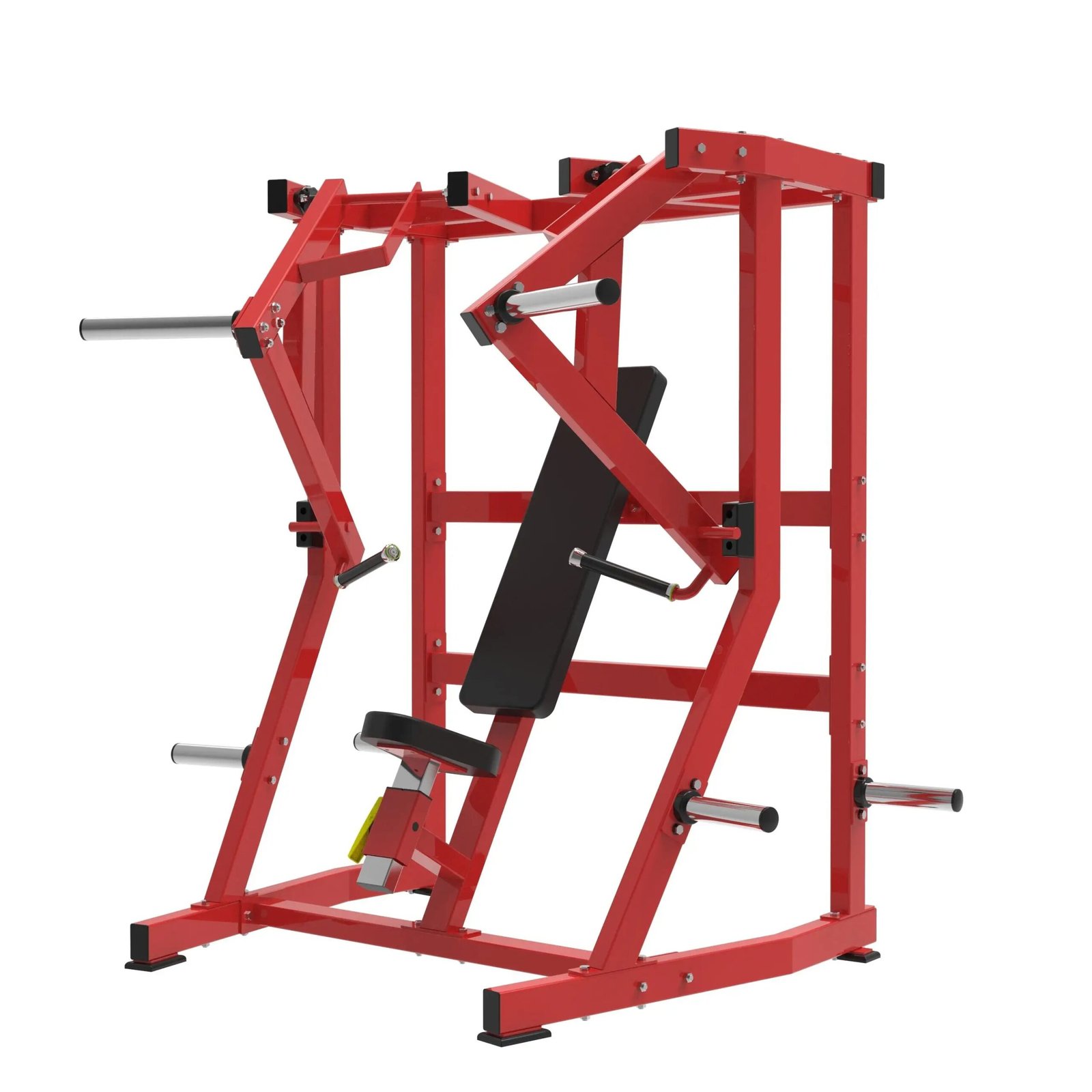
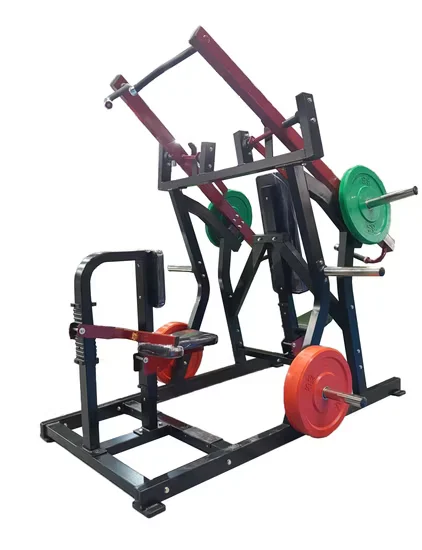
10,000-Hour Drive Validation — Every welded joint and sealed bearing in this ISO-Lateral Chest/Back unit completes continuous high-frequency fatigue cycles before leaving the factory.
Technical Specifications
| Parameter | Value |
|---|---|
| Product Type | ISO-Lateral Chest/Back |
| Designation | OS — H5002 |
| Exercise Part | Chest |
| Frame Material | Steel |
| Net Weight | 160 kg |
| Product Dimensions | 1850 × 1770 × 2000 mm |
| Main Frame Color | Custom color options available |
| Cushion Color | Custom color options available |
| Fit Area | Professional gym and club |
| OEM/ODM | Acceptable |
| Certification | ISO 9001, CE |
| Transport Package | Plywood box |
Application Suitability
| Deployment Scenario | Typical Use |
|---|---|
| Chain gym strength training zone | High-frequency chest and back isolation work across peak membership hours |
| Corporate wellness center | Employee circuit training combining pressing and pulling movements |
| Community fitness facility | General population strength conditioning with adjustable loading |
| Professional sports training base | Athlete hypertrophy and muscular balance programming |
| Hotel fitness room | Compact footprint accommodating traveler self-directed sessions |
Why Frame Fatigue Reaches Members Before Maintenance Logs Show It
Continuous lateral loading on independent arms exposes weak welds within the first season of commercial use.
When an ISO-Lateral Chest/Back trainer sits in a busy chain gym, the independent arm mechanism endures asymmetric force vectors hundreds of times per day. Most frame failures begin at the pivot bearing housing where stress concentration exceeds the weld bead’s fatigue limit. Maintenance teams rarely catch micro-cracks until a member notices wobble during a heavy press [NEED_CITE: frame fatigue failure patterns in commercial strength equipment]. By that point, the unit has already been generating uneven resistance for weeks, creating a poor training experience that drives members toward competing facilities.
Positioning This Unit Within a Commercial Strength Floor
This ISO-Lateral Chest/Back trainer fills the independent-arm pressing and pulling slot in a strength zone, complementing fixed-path selectorized machines and free-weight benches. The dual-function design lets one footprint serve both chest isolation and back work, reducing total unit count for facilities managing square-meter costs. The 1850 × 1770 mm footprint positions naturally along perimeter walls or as a divider between free-weight and selectorized sections. The steel frame and plate-loading architecture suit use densities typical of commercial facilities open 16 or more hours daily. Load capacity accommodates users across the full commercial body-weight range up to 180 kg.
Continuous Load and Deployment Environment Requirements
A chain gym running this ISO-Lateral Chest/Back unit through peak hours demands that pivot bearings and guide rods sustain repeated lateral force without developing play. Deploying the unit on upper floors of mixed-use buildings requires vibration-damping mats beneath the 160 kg frame to prevent structural transmission of plate-loading impact [NEED_CITE: vibration isolation requirements for strength equipment on suspended floors]. Adequate clearance on all four sides—minimum 600 mm—ensures safe plate loading and member passage. Level flooring is critical; even minor tilt causes the independent arms to drift toward the lower side, producing uneven resistance that members detect immediately. Ambient temperature and humidity affect cushion and grip surfaces over time, so HVAC airflow should reach the strength zone consistently.
Decoding the Load Path and Bearing Specifications
The independent-arm mechanism relies on sealed pivot bearings at each shoulder joint to translate user force into smooth arc motion. Bearing quality determines whether the arm tracks consistently or develops lateral play that worsens with each session. Steel frame gauge and welding pattern at the main upright directly govern how the structure handles off-center loading when a member presses harder on one side. Plate-loading horns positioned at the arm’s effective lever point let users micro-adjust resistance in small increments, unlike selectorized stacks that jump in fixed steps. The 160 kg net weight provides inherent stability against tipping during aggressive unilateral pressing, reducing the need for floor anchoring in most installations [NEED_CITE: static stability requirements for plate-loaded strength machines]. Custom frame and cushion color options allow the unit to align with facility visual identity systems without aftermarket painting that could void coating warranties.
The Hidden Cost of Compromised Pivot Hardware
Facilities that source strength equipment based on price alone often discover that undersized pivot bearings develop noticeable play within the first year of commercial rotation. Members feel the wobble during slow eccentrics and abandon the station, leaving it as dead floor space. Replacing bearings on a welded frame requires pulling the unit offline for extended periods, and repeated disassembly weakens the housing bore. Cheap cushion covers crack and peel under gym humidity, creating a visual impression that the entire facility is aging [NEED_CITE: upholstery degradation timelines in commercial fitness environments]. Once several units show visible wear, prospective members touring the floor draw conclusions about maintenance standards before they ever try a machine.
Why This Product Line Holds Up Across Deployment Scenarios
Every unit in this line passes the same 10,000-hour continuous cycle testing applied to the cardio range, meaning pivot bearings and frame welds are validated for the duty cycles that commercial strength zones demand. The ISO-Lateral independent arm design ensures bilateral training balance that fixed-path machines cannot replicate, supporting member retention through measurable strength symmetry. Full OEM/ODM capability extends to frame color, cushion material, and brand badging, so chain operators maintain visual consistency across locations. The 1850 × 1770 × 2000 mm dimensions allow the 3D layout team to model exact spacing and member flow before a single unit ships. Backing from a team with 15 years of cardio and strength engineering experience means installation guides address real-world floor conditions, not just ideal scenarios. Around-the-clock technical support ensures that bearing adjustments and alignment questions get answered before a unit sits idle through a Monday rush.
Documentation & Test Records
- CE declaration of conformity covering this plate-loaded strength unit
- EN 957 test report verifying structural integrity under cyclic loading
- ISO 9001 certificate for manufacturing quality management
- Noise and vibration assessment for upper-floor deployment
- Durability test record on pivot bearing and frame weld fatigue
- Installation guide with floor-leveling and clearance specifications
Installation, Commissioning & Maintenance
- Maintain minimum 600 mm clearance around the 1850 × 1770 mm footprint for safe plate loading
- Place vibration-damping pads under the 160 kg frame when deploying on suspended floors
- Verify floor levelness before tightening anchor bolts to prevent independent arm drift
- Inspect sealed pivot bearings for lateral play at quarterly maintenance intervals
- Wipe cushion surfaces daily with pH-neutral cleaner to prevent sweat-driven material breakdown
- Check plate-loading horn retention clips monthly to prevent accidental plate dislodgement
Planning Your Strength Zone Equipment Selection
Share your floor plan dimensions and target member capacity to receive a 3D layout mapping this ISO-Lateral Chest/Back unit alongside complementary machines for balanced member flow. Specify expected daily usage hours so the team can confirm pivot bearing duty-cycle ratings match your volume. Indicate deployment floor level and adjacent room types to determine whether supplemental vibration isolation is necessary. Note target market voltage standards if integrating any future console-equipped or smart-resistance units into the same zone.
Frequently Asked Questions
Q: How does ISO-Lateral independent arm design differ from fixed-path chest machines?
A: Independent arms let each side move through its own arc, so the dominant arm cannot compensate for the weaker side. This exposes and corrects bilateral imbalances over time. Fixed-path machines lock both arms to a single track, which masks asymmetry and can reinforce existing strength gaps during heavy pressing sets.
Q: What maintenance schedule do the pivot bearings require?
A: Sealed pivot bearings in this ISO-Lateral Chest/Back unit need visual inspection for lateral play every quarter. If wobble is detected, the bearing cartridge is replaced rather than re-lubricated, which restores original tolerance without machining the housing. Keeping a small spare inventory prevents extended downtime.
Q: Can the frame and cushion colors match our facility branding?
A: Yes. The OEM/ODM program covers main frame powder-coat color and cushion upholstery color, allowing chain operators to maintain visual identity across multiple locations. Color samples are confirmed before production runs begin, so there are no surprises when the container arrives at the facility.
Q: How does the footprint affect strength zone layout planning?
A: At 1850 × 1770 × 2000 mm, this unit fits standard perimeter wall placements and can serve as a zone divider between free-weight and selectorized areas. The 3D layout service maps exact clearance radii, member approach paths, and adjacent equipment spacing to prevent congestion during peak hours.