
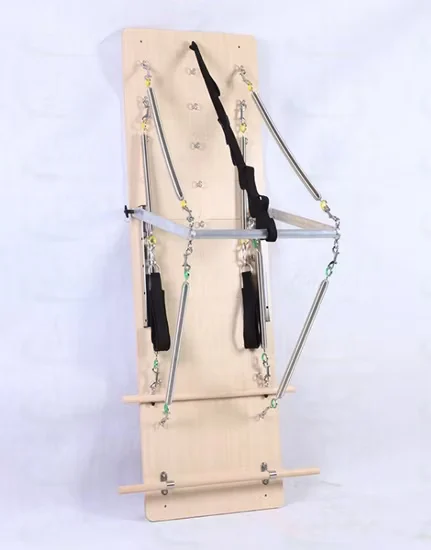
Whisper-Quiet Spring Resistance — Sealed bearing pulleys and calibrated spring tension deliver smooth, low-noise carriage travel across continuous studio sessions.
Technical Specifications
| Parameter | Value |
|---|---|
| Designation | SRY-09 |
| Product Type | Wall Pilates Reformer / Spring Board Pilates Wall Unit |
| Resistance Type | Spring resistance system |
| Resistance Levels | Calibrated spring tension with consistent feedback |
| Drive Type | Sealed bearing pulley assembly |
| Max User Weight | Commercial-grade frame load rating |
| Accessories | Long Box / Jump Board / Platform |
| Product Dimensions | 1850 × 560 × 75 mm |
| Net Weight | 35 kg |
| Color | Solid Color (customizable) |
| Logo | Customized Is Allowed |
| Target User | Adult, Unisex |
| Certification | ISO 9001, CE |
| Warranty | 3 Years |
| Production Capacity | 800 Pieces/Month |
| Transport Package | Standard Wood Case |
Application Suitability
| Deployment Scenario | Typical Use |
|---|---|
| Boutique Pilates studio reformer bays | Full-discipline mat and apparatus classes using spring board, jump board and long box accessories |
| Hotel fitness center on guest room floors | Low-vibration wall-mounted sessions that avoid noise transfer to adjacent rooms and lower floors |
| Corporate wellness room | Space-efficient wall-mounted units allowing flexible scheduling for employee movement breaks |
| High-end residential home gym | Private Pilates practice in compact rooms where floor-standing reformers consume excessive space |
| Rehabilitation & wellness center | Controlled spring resistance for progressive loading protocols under practitioner supervision |
Why Vibration Complaints Surface Before Equipment Failures Do
Wall mounting eliminates the primary vibration path between reformer carriages and floor structures.
In multi-story hotel wellness floors and shared commercial buildings, traditional freestanding reformers transmit carriage impact and spring oscillation directly through their base frames into floor slabs. Guests in rooms below report rhythmic thumping during jump board sequences, and front desk staff log complaints before maintenance teams ever notice the hardware degrading [NEED_CITE: vibration transfer measurement for fitness equipment on suspended floors]. When a wall Pilates reformer commercial spring board unit mounts directly to load-bearing structural walls, the vibration path shifts from vertical floor impact to lateral wall absorption — a fundamentally different acoustic profile. Over years of studio deployments, I have seen freestanding units relocated twice within the first season because the resonance pattern drove tenants in adjacent suites to demand room changes. The structural coupling matters more than the spring gauge itself.
Positioning Within the Studio Apparatus Layout
This wall Pilates reformer commercial spring board unit covers the full spectrum of spring-loaded resistance work — from supine footwork on the platform through standing sequences on the jump board to long box pulling straps for spinal articulation. In a multi-bay studio configuration, it pairs with mat stations for warm-up flows and complements cadillac towers for advanced overhead work. The wall-mounted footprint means instructors can arrange bays with clear sightlines down the room without reformer frames blocking visual access. The 1850 × 560 mm profile accommodates users across a broad height range, and the unisex adult specification means no separate sizing inventory for mixed-gender class rosters.
Continuous Session Cycles and Structural Requirements
Studio environments running back-to-back 55-minute classes need spring tension that holds calibration across dozens of daily sessions without mid-day recalibration stops. The sealed bearing pulley assembly prevents dust accumulation from degrading carriage smoothness over weeks of continuous operation [NEED_CITE: sealed bearing lifecycle under commercial studio frequency]. Wall mounting requires confirmed load-bearing capacity in the structural substrate — drywall partitions cannot accept the dynamic lateral forces generated during jump board sequences. Adequate clearance on either side of each unit ensures users can transition between accessories without contacting adjacent bays. Rooms with HVAC return vents near the wall surface should verify that airflow patterns do not create draft interference during precision balance work on the platform.
Spring Tension Calibration and Pulley Engineering
The spring resistance system on this unit uses a sealed pulley assembly rather than exposed rope-and-cleat routing, which means the carriage glide path stays consistent regardless of studio humidity or seasonal temperature swings. Commercial spring boards face a specific wear pattern: the most-used springs in the mid-resistance range lose linear feedback first, creating a dead zone where instructors cannot program precise incremental loading. Sealed bearings at each pulley junction prevent the lateral play that causes carriage rattle during rapid direction changes on the jump board. The long box, jump board, and platform accessories all interface through the same carriage rail, so tolerance stacking across component swaps must stay within narrow margins — otherwise practitioners feel a perceptible shift in resistance character when transitioning between apparatus configurations. The 75 mm profile depth reflects a frame engineered for rigidity under lateral load rather than minimal material cost.
The Hidden Cost of Specification Compromises
Studios that select spring boards based on unit price alone often discover within the first year that mid-range springs lose their linear tension curve, forcing instructors to redesign class progressions around the equipment’s degraded feedback. Exposed pulley systems accumulate chalk dust and skin oils, creating inconsistent carriage travel that practitioners interpret as poor form cues rather than mechanical drift [NEED_CITE: spring tension drift measurement across commercial usage cycles]. Units mounted to insufficient wall substrates develop fastener loosening over repeated jump board impact cycles, generating both a maintenance burden and a liability concern. When accessory interfaces do not share a common carriage tolerance, studios end up maintaining separate inventory for components that should interchange freely — driving parts cost upward while limiting class programming variety.
Why This Product Line Meets Commercial Deployment Standards
Every SRY-09 unit undergoes spring tension calibration verification before leaving the production line, ensuring the resistance curve matches the specification sheet across the full accessory range. The sealed bearing pulley assembly is tested for continuous high-frequency carriage cycles consistent with back-to-back studio scheduling. Full OEM customization covers logo application and color matching so studios maintain brand consistency across all visible equipment surfaces. The wall-mounted format allows 3D layout planning that accounts for sightlines between instructor station and practitioner bays, member flow paths during class transitions, and clearance for accessory swaps. Installation documentation specifies wall substrate requirements, fastener torque values, and first-commissioning calibration checks. The 24/7 technical support response covers calibration questions and accessory compatibility verification across the deployment lifecycle.
Documentation & Test Records
- CE declaration of conformity covering structural load and material safety for the SRY-09
- EN 957 test report documenting frame load-bearing and carriage durability performance
- ISO 9001 certificate validating manufacturing process controls across production batches
- Spring tension calibration records confirming linear resistance curve for each unit
- Sealed bearing pulley lifecycle test data under simulated commercial usage frequency
- Installation guide with wall substrate requirements and fastener torque specifications
Installation, Commissioning & Maintenance
- Confirm load-bearing wall substrate before mounting the 1850 × 560 mm frame with specified fastener pattern
- Verify lateral clearance on both sides for safe jump board and long box accessory transitions
- Calibrate spring tension at first commissioning against the provided resistance curve documentation
- Inspect sealed bearing pulleys quarterly for smooth carriage travel and absence of lateral play
- Clean carriage rail and spring housings monthly to prevent dust accumulation affecting glide consistency
- Verify all accessory mounting interfaces remain within tolerance after initial 30-day break-in period
Equipment Selection and Deployment Planning
Provide your studio floor plan with bay count and adjacent room usage so we can generate a 3D layout addressing sightlines, member flow, and structural mounting verification. Specify the daily class schedule frequency to confirm spring tension calibration intervals match your operational cadence. Identify the wall substrate type in each planned mounting location so the installation guide addresses fastener selection before the units arrive. Confirm whether accessory packages need to be standardized across all bays or configured per discipline specialty.
Frequently Asked Questions
Q: How does spring resistance compare to rope-pulley systems for commercial studio durability?
A: Spring resistance delivers linear, predictable tension feedback that practitioners feel through every phase of movement, which matters when instructors program incremental loading progressions. Rope-pulley systems can develop friction inconsistencies as guides wear, creating resistance variability between identical exercises. Sealed bearing pulleys on spring boards prevent dust and moisture from degrading the carriage travel path, maintaining consistent feel across high-frequency class schedules.
Q: What are the vibration and noise differences between wall-mounted and freestanding reformers?
A: Freestanding reformers transmit carriage impact and spring oscillation vertically through their base frames into floor structures, which causes audible thumping in rooms below. Wall-mounted units redirect those forces laterally into load-bearing structural walls, fundamentally changing the acoustic transfer path. This matters most in hotel fitness centers on guest room floors and multi-tenant commercial buildings where noise complaints reach front desks before maintenance teams detect mechanical issues.
Q: Are the long box, jump board, and platform accessories interchangeable across units?
A: All three accessories interface through the same carriage rail system with matched tolerances, so practitioners experience consistent resistance character when transitioning between configurations. This interchangeability means studios can reconfigure bays between class types without maintaining separate accessory inventories. The common mounting standard also allows upgrading individual components as programming needs evolve without replacing the base unit.
Q: What OEM customization is available for studio branding requirements?
A: Logo application and solid color finishes can be specified to match studio interior design standards across all visible equipment surfaces. This ensures brand consistency when the wall Pilates reformer commercial spring board unit is installed in reception-visible bays or featured in marketing photography. Customization scoping occurs during the quotation phase so production tooling aligns with your deployment timeline.
Q: What wall structure requirements must be confirmed before installation?
A: Load-bearing structural walls or reinforced concrete substrates are required to accept the dynamic lateral forces generated during jump board sequences and high-tension spring exercises. Drywall partitions and lightweight stud framing cannot reliably sustain repeated impact cycles. The installation guide specifies fastener types, torque values, and substrate verification steps that must be completed before mounting the frame.

![Commercial Black Aluminum Alloy Pilates Reformer with Tower [WARN] draft identifier mismatch](https://bicksport.com/wp-content/uploads/2026/08/commercial-black-aluminum-alloy-pilates-reformer-with-tower-warn-draft-identifier-mismatch-21edb3.webp)

