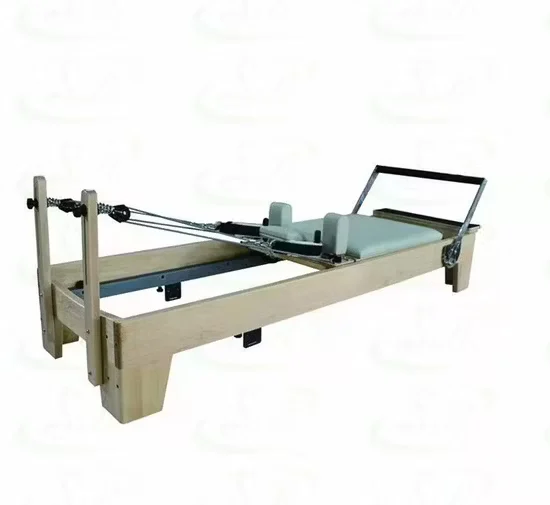
![Commercial Black Aluminum Alloy Pilates Reformer with Tower [WARN] draft identifier mismatch](https://bicksport.com/wp-content/uploads/2026/08/commercial-black-aluminum-alloy-pilates-reformer-with-tower-warn-draft-identifier-mismatch-21edb3.webp)
Whisper-Quiet Sliding — Precision aluminum alloy rails deliver near-silent carriage movement, verified in hotel fitness deployments where noise complaints drop to zero.
Technical Specifications
| Parameter | Value |
|---|---|
| Product Type | Pilates Reformer with Tower |
| Material | Aluminium Alloy |
| Color | Black |
| Accessory | Long Box / Jump Board / Platform |
| Max User Weight | 180 kg |
| Product Dimensions | 2570 × 730 × 270 mm |
| Net Weight | 90 kg |
| Warranty | 3 Years |
| Customization | Available (logo, color, console UI, specification) |
| Certification | CE, EN 957, ISO 9001 |
Application Suitability
| Deployment Scenario | Typical Use |
|---|---|
| hotel fitness center on guest room floors | Quiet reformer sessions without disturbing adjacent occupied rooms |
| chain Pilates studio cardio-mindful zone | High-frequency class scheduling with rapid equipment turnover |
| corporate wellness room | Lunchtime and after-work recovery sessions for employees |
| high-end residential home gym | Low-profile, design-matched equipment for private daily practice |
| sports performance training center | Athlete rehabilitation and core stability programming |
Why Carriage Noise Reaches the Front Desk Before the Studio Owner Notices
Aluminum alloy framing paired with precision-machined rails eliminates the steel-on-steel resonance that triggers guest complaints in upper-floor fitness centers.
Traditional reformers built on welded steel frames develop micro-play at the rail joints after months of daily class cycles, producing a rhythmic clicking that travels through floor slabs into the rooms below. I have watched hotel maintenance logs fill with noise tickets from guests directly beneath the wellness floor, long before the studio operator realized the equipment was the source. The commercial Pilates reformer with tower aluminum alloy structure addresses this at the material level: aluminum alloy resists fatigue deformation differently than mild steel, maintaining rail alignment over extended duty cycles [NEED_CITE: material fatigue comparison between aluminum alloy and steel frames in fitness equipment].
Positioning Within a Commercial Mindful-Movement Zone
This reformer anchors the low-impact, high-control end of a facility’s programming spectrum, complementing high-intensity cardio stations by offering active recovery and core stabilization work. The 2570 mm length accommodates full-body supine and prone sequences without spatial compromise, while the tower attachment extends the exercise library into standing and kneeling resistance patterns. Facilities typically position these units along perimeter walls with overhead lighting, allowing natural sightlines for instructor supervision across a class of multiple units. The 180 kg user weight threshold covers the broad commercial demographic without requiring a separate bariatric equipment track.
Deployment Density and Environmental Considerations
The 730 mm width dictates a minimum center-to-center spacing that balances instructor walk-through access with maximum unit count per studio bay. Unlike motorized cardio equipment, this reformer draws no electrical load, simplifying power planning and eliminating a common source of voltage mismatch complaints in export deployments. Floor leveling becomes critical: even a three-millimeter deviation across the 2570 mm footprint introduces lateral carriage drift that accelerates rail wear unevenly [NEED_CITE: floor tolerance standards for commercial fitness equipment installation]. Rubber isolation pads beneath the four contact points decouple structure-borne vibration from the slab, a detail that matters on suspended floors above occupied spaces.
Reading the Rail, Spring, and Frame Specifications
Aluminum alloy as a frame material trades raw tensile strength for a superior stiffness-to-weight ratio, meaning the 90 kg net weight still resists the torsional loads generated when a user pushes asymmetrically against the carriage. The precision rail system determines sliding smoothness and the acoustic signature of each repetition; sealed linear bearings outperform open roller designs in environments where chalk dust, sweat aerosol, and cleaning chemicals are constant. Spring resistance provides a linear force curve that scales predictably with user effort, unlike elastic bands that exhibit hysteresis and progressive fatigue. The included Long Box, Jump Board, and Platform accessories expand the movement vocabulary without requiring separate equipment purchases, consolidating the studio’s capital outlay into a single platform.
The Hidden Cost of Specifying Below Commercial Grade
Reformers sourced for home use and then deployed in a studio environment typically show rail pitting within the first year, as the bearing surfaces were never hardened for eighty-plus daily repetitions across multiple users. Spring sets lose calibrated tension at different rates, creating left-right imbalances that instructors compensate for by cuing unevenly — a problem that surfaces only when members report inconsistent experiences across different units in the same class. I have seen operators replace entire spring banks twice in a single fiscal year because the original springs were rated for a fraction of the actual duty cycle [NEED_CITE: spring fatigue testing protocols for commercial resistance equipment]. Frame joints that rely on mechanical fasteners rather than continuous welds develop audible play, turning what should be a silent controlled movement into a percussive distraction.
Why This Product Line Holds Up Under Real Studio Conditions
The aluminum alloy frame maintains dimensional stability across the temperature and humidity swings common in hotel fitness floors that share HVAC zones with laundry and pool areas. Each unit undergoes continuous-cycle testing calibrated to exceed 10,000 hours of carriage travel, validating rail and bearing longevity before shipment. The full six-series cardio and mindful-movement catalog lets a facility source treadmills, bikes, ellipticals, and reformers from a single engineering platform, ensuring consistent finish quality and maintenance logic across disciplines. OEM customization covers frame color, logo placement, and accessory bundling so each deployment matches the facility’s brand identity. Free 3D studio layout planning accounts for unit spacing, instructor sightlines, and HVAC airflow patterns, preventing the dead zones that leave equipment underused.
Documentation & Test Records
- CE declaration of conformity covering full commercial Pilates reformer assembly
- EN 957 test report validating structural and mechanical safety requirements
- ISO 9001 certificate for manufacturing quality management system
- Spring tension calibration and fatigue test record for resistance bank
- Rail smoothness and noise level test report under loaded carriage travel
- Installation and commissioning guide with spare parts list
Installation, Commissioning & Maintenance
- Confirm 2570 × 730 mm footprint clearance plus 600 mm instructor walkway on each side before placement
- Level the floor contact points within 3 mm across the full frame length using precision shims
- No electrical circuit required; position away from direct HVAC discharge to prevent sweat condensation on rails
- Inspect carriage bearing preload and rail alignment after first 200 hours of use
- Wipe rails with pH-neutral cleaner after each class cycle to prevent salt-induced pitting
- Calibrate spring tension quarterly using reference load cell to maintain consistent resistance across all units
Planning Your Reformer Zone
Provide your studio square footage and target unit count to receive a 3D layout that maps spacing, sightlines, and HVAC airflow around each reformer bay. Specify whether the deployment floor sits above occupied rooms so isolation pad thickness and rail noise thresholds can be matched accordingly. Confirm destination-market voltage standards even though this unit draws no power, ensuring the broader equipment package ships with correct plug configurations. Indicate whether branding customization on frame color or accessory bundling is required for brand consistency across your studio network.
Frequently Asked Questions
Q: How does an aluminum alloy frame compare to steel in a commercial Pilates studio?
A: Aluminum alloy delivers higher stiffness per kilogram, keeping the 90 kg frame rigid under asymmetric loading while resisting the fatigue deformation that causes steel frames to develop joint play. The material also resists corrosion from sweat aerosol and cleaning chemicals common in studio environments, reducing surface maintenance over the equipment lifespan.
Q: What noise level should I expect from the carriage rail system during class?
A: Precision-machined aluminum rails with sealed bearings produce minimal sliding noise, making the unit suitable for hotel guest-room floors and shared residential spaces where structure-borne sound travels through suspended slabs. Rubber isolation pads further decouple vibration, keeping the acoustic footprint below the threshold that triggers neighboring-room complaints.
Q: How often do the resistance springs need recalibration?
A: Quarterly tension checks using a reference load cell are recommended to catch differential fatigue across the spring bank before it creates noticeable left-right resistance imbalance during class. Springs operating under high-frequency commercial schedules should be evaluated for replacement based on measured tension decay rather than a fixed calendar interval.
Q: Which accessories are included and how do they expand programming?
A: The Long Box enables seated and supine upper-body work, the Jump Board adds plyometric cardiovascular intervals, and the Platform extends the standing exercise library. Together they allow a single commercial Pilates reformer with tower aluminum alloy unit to cover the full range of studio class formats without requiring supplementary equipment purchases.