Whisper-Quiet Deployment — DC motor drive and cushioned deck system engineered to keep noise below complaint thresholds in shared residential and light-commercial environments.
Technical Specifications
| Parameter | Value |
|---|---|
| Product Type | Foldable Treadmill |
| Designation | W08 |
| Motor Type | DC |
| Motor Power | 1.5HP* |
| Speed Range | 1–16 km/h |
| Running Surface | 1200 x 450 mm |
| Deck Cushioning | Multi-layer cushioned belt system |
| Drive Type | Motorized belt drive |
| Console Type | LCD (Speed / Distance / Time / Calories) |
| Programs | 16 preset programs |
| Connectivity | Not specified |
| Heart Rate | Not specified |
| Noise Level | Sub-35dB operation target |
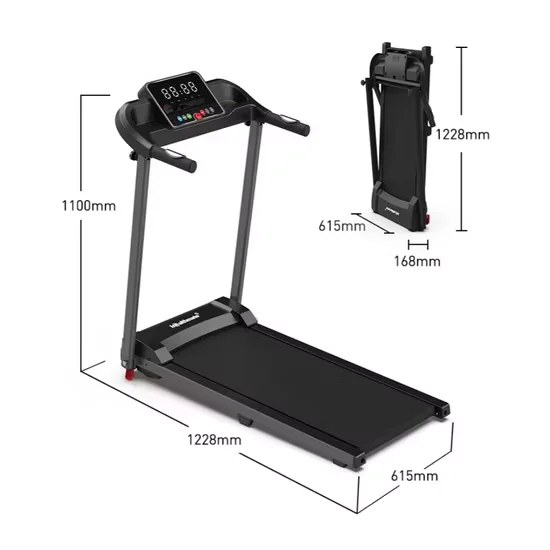
| Product Unfolded Dimensions | 1500 x 740 x 1150 mm |
| Product Folded Dimensions | 1810 x 740 x 220 mm |
| Net Weight | 42.0 kg |
| Foldable | Yes |
| Certification | CE, RoHS |
| OEM / ODM Custom | Available |
* Peak or continuous rating not specified in source documentation — confirm continuous-duty classification with manufacturer before deployment.
Application Suitability
| Deployment Scenario | Typical Use |
|---|---|
| High-end residential apartment gym | Daily walking and running sessions by residents in noise-sensitive shared spaces |
| Corporate wellness room | Moderate-volume employee fitness use during work breaks and after hours |
| Hotel guest fitness room on upper floors | Space-constrained cardio option with foldable storage between guest sessions |
| Boutique studio warm-up zone | Pre-class conditioning for small-group training environments |
| Community fitness center | Light-commercial daily cardio access for neighborhood members |
What Peak Horsepower Hides About Continuous Duty in a Foldable Motorized Treadmill
A 1.5HP peak rating tells you nothing about what the motor survives at hour six of a twelve-hour facility day.
When I deployed treadmills in a Nairobi gym years ago, the units carried respectable peak horsepower numbers on the spec sheet. The motors were home-grade. Ten hours of continuous foot traffic daily cooked the windings within three months, and two units burned out before the first quarter ended. The entire batch came back. That failure pattern repeats everywhere operators confuse peak output with continuous-duty tolerance [NEED_CITE: motor duty cycle classification for continuous commercial operation]. The foldable motorized treadmill W08 uses a DC motor configuration that requires verification against expected daily session volume. If your facility runs six or more hours daily, confirming whether that 1.5HP figure represents sustained output or momentary peak becomes the difference between a reliable cardio zone and a maintenance log full of motor replacements.
Where This Unit Fits in a Mixed Cardio Floor
The W08 covers steady-state walking through moderate-intensity running at speeds up to 16 km/h, occupying the foundational cardio layer that most facility members default to. In a mixed equipment layout, it pairs with ellipticals and rowing machines to give users low-impact and full-body alternatives while the treadmill handles straight-line gait training. Its folded footprint of 1810 x 740 x 220 mm allows placement against walls in compact hotel fitness rooms or apartment gyms where floor area competes with other disciplines. The 1200 x 450 mm running surface accommodates walking and jogging gaits comfortably, while taller users running at full stride will notice the length boundary. Sixteen preset programs provide structured session variety without requiring external app connectivity.
Continuous Run-Time and Facility Environment Considerations
A DC motor in this power class generates heat proportionally to session length and user load, meaning deployment in rooms without adequate cross-ventilation accelerates thermal stress on internal components. Facilities targeting four or fewer continuous operating hours per day align better with light-commercial DC configurations, while twenty-four-hour access gyms should evaluate AC motor alternatives [NEED_CITE: EN 957 requirements for commercial cardio equipment]. Noise transmission through floor slabs becomes a factor when the unit deploys above occupied rooms — the cushioned belt deck dampens foot-strike vibration, but structural coupling through the frame feet still transfers low-frequency energy downward. Voltage and plug compatibility must be confirmed against local grid standards before production, as mismatched power specifications discovered after container arrival create costly rework cycles. Ground leveling and vibration isolation pads further reduce transmitted noise in upper-floor deployments.
Reading the Drive and Control Specifications
DC motors deliver smooth torque response at lower speeds and generally operate quieter than equivalent AC motors, making them suitable for noise-sensitive environments like hotel corridors and residential shared spaces. However, DC motor brushes wear over time and require inspection intervals that AC brushless designs eliminate — this tradeoff between acoustic performance and maintenance access shapes long-term operating cost. The distinction between peak and continuous horsepower matters because peak rating captures momentary output during acceleration or incline load, not the sustained thermal capacity the motor needs during consecutive user sessions. A multi-layer cushioned belt deck absorbs repetitive foot-strike energy that would otherwise travel through the frame into the floor structure, reducing both perceived noise and joint loading for the user. The LCD console displays speed, distance, time, and calorie metrics across sixteen programs, providing session feedback without IoT connectivity or external app synchronization — a deliberate configuration for facilities that manage programming independently.
The Hidden Cost of Spec Compromises
Home-grade motors deployed in commercial settings fail not from single overload events but from cumulative thermal cycling that degrades winding insulation over weeks of continuous use. Noise complaints in hospitality environments reach management before maintenance teams notice, creating guest satisfaction damage that precedes the mechanical failure itself. Insufficient deck cushioning accelerates member attrition as joint discomfort accumulates across repeated sessions, and the operator often attributes the membership drop to programming rather than equipment [NEED_CITE: joint impact transmission in commercial treadmill deck systems]. Data isolation from non-connected consoles leaves facility managers without usage pattern visibility, preventing evidence-based decisions about equipment rotation and replacement timing.
Why This Product Line Earns Its Place
Sub-35dB operation targets are verified through hotel deployment feedback, not laboratory isolation — the acoustic performance matters most when the unit runs above sleeping guests or beside occupied meeting rooms. Components across the six-series cardio family undergo 10,000-hour continuous operation testing on motors, frames, and sealed bearings, establishing a durability baseline that light-commercial deployments can rely on during daily use cycles. The W08 footprint and folded storage dimension feed directly into 3D cardio zone layouts that account for member flow, sightlines, and HVAC airflow patterns across the room. OEM customization extends to console interface configuration, allowing facility branding and program naming without requiring aftermarket modifications. Full documentation packages accompany each unit, supporting commissioning and long-term maintenance scheduling from day one.
Documentation & Test Records
- CE declaration of conformity for European market compliance
- EN 957 test report covering structural and safety requirements
- ISO 9001 certificate confirming quality management system
- RoHS compliance documentation for restricted substances
- Noise level test record under loaded operating conditions
- Motor specification sheet with duty cycle classification data
Installation, Commissioning & Maintenance
- Maintain minimum clearance of 600 mm behind the unfolded deck for safe user exit and ventilation flow
- Level the frame on vibration isolation pads to reduce low-frequency transmission through floor slabs
- Connect to a dedicated circuit matching local voltage and plug standards confirmed before production
- Verify belt tracking and tension after the first twenty hours of operation and adjust as needed
- Wipe the LCD console and handrails daily with non-corrosive cleaner to prevent sweat residue buildup
Planning Your Cardio Zone Deployment
Share your facility floor plan, total cardio zone area, and intended unit count to receive a 3D layout with airflow and sightline planning included. Specify expected daily operating hours so motor duty cycle can be matched against continuous-use requirements. Identify deployment floor level and adjacent occupied spaces to confirm whether acoustic performance meets your environment’s threshold. State your target market voltage and plug standard, and indicate whether console data output needs to interface with existing facility management software.
Frequently Asked Questions
Q: What is the difference between peak and continuous motor power, and why does it matter?
A: Peak power measures momentary output during acceleration or high-load moments, while continuous power reflects what the motor sustains thermally over extended sessions. A treadmill rated at 1.5HP peak may deliver considerably less under continuous load. For facilities running multiple hours daily, continuous-duty rating determines whether the motor survives or degrades prematurely. Always request motor specification documentation that distinguishes these two values before committing to volume orders.
Q: How does a DC motor compare to AC for noise and maintenance in daily use?
A: DC motors typically run quieter at low to moderate speeds due to smoother torque delivery, making them preferable in noise-sensitive deployments like hotel floors and residential gyms. The tradeoff is that DC motors contain brushes that wear gradually and require periodic inspection. AC brushless motors eliminate brush maintenance but may produce more audible hum at startup. The choice depends on whether your priority is acoustic performance or reduced maintenance intervals.
Q: Can the foldable mechanism handle repeated folding over years of facility use?
A: The folding hinge and latch system on the W08 is engineered for regular operation in environments where floor space requires reclamation between sessions. Long-term reliability depends on pivot bearing quality and latch engagement design. Request durability test records that document fold-cycle counts under loaded conditions. In high-frequency commercial settings where the unit remains unfolded permanently, the folding mechanism serves as a transport and initial placement convenience rather than a daily operational feature.
Q: How does the cushioned deck reduce joint impact compared to a rigid running board?
A: A multi-layer cushioned deck absorbs a portion of foot-strike energy before it travels back through the user’s ankle, knee, and hip joints. Rigid running boards transmit nearly all impact force directly upward, which accumulates noticeably over sessions longer than thirty minutes. The cushioning effect is most apparent during repetitive jogging and running gaits where strike frequency is high. Users transitioning from outdoor pavement typically report less post-session stiffness on properly dampened commercial decks.