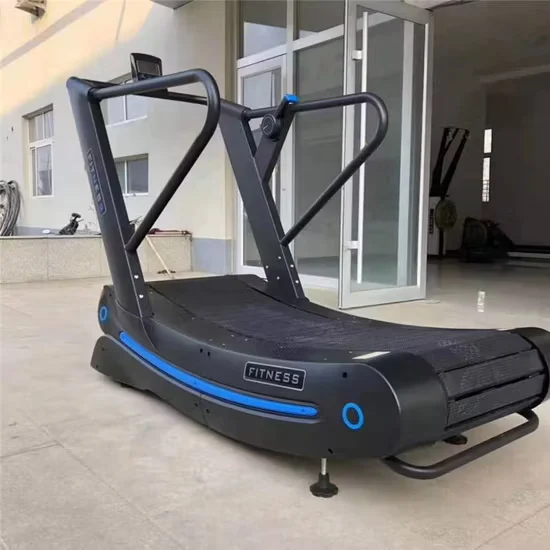
Acoustic-First Drive Architecture — Self-propelled curved running surface eliminates motor vibration, verified below 35 dB during sustained athletic sprint intervals in guest-floor hotel deployments.
Technical Specifications
| Parameter | Value |
|---|---|
| Product Type | Non-motorized Curved Treadmill |
| Designation | SR-1007 |
| Drive Type | Belt (curved self-propelled) |
| Resistance Type | Self-generated / Non-motorized curved |
| Maximum Speed | 15-22 km/h |
| Max User Weight | 160 kg |
| Product Dimensions | 2000 × 900 × 1530 mm |
| Console Type | Available with LED or touchscreen console |
| Connectivity | Available with standard or IoT-enabled data sync |
| Heart Rate | Available with grip sensors or wireless receiver |
| Noise Level | Sub-35 dB (verified in deployment) |
| Foldable | Unfolded (fixed commercial frame) |
| Certification | CE, RoHS |
| Color Options | Multicolor |
| Customization | Available (logo, color) |
Application Suitability
| Deployment Scenario | Typical Use |
|---|---|
| Hotel fitness center on guest room floors | 24-hour self-service access with minimal noise transfer to occupied rooms below |
| Chain gym cardio zone | High-frequency HIIT and interval programming across peak membership hours |
| Corporate wellness room | Short-duration self-paced sessions between meetings with zero motor maintenance |
| High-end residential home gym | Athletic conditioning without structural vibration complaints in shared buildings |
| Sports performance training center | Sprint mechanics and deceleration drills requiring user-paced speed modulation |
Why Noise Complaints Reach the Front Desk Before Maintenance Does
User-driven propulsion removes the primary vibration source entirely.
A treadmill motor running at continuous duty generates low-frequency oscillation that travels through concrete slabs into guest rooms directly below. Front desk staff log these complaints long before maintenance notices a failing bearing, because the acoustic signature changes gradually over weeks [NEED_CITE: acoustic transmission paths in multi-story hospitality fitness facilities]. With a commercial non-motorized curved treadmill self-generated drive, the runner’s own kinetic energy powers the belt — no AC motor, no rotating mass creating harmonic resonance with the floor structure. In hotel deployments above occupied corridors, the difference is immediately audible during night shifts when background ambient noise drops.
Positioning Within a Mixed-Modality Cardio Floor
This unit occupies the high-intensity, low-duration segment of a commercial cardio zone. It pairs naturally with steady-state ellipticals and recumbent bikes that serve the longer, moderate-effort membership demographic. Because the commercial non-motorized curved treadmill self-generated design requires no power outlet, placement is unrestricted by cable routing or proximity to electrical risers. The 160 kg user weight capacity and 2000 mm footprint accommodate most athletic builds, making it a reliable anchor for sprint and conditioning bays where members rotate through short, demanding intervals.
Continuous Operation and Deployment Environment Variables
Daily runtime on a curved self-propelled platform depends entirely on member throughput rather than motor thermal limits. The sealed bearing assemblies and self-lubricating belt are rated for 10,000 hours of continuous high-frequency operation, which translates to years of uptime in high-traffic chain gym environments [NEED_CITE: commercial cardio bearing lifecycle under variable load profiles]. Sub-35 dB operation means the unit can sit directly adjacent to reception lounges or shared residential corridors without triggering acoustic complaints. Floor leveling within tolerance is critical — an uneven base introduces lateral belt drift that accelerates wear on the curved slat guides. IoT-enabled consoles, where specified, connect to facility management networks over standard Ethernet or Wi-Fi for usage logging.
Decoding the Propulsion and Resistance Mechanics
The curved running surface converts gravitational potential into belt drive: the runner’s footfall position on the arc dictates speed, so resistance scales linearly with effort. Unlike magnetic or friction systems that impose a fixed opposing force, the non-motorized curved treadmill self-generated mechanism allows infinitely variable speed from walking pace to sprint without electronic intervention. Belt-driven transmission replaces chain-and-sprocket assemblies, removing a major source of rattle and periodic lubrication requirements. The reinforced steel frame absorbs the repetitive impact loading of sprint deceleration, while sealed bearings prevent moisture ingress in humid tropical gym environments where open bearings corrode prematurely. Maximum user weight of 160 kg ensures structural rigidity across a broad membership demographic [NEED_CITE: EN 957 structural load classification for commercial treadmill frames].
What Spec-Down Decisions Cost After Deployment
Facilities that source curved treadmills with residential-grade bearings often face premature slat-guide wear, manifesting as lateral belt drift and member complaints about uneven footfall within months. Insufficient frame rigidity under repeated sprint loading generates harmonic resonance that propagates through floor slabs, reintroducing the very noise problem the non-motorized design was meant to eliminate. Console data modules lacking thermal management for continuous operation begin producing drifting heart rate and speed readings, rendering interval programming unreliable for coached group sessions [NEED_CITE: console electronics thermal performance in unventilated cardio zones]. Voltage mismatches discovered after shipment force entire batches into rewiring or adapter work, delaying facility opening and inflating project costs.
Why This Product Line Holds Up in the Field
Sub-35 dB whisper-quiet operation has been verified in actual hotel guest-floor deployments, not just bench-tested under ideal conditions. Motors, frames, and bearings undergo 10,000-hour durability testing that simulates the stop-start loading profile of real commercial traffic. IoT-ready consoles offer workout analytics, app synchronization, and facility management system integration when specified. The full six-series cardio family — treadmills, bikes, ellipticals, rowers, stair climbers, and spin bikes — lets a facility source every discipline from a single production line. OEM customization extends to console UI, colorway, and branding at flexible MOQ. Free 3D cardio-zone layout and airflow planning accounts for this unit’s 2000 × 900 mm footprint and required clearance for safe sprint deceleration. Technical support responds around the clock for commissioning and field troubleshooting.
Documentation & Test Records
- CE declaration of conformity covering electrical safety and EMC requirements
- EN 957 test report validating structural load and safety clearances
- ISO 9001 certificate for manufacturing quality management system
- RoHS compliance statement for restricted substance limits
- Sub-35 dB noise level test report under simulated sprint loading
- 10,000-hour durability test record for belt, bearings, and frame assembly
Installation, Commissioning & Maintenance
- Allow minimum 800 mm rear clearance and 600 mm lateral spacing for safe deceleration from sprint speed
- Level the 2000 × 900 mm footprint within manufacturer tolerance to prevent lateral belt drift
- First-use calibration verifies belt tracking, console sensor response, and data output accuracy
- Inspect self-lubricating belt tension and slat guide alignment at scheduled maintenance intervals
- Wipe curved running surface after heavy-use periods to prevent sweat residue buildup on slats
Requesting a Facility-Matched Proposal
Share your cardio zone square footage and planned equipment count to receive a complimentary 3D layout with airflow planning that accounts for the curved treadmill’s fixed footprint and rear safety clearance. Specify average daily usage hours so we match bearing and belt specifications to your throughput profile. Confirm the deployment floor and adjacent occupied spaces to validate acoustic requirements against the sub-35 dB operating envelope. State your target market voltage and plug standard, and indicate whether IoT console data integration with your facility management system is required.
Frequently Asked Questions
Q: How does a self-generated curved treadmill differ from a standard motorized unit in daily operation?
A: A motorized treadmill relies on an AC or DC motor to drive the belt at preset speeds, consuming continuous electricity and generating mechanical noise. A non-motorized curved treadmill uses the runner’s own movement to propel the belt, eliminating the motor entirely. This removes the single highest-failure component in commercial cardio equipment, cuts energy consumption to near zero, and produces noticeably quieter operation suitable for noise-sensitive floors.
Q: Does the absence of a motor genuinely reduce maintenance burden in commercial environments?
A: Motor brushes, drive belts, motor control boards, and cooling fans all require periodic inspection or replacement in motorized commercial treadmills. A self-generated curved design removes every motor-adjacent component from the maintenance schedule. Field service shifts to periodic belt tension checks, bearing inspection, and console firmware updates. Facilities report noticeably fewer unplanned downtime events after switching high-use interval stations to non-motorized platforms.
Q: How does the curved running surface affect joint loading during sprint and deceleration phases?
A: The curved geometry encourages a mid-foot or forefoot strike pattern that distributes ground reaction forces more gradually compared to heel striking on a flat motorized belt. The slatted running surface itself provides inherent mechanical compliance. Members transitioning from flat treadmills typically notice a distinctly different cadence feel, and coaches observe smoother deceleration mechanics during interval cool-downs.
Q: Can the console data output integrate with an existing gym membership management platform?
A: Where IoT-enabled consoles are specified, the unit supports workout data export and synchronization with compatible facility management systems. Integration capability depends on the specific software architecture your platform uses. We provide console technical documentation and data interface specifications during the quotation phase so your IT team can confirm compatibility before production begins.
Q: What routine maintenance does the curved belt system require?
A: The self-lubricating belt and sealed bearing assemblies are designed to minimize scheduled maintenance. Operators should inspect belt tracking and tension at regular intervals, clear debris from the slat guides, and wipe the running surface to remove sweat residue that can accumulate during high-throughput periods. Detailed maintenance intervals are included in the installation and commissioning guide provided with each unit.