
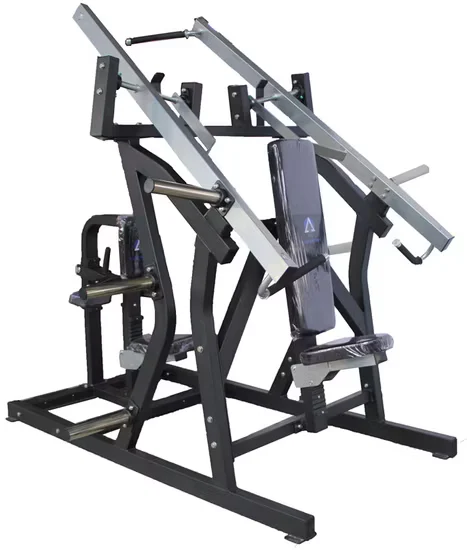
Acoustic Precision — Sealed commercial bearings and ISO-lateral pivot geometry keep operational noise below ambient gym levels during continuous chest and back loading cycles.
Technical Specifications
| Parameter | Value |
|---|---|
| Designation | 5002 |
| Product Type | ISO-Lateral Chest/Back Machine |
| Exercise Part | Chest and Back |
| Material | Steel |
| Product Dimensions | 1850 × 1770 × 2000 mm |
| Net Weight | 160 kg |
| Max User Weight | 180 kg |
| Age Group | Adult |
| Gender | Unisex |
| Appliance | Community, Gymnasium |
| Fit Area | Professional Gym and Club |
| OEM/ODM | Available |
| Certification | ISO 9001, CE |
| Production Capacity | 500 PCS/Month |
| HS Code | 9506911900 |
| Origin | Dezhou-Shandong-China |
Application Suitability
| Deployment Scenario | Typical Use |
|---|---|
| hotel fitness center on guest room floors | Early-morning and late-night strength sessions where structural noise transfer must stay below ambient thresholds |
| chain gym cardio zone | High-frequency chest and back superset stations placed between treadmill rows and plate-loaded bays |
| corporate wellness room | Mid-shift circuit training with adjustable seating for diverse employee body types |
| high-end residential home gym | Multi-user household strength training without requiring dedicated acoustic isolation |
| sports performance training center | Unilateral and bilateral pressing and pulling movements for athlete periodization blocks |
Why Frame Flex and Pivot Noise Ruin Commercial Strength Zones
Structural rigidity and independent arm alignment eliminate the two most common reasons members avoid plate-loaded chest and back stations.
When a commercial gym installs strength equipment with inadequate frame welding or shared-axis pivot points, two failures emerge within months. The frame develops micro-flex under repeated loading, creating audible creaking that travels through floor joists — especially on upper hotel floors where structural noise reaches guest rooms before it reaches the maintenance desk [NEED_CITE: EN 957 structural load testing for commercial strength equipment]. Simultaneously, shared-axis machines force both arms through identical movement paths that ignore natural biomechanical asymmetry, generating friction noise at the pivot and uneven bearing wear. Facilities end up rotating machines off the floor for re-welding or replacement, and members migrate to cable stations where the movement feels more natural. The ISO-lateral chest and back machine commercial gym operators specify must address both failure modes at the engineering stage, not after deployment complaints accumulate.
Positioning Within the Strength Zone Layout
This ISO-lateral chest and back machine occupies the transitional space between selectorized multi-stations and plate-loaded free weight areas. It covers pressing and pulling movement patterns across moderate to heavy loading ranges, complementing adjacent lat pulldown stations and chest press selectorized units without duplicating their fixed-path constraints. The independent arm design suits deployment in high-traffic zones where users rotate through quickly, since adjustable seating and unilateral capability reduce wait times. It accommodates adult users across a broad anthropometric range, with the seat and arm geometry scaled for both smaller-framed and larger-framed members without requiring manual reconfiguration between sets.
Continuous Use Cycles and Facility Environment Requirements
Commercial strength equipment in 24/7 facilities faces loading patterns that differ fundamentally from residential use — not continuous motor run-time, but repeated impact loading and pivot cycling that compounds bearing wear [NEED_CITE: duty cycle classification for commercial strength pivot mechanisms]. This unit’s sealed bearing specification targets environments where sweat, chalk dust, and humidity accelerate corrosion at moving joints. The reinforced steel frame requires level concrete flooring with adequate vibration isolation to prevent noise transfer to adjacent rooms or floors below. Power requirements are minimal since this is a plate-loaded design, but the surrounding floor space must accommodate full arm extension and user ingress from both sides. Facilities deploying multiple units should plan sightlines so members can see available stations without walking through the strength zone.
Engineering Decisions Behind the Pivot and Frame
The ISO-lateral mechanism uses independent pivot points for each arm, allowing the pressing and pulling paths to follow each user’s natural shoulder mechanics rather than forcing both arms through a single shared axis. This reduces friction at the bearing surfaces because each arm moves through its own arc without fighting the opposing side’s path. The reinforced steel frame carries a 160 kg machine weight that provides inherent stability during heavy unilateral loading — when a user presses maximally with one arm, the frame mass and footprint geometry resist tipping without requiring floor anchoring in most deployments. Commercial-grade sealed bearings at each pivot point exclude sweat and chalk contamination that would otherwise accelerate wear in humid gym environments. The 1850 × 1770 × 2000 mm footprint balances stability with floor efficiency, fitting between standard plate-loaded stations without requiring oversized safety corridors. Adjustable seating and grip positions allow the machine to serve users across a wide anthropometric range without tool-based reconfiguration between sets.
What Specification Compromises Cost Over a Three-Year Deployment
Facilities that source chest and back machines based on initial unit price typically encounter three categories of failure within the first eighteen months. Frames built from lighter-gauge steel develop audible flex under repeated heavy loading, generating noise complaints from adjacent spaces and requiring structural reinforcement or full replacement [NEED_CITE: structural fatigue failure modes in commercial gym strength equipment]. Shared-axis pivot mechanisms wear unevenly when members consistently favor one side, creating asymmetric resistance feel that drives users toward cable machines. Bearings without adequate sealing corrode in humid environments, increasing friction noise and requiring quarterly maintenance that most facility operators lack the staffing to sustain. The cumulative result is a strength zone where the chest and back stations sit empty while selectorized machines develop wait times, directly reducing member retention.
Why This Product Line Addresses Facility-Level Requirements
The 5002 is engineered around the same acoustic and durability priorities that govern the cardio range — sub-35dB operational targets apply to pivot noise as well as motor noise, which matters when strength zones share walls with hotel corridors or residential units. Each unit undergoes load-cycle testing at the factory that simulates continuous commercial use patterns, not just static load capacity. The full six-series cardio family allows facilities to source treadmills, bikes, ellipticals, rowers, stair climbers and spinning bikes from the same OEM relationship, simplifying warranty management and spare parts inventory. OEM customization extends to frame color, logo placement, and upholstery to match facility branding without requiring separate vendor relationships. The 3D layout service covers strength zone sightlines and member flow alongside cardio zone airflow, so the ISO-lateral station gets positioned with correct spacing for user ingress and plate loading access. Technical support covers commissioning guidance and bearing maintenance scheduling for the deployment life of the equipment.
Documentation & Test Records
- CE declaration of conformity covering mechanical safety requirements for commercial strength equipment
- EN 957 test report validating structural load capacity and pivot mechanism durability
- ISO 9001 certificate confirming manufacturing quality management across the production line
- Noise level test record measuring operational sound at pivot points under loaded cycling
- Durability test log documenting repeated load cycles on frame welds and bearing assemblies
- Spare parts list with bearing specifications and replacement intervals for facility maintenance teams
Installation, Commissioning & Maintenance
- Maintain minimum 600 mm clearance on both sides of the 1850 × 1770 mm footprint for user ingress and plate loading access
- Install on level concrete with vibration isolation pads to prevent structural noise transfer to floors below
- Verify frame level and pivot alignment during first commissioning to prevent uneven bearing wear
- Inspect sealed bearings quarterly for sweat and chalk contamination in high-humidity gym environments
- Check frame weld joints annually under loaded conditions to detect early structural flex development
- Wipe pivot points and seat adjustment mechanisms daily to prevent corrosion from accumulated sweat residue
Equipment Selection and Deployment Planning
Provide the strength zone square footage and planned equipment list to receive a 3D layout that positions this ISO-lateral station with correct member flow and adjacent machine spacing. Specify the expected daily user volume so bearing and pivot specifications can be confirmed against the facility’s duty cycle. Identify the deployment floor and adjacent occupied spaces so noise transfer requirements are matched to the correct vibration isolation approach. Confirm the target market voltage standards if integrating any data collection accessories, and indicate whether console-based usage tracking is required for facility management system integration.
Frequently Asked Questions
Q: How does ISO-lateral design compare to plate-loaded machines for high-traffic commercial gyms?
A: ISO-lateral independent arms allow each side to move through its own biomechanical path, which reduces pivot friction and uneven wear compared to shared-axis plate-loaded designs. In high-traffic facilities where members rotate through quickly, the independent arm movement also eliminates the need to balance plates on both sides between users, reducing transition time between sets and keeping the strength zone flow moving during peak hours.
Q: What frame and weld standards apply to 24/7 facility strength equipment?
A: Commercial facilities operating continuously require frames built from reinforced steel with full-penetration welds at all load-bearing joints, validated through repeated cycle testing that simulates years of heavy unilateral loading. EN 957 test protocols specify static and dynamic load requirements that exceed residential standards. Facilities should request weld inspection records and load-cycle test documentation before committing to a procurement decision, particularly for machines positioned in high-traffic strength zones.
Q: How often do sealed bearings require maintenance in humid gym environments?
A: Sealed bearings at pivot points exclude most sweat and chalk contamination, but facilities in high-humidity environments should schedule quarterly visual inspections to verify seal integrity. When seals show wear or contamination ingress, bearing replacement prevents the friction noise and uneven resistance feel that drive members away from the station. Maintenance frequency depends on daily user volume and ambient humidity levels rather than a fixed calendar interval.
Q: What OEM customization is available for branding and facility integration?
A: OEM/ODM options cover frame color, logo placement, upholstery material, and console interface where applicable. For strength equipment without electronic consoles, customization focuses on visual branding and upholstery to match facility design standards. Facilities sourcing multiple equipment categories can consolidate branding requirements across cardio and strength lines through a single OEM relationship, maintaining visual consistency throughout the fitness floor.
Q: How should strength zone layout account for ISO-lateral machine spacing and member flow?
A: The 1850 × 1770 mm footprint requires clearance on both sides for plate loading access and user ingress, plus adequate overhead space for full arm extension at the 2000 mm height. Positioning should allow members to see available stations from the zone entrance without walking through active training areas. Sightline planning and adjacent machine spacing prevent congestion during peak hours and ensure the station integrates into the overall strength zone traffic pattern.
![2019 Hammer Strength ISO-Lateral Wide Chest 19 Commercial Gym Equipment [WARN] draft identifier mismatch](https://bicksport.com/wp-content/uploads/2026/08/2019-hammer-strength-iso-lateral-wide-chest-19-commercial-gym-equipment-warn-draft-identifier-mismatch-c85a21.webp)
![Hammer Strength Machine ISO-Lateral D.Y. Row Commercial Gym Equipment [WARN] draft identifier mismatch](https://bicksport.com/wp-content/uploads/2026/08/hammer-strength-machine-iso-lateral-d-y-row-commercial-gym-equipment-warn-draft-identifier-mismatch-e2751b.webp)

![Commercial Plate Loaded Hammer Strength Squat Lunge Machine [WARN] draft identifier mismatch](https://bicksport.com/wp-content/uploads/2026/08/commercial-plate-loaded-hammer-strength-squat-lunge-machine-warn-draft-identifier-mismatch-8eb043.webp)