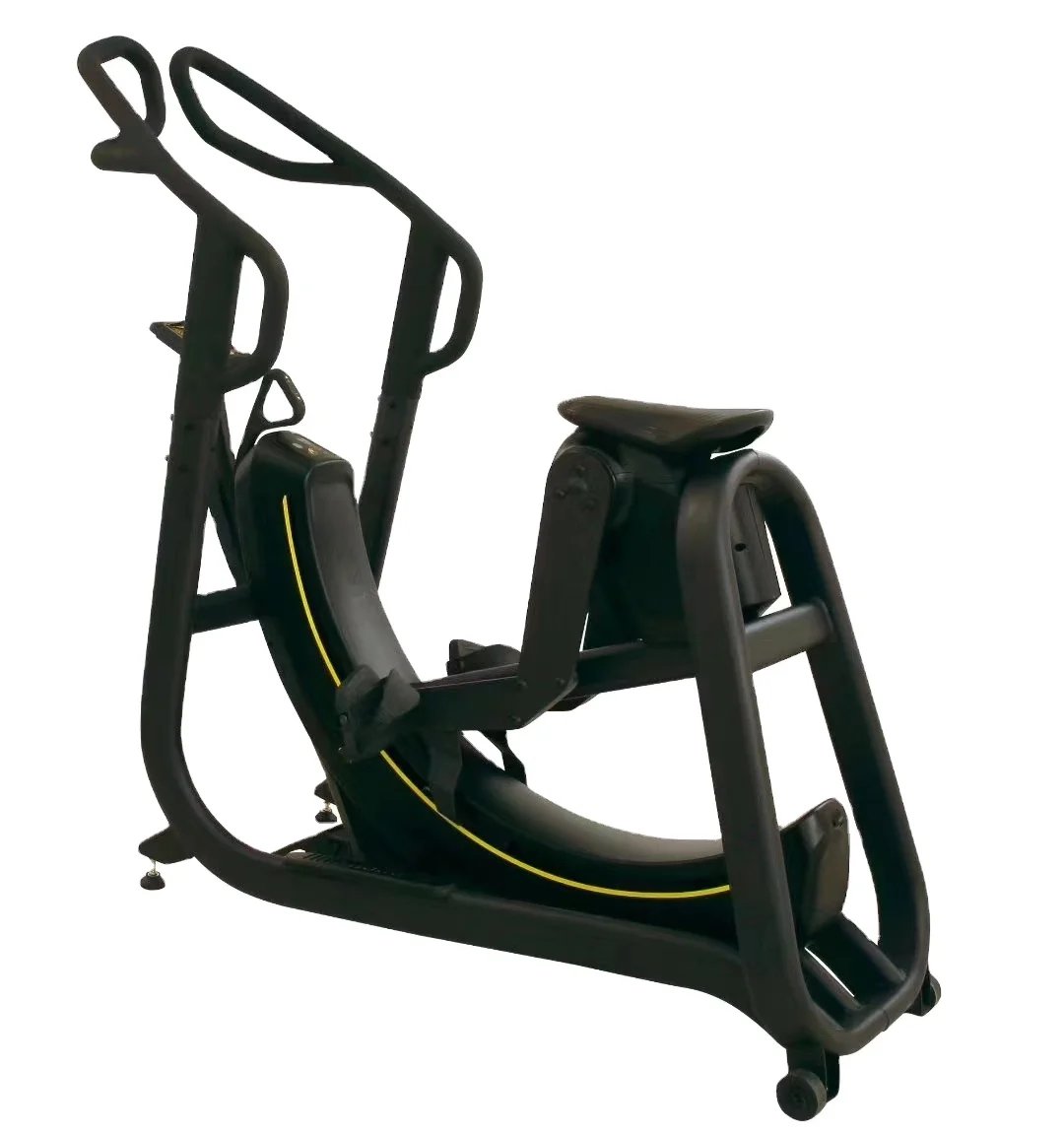
Whisper-Quiet Magnetic Operation — Verified sub-35dB output under load, enabling 24-hour deployment on noise-sensitive hotel floors without guest complaints.
Technical Specifications
| Parameter | Value |
|---|---|
| Designation | CTC60-T |
| Product Type | Elliptical Trainer / Cross Trainer |
| Resistance Type | Magnetic |
| Resistance Levels | 25 (1-25) |
| Stride Grade | 1-10 |
| Step Depth Grade | 1-15 |
| Pedal Center Distance | 230mm |
| Console Type | 10.1" Touch Screen |
| Max User Weight | 180kg |
| Product Dimensions | 2120 × 790 × 1680mm |
| Net Weight | 240kg |
| Foldable | Unfolded |
| Certification | ISO 9001, CE, EN 957, RoHS |
Application Suitability
| Deployment Scenario | Typical Use |
|---|---|
| Five-star hotel fitness center on guest room floors | 24/7 self-service cardio with acoustic isolation requirements |
| International gym chain cardio zone | High-frequency member use with app-synced workout tracking |
| Corporate wellness room | Lunch-break and after-work sessions in shared office environments |
| High-end residential home gym | Daily multi-user household training with noise-sensitive neighbors |
| Professional sports training center | Athlete conditioning with biometric data capture for coaching staff |
Why Front Desk Complaints Arrive Before the Maintenance Ticket Does
Magnetic resistance eliminates the friction noise that puts cardio equipment on the hotel complaint log.
When an elliptical trainer runs on the floor directly above occupied guest rooms, every belt slap and bearing grind travels through the slab. Housekeeping logs the call before engineering even opens a work order. The CTC60-T commercial elliptical trainer magnetic resistance 10.1 inch touch screen addresses this at the source: a sealed magnetic drive that removes mechanical contact from the resistance path entirely. We learned this the hard way — an early batch shipped to a Middle East hotel group came back because magnetic gap tolerances were off, causing resistance jumps mid-stride that guests noticed immediately [NEED_CITE: acoustic transmission through concrete floor slabs in hospitality environments]. That return taught us to verify every unit under load before it leaves the Shandong line.
Positioning the Elliptical Within a Mixed-Modal Cardio Zone
This elliptical trainer covers steady-state Zone 2 work through high-cadence interval blocks, filling the gap between treadmill running and seated cycling. In a six-unit cardio row, it pairs with a stair climber for vertical loading and a recumbent bike for active recovery. The 230mm pedal center distance and adjustable stride grade (1-10) accommodate users from petite to tall frames, while the 180kg user weight capacity keeps the machine accessible across the full membership demographic. The commercial elliptical trainer magnetic resistance 10.1 inch touch screen console captures cadence, resistance level, stride grade, and heart rate for facility analytics without prescribing specific training protocols.
Continuous Duty Expectations and Deployment Environment Variables
A hotel fitness center running 24 hours demands an elliptical that handles overlapping user sessions without thermal shutdown. The CTC60-T’s sealed bearing and reinforced steel frame assembly targets 10,000+ hours of continuous high-frequency operation under those conditions. Noise-sensitive deployments require attention to floor coupling — placing the 240kg unit on a vibration-isolation pad prevents structure-borne transmission to rooms below [NEED_CITE: structure-borne vibration isolation for commercial cardio on elevated floor slabs]. The 10.1" IoT touchscreen requires a stable network connection for workout analytics sync and facility management software integration. Voltage and plug standards must match the target market before the container ships, because discovering a mismatch on the dock is the most expensive kind of oversight.
Reading the Magnetic Drive and Console Specifications
Magnetic resistance operates through eddy current braking — a permanent magnet adjusts proximity to a metal flywheel, creating resistance without physical contact. This is fundamentally different from friction-pad or belt-driven systems where wear parts degrade over months. The 25 resistance levels on the CTC60-T provide a broad enough curve for rehabilitation users at level 1 through advanced athletes at level 25, with no maintenance intervals for pad replacement or belt tensioning. The 10.1" touchscreen console handles workout analytics, app sync, virtual coaching, and entertainment streaming, functioning as both a user interface and a data node for the facility’s management platform. Heart rate capture relies on grip sensors on the multi-position handlebars; for users requiring continuous chest-strap accuracy during intervals, the console supports external monitor pairing. The stride grade (1-10) and step depth grade (1-15) adjustments are mechanical, allowing biomechanical tuning without adding electronic failure points.
What Cutting Corners on Commercial Specs Actually Costs
Facilities that spec light-commercial ellipticals for public access environments see motor and bearing failures within the first year of continuous operation. Noise complaints from adjacent rooms force reactive equipment swaps that cost more than buying commercial-grade from the start. When console data cannot sync with the gym’s membership platform, usage analytics remain trapped on the machine screen — invisible to the operator making layout and retention decisions [NEED_CITE: member attrition correlation with equipment downtime in commercial fitness facilities]. We have seen entire deployments pulled and reworked because magnetic gap calibration drifted out of tolerance, turning what should have been a silent resistance curve into a noticeable jolt at every level change.
Why This Product Line Earns Its Floor Space
Every CTC60-T leaving our facility carries a noise test record verifying sub-35dB operation under loaded conditions — not an idle measurement, but one taken with a user-weight load on the pedals. The frame, motor, and bearing assembly undergoes durability testing aligned with 10,000-hour continuous operation benchmarks. The 10.1" IoT console supports OEM UI customization, so a hotel group can brand the interface and pre-load property-specific content. When planning a cardio zone, we provide a 3D layout that accounts for the CTC60-T’s 2120 × 790mm footprint, required clearance for stride motion, and airflow paths between units. All six cardio disciplines are available from one product family, so a facility sources treadmills, bikes, climbers, and ellipticals from a single engineering platform with unified documentation and support.
Documentation & Test Records
- CE declaration of conformity covering the CTC60-T elliptical platform
- EN 957 test report validating safety and performance under commercial load
- ISO 9001 certificate for the manufacturing quality management system
- Noise level test report confirming sub-35dB operation under user-weight load
- Durability test record documenting 10,000-hour continuous operation validation
- Console technical documentation with IoT connectivity and API integration details
Installation, Commissioning & Maintenance
- Allow 2120 × 790mm footprint plus clearance for full stride extension on all sides
- Place on vibration-isolation pads when deployed on floors above occupied guest rooms
- Confirm local voltage and plug standard match before connecting the dedicated circuit
- Calibrate magnetic gap and stride mechanism during first commissioning before user access
- Wipe console screen and handlebar grip sensors daily to prevent sweat residue buildup
Planning Your Cardio Equipment Inquiry
Provide the cardio zone square footage and target unit count so we can generate a 3D layout with airflow and sightline planning. Specify the daily operating hours and expected user volume to confirm the duty-cycle match. Identify the deployment floor and adjacent room types so we can advise on acoustic isolation requirements. State the destination market voltage and plug standard to prevent dockside mismatches. Indicate whether the 10.1" touchscreen console needs to integrate with your existing facility management software or member app ecosystem.
Frequently Asked Questions
Q: How does magnetic resistance compare to belt-driven systems in noise and maintenance?
A: Magnetic resistance generates braking force through eddy currents without physical contact between the magnet and flywheel. Belt-driven systems rely on friction surfaces that wear over time, requiring periodic tensioning and replacement. The contactless design of the CTC60-T eliminates those wear parts entirely, which is why it sustains sub-35dB operation throughout its service life without maintenance-driven noise increases.
Q: Can the 10.1" touchscreen console integrate with existing gym management software?
A: The IoT-enabled console supports workout analytics export and facility management system integration through documented connectivity protocols. Before deployment, request the API documentation and confirm protocol compatibility with your specific software platform. This prevents data silos where usage metrics remain trapped on the machine screen instead of feeding into your operational dashboard and member retention analytics.
Q: What is the difference between continuous duty and peak power ratings for commercial ellipticals?
A: Peak power describes the maximum output a drive system can sustain for short bursts, while continuous duty reflects what it can deliver over hours of uninterrupted operation. Light-commercial units often advertise peak ratings that collapse under sustained public facility use. Always request the continuous duty specification and verify it against your facility’s daily operating hours and expected user turnover rate.
Q: How does the 180kg user weight capacity ensure durability in high-traffic facilities?
A: A 180kg rated frame requires reinforced steel construction and sealed bearings sized for loads well beyond average user weight. This engineering margin means the structure handles repeated mounting, dismounting, and dynamic stride forces without deflection or fatigue cracking. In high-traffic environments where equipment sees overlapping users around the clock, that margin is what separates units running reliably past the warranty period from those needing mid-year frame inspections.
Q: What acoustic considerations apply when deploying ellipticals on hotel floors?
A: Structure-borne vibration transmits through concrete slabs more readily than airborne noise. Even a sub-35dB machine will generate low-frequency vibration at the foot pads during stride loading. Deploying on vibration-isolation pads decouples the unit from the floor structure. Additionally, room placement should consider headboard walls of adjacent guest rooms, and maintenance schedules should include bearing and magnetic gap checks to prevent noise drift over time.

![Commercial Cross Trainer Elliptical Trainer Exercise Gym Equipment CTC60-T [WARN] draft identifier mismatch](https://bicksport.com/wp-content/uploads/2026/08/commercial-cross-trainer-elliptical-trainer-exercise-gym-equipment-ctc60-t-warn-draft-identifier-mismatch-db8f96.webp)
![CTC60 Commercial Elliptical Trainer Magnetic Resistance Machine [WARN] draft identifier mismatch](https://bicksport.com/wp-content/uploads/2026/08/ctc60-commercial-elliptical-trainer-magnetic-resistance-machine-warn-draft-identifier-mismatch-532d5a.webp)