
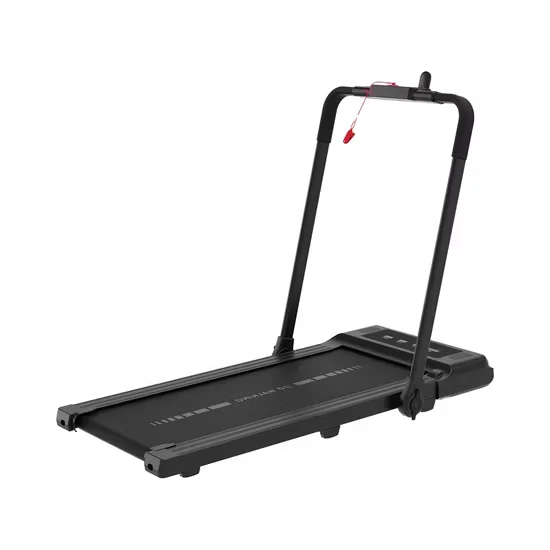
Space-Saving Foldable Frame — Engineered with a compact folding mechanism that reduces storage footprint by over 50%, enabling flexible deployment in space-constrained environments.
Technical Specifications
| Parameter | Value |
|---|---|
| Designation | W06D5 |
| Product Type | Foldable Treadmill |
| Motor Type | Electric |
| Speed Range | 1-8 km/h |
| Maximum Speed | <15 km/h |
| Running Surface | 1000 x 400 mm |
| Programs | 6 Preset Programs |
| Console Type | LED Screen |
| Console Metrics | Speed / Distance / Time / Calories |
| Product Dimensions | 1270 x 650 x 965 mm |
| Foldable | Yes |
| Age Group | Adult |
| Certification | CE, RoHS |
Application Suitability
| Deployment Scenario | Typical Use |
|---|---|
| High-end residential home gym | Daily moderate-intensity walking and light jogging for household members |
| Apartment fitness room | Compact deployment in shared residential facilities where space and noise are constraints |
| Corporate wellness center | Low-to-moderate intensity cardio sessions for employees during work breaks |
| Small fitness studio | Personal training sessions or supplemental cardio for small-group classes |
Why Noise Complaints Reach the Front Desk Before Maintenance Does
A foldable treadmill compact home gym unit must prioritize acoustic management to survive in shared spaces.
When cardio equipment operates above or beside occupied rooms, low-frequency vibration travels through structural slabs faster than airborne sound. In apartment fitness rooms and boutique studios, a poorly isolated motor or unbalanced drive system generates tonal noise that penetrates floor assemblies. This isn’t just a user annoyance—it becomes a facility management liability when adjacent tenants file formal complaints. The engineering focus must be on the entire drivetrain, from motor mounting to deck isolation, to ensure that a foldable treadmill compact home gym deployment doesn’t become the subject of a noise abatement notice [NEED_CITE: structural vibration transmission standards for residential fitness equipment].
Placement Logic Within a Compact Cardio Zone
This unit covers steady-state walking and light jogging, occupying the lower-to-moderate intensity band of the cardio spectrum. In a small wellness room or apartment gym, it pairs logically with a stationary bike or elliptical to offer users a choice between weight-bearing and low-impact modalities without requiring a large floor area. The 1000 x 400 mm running surface accommodates adult users performing walking and jogging gaits, while the foldable footprint allows facility managers to reclaim floor space during off-hours. It is best deployed against a wall with adequate clearance for the folding arc and user mounting. As a foldable treadmill compact home gym solution, it serves environments where every square meter must justify its presence.
Duty Cycle Expectations for Light-Commercial Environments
The motor in this class of equipment is designed for intermittent use patterns typical of home gyms and small corporate wellness rooms—several sessions per day, each lasting under an hour. It is not engineered for the continuous relay use seen in large chain gyms where machines run for 12+ hours daily. Deployment on upper floors requires attention to vibration isolation pads and subfloor rigidity to prevent structure-borne noise transmission to rooms below. Standard single-phase power is sufficient, but the circuit should be dedicated to prevent voltage sag from affecting console electronics [NEED_CITE: electrical circuit requirements for light-commercial fitness equipment]. The folding mechanism must be inspected periodically to ensure locking pins remain secure under repeated deployment cycles.
Reading the Drivetrain and Console Specifications
The LED console provides real-time readouts for speed, distance, time, and calorie estimates without the complexity and maintenance overhead of full-touch systems. LED displays are less susceptible to sweat ingress and touchscreen calibration drift, making them practical for environments where equipment is shared but not continuously supervised. The 1-8 km/h speed range covers brisk walking through light jogging, which aligns with the 1000 x 400 mm belt surface—a dimension that supports comfortable walking strides while requiring users to moderate stride length at higher jogging speeds. The six preset programs introduce structured intensity variation without requiring users to manually adjust speed mid-session. The foldable frame design introduces a mechanical pivot and locking system that must be rated for the repeated stress of deployment and stowage; the engineering integrity of this hinge point is as critical as the motor itself.
The Hidden Cost of Specification Compromises
When a treadmill in this category is pushed beyond its intended duty cycle—such as installation in a busy commercial gym—motor winding temperatures exceed design limits, leading to premature insulation failure and burnout. In shared residential buildings, insufficient vibration damping transfers low-frequency hum through concrete slabs, triggering tenant complaints that force facility operators to replace entire equipment batches. A running surface that is too short or narrow for the target user population causes gait compensation, which users perceive as discomfort without being able to articulate the cause, leading to equipment abandonment. LED consoles that lack data connectivity leave usage metrics stranded on the device, preventing facility managers from tracking utilization patterns and making informed replacement decisions [NEED_CITE: equipment utilization tracking in managed fitness facilities].
Why This Product Line Addresses These Risks
The W06D5 is part of a cardio family engineered with acoustic performance as a primary design constraint, with sub-35dB operation verified in hotel deployments where equipment sits directly above guest rooms. Motors and bearings across the product line undergo 10,000-hour continuous operation testing to validate thermal management under sustained load. The foldable frame of this model reduces its floor footprint when stowed, which directly informs the 3D cardio-zone layout planning—our engineers can model multiple unit placements within a constrained apartment fitness room, optimizing sightlines and airflow around each station. OEM customization extends to console UI and color matching, allowing corporate wellness centers to align equipment appearance with brand identity. Documentation includes noise level test reports and durability records specific to the unit’s drivetrain configuration. Full technical support and spare parts availability ensure that a single failed component doesn’t sideline the machine indefinitely.
Documentation & Test Records
- CE declaration of conformity confirming compliance with European machinery safety directives
- EN 957 test report covering mechanical safety and structural load requirements
- ISO 9001 certificate validating manufacturing quality management systems
- RoHS compliance documentation confirming restriction of hazardous substances
- Noise level test report documenting acoustic output under defined operating conditions
- Durability test record for motor, bearings, and folding mechanism lifecycle validation
Installation, Commissioning & Maintenance
- Verify 1270 x 650 mm footprint clearance plus rear safety zone before placement
- Use vibration isolation pads on upper-floor deployments to mitigate structure-borne noise
- Connect to a dedicated single-phase circuit to protect LED console electronics from voltage fluctuation
- Inspect folding mechanism locking pins monthly for wear and secure engagement
- Check running belt tension and alignment after the initial 50 hours of operation
- Wipe LED console and handrails with non-corrosive cleaner after each use session
Equipment Selection and Project Scope Definition
Provide the cardio zone floor area and target unit count to receive a 3D layout that models equipment spacing, user flow, and ventilation requirements for the W06D5 within your specific room geometry. Specify the expected daily usage duration per unit so that motor duty cycle can be matched to the deployment scenario. Identify the floor level and adjacent occupied spaces to confirm whether additional vibration isolation is required. Confirm the target market voltage and plug standard to ensure electrical compatibility upon arrival. Indicate whether console data output is needed for integration with facility management or member engagement systems.
Frequently Asked Questions
Q: What is the difference between foldable and non-foldable treadmills for facility deployment?
A: Foldable models prioritize space recovery, allowing the unit to be stowed when not in use—valuable in apartment gyms and corporate wellness rooms. Non-foldable commercial treadmills typically feature heavier frames and larger motors designed for continuous operation in high-traffic gyms. The choice depends on whether floor area or duty cycle is the primary constraint.
Q: How does motor duty cycle affect treadmill lifespan in daily use?
A: Duty cycle defines how long a motor can run continuously before requiring a cool-down period. Light-commercial motors in foldable units are rated for intermittent sessions typical of home and small wellness environments. Exceeding this rating causes thermal accumulation in windings, accelerating insulation degradation and leading to premature motor failure.
Q: Can the LED console connect to fitness apps or facility management systems?
A: The LED console on this model displays speed, distance, time, and calories locally without wireless connectivity. For facilities requiring data integration with management software or member apps, IoT-enabled touchscreen consoles are available on other models within the product line, supporting app sync and usage analytics.
Q: What maintenance is required for the folding mechanism and running belt?
A: The folding hinge and locking pins should be inspected monthly for secure engagement and signs of mechanical wear. The running belt requires periodic tension and alignment checks, particularly after the initial break-in period. Belt lubrication intervals depend on usage frequency and should follow the commissioning guide specifications.
Q: Is this treadmill suitable for continuous commercial gym operation?
A: This model is engineered for home gyms, apartment fitness rooms, and corporate wellness centers with moderate daily usage. For large commercial gyms requiring 12+ hours of continuous daily operation, a non-foldable treadmill with a higher-rated motor and reinforced frame from the commercial series is recommended to ensure long-term durability.
![Anti-Tipping Mt296 Electric Treadmill for Home Fitness Running [WARN] draft identifier mismatch](https://bicksport.com/wp-content/uploads/2026/08/anti-tipping-mt296-electric-treadmill-for-home-fitness-running-warn-draft-identifier-mismatch-f67a1d.webp)
![Mt296 Home Use Electric Treadmill for Professional Training [WARN] draft identifier mismatch](https://bicksport.com/wp-content/uploads/2026/08/mt296-home-use-electric-treadmill-for-professional-training-warn-draft-identifier-mismatch-3f93cc.webp)