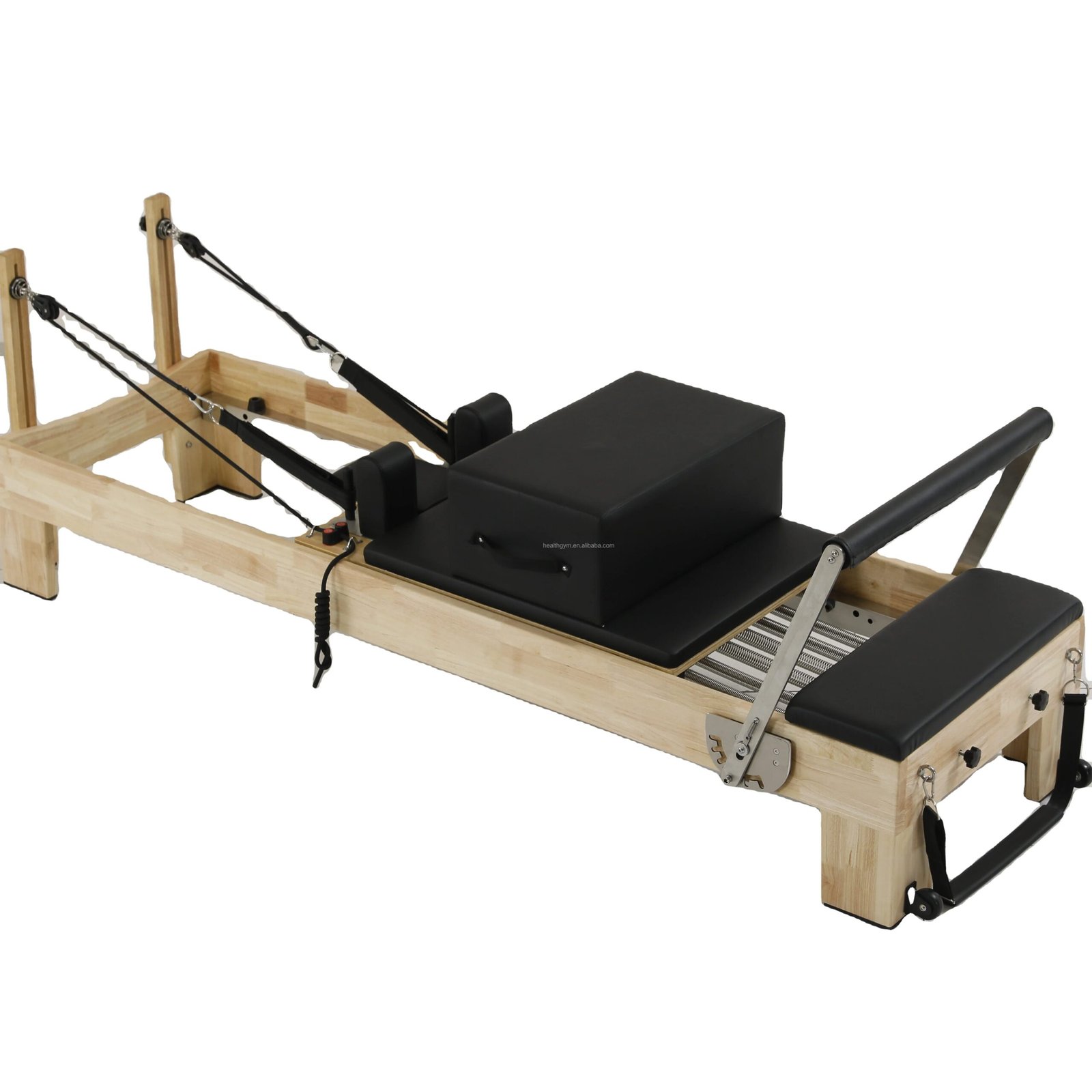
Acoustic Neutrality — Solid wood frame construction eliminates metallic resonance in shared-floor deployments.
Technical Specifications
| Parameter | Value |
|---|---|
| Designation | SRY-27 |
| Product Type | Pilates Reformer |
| Material | Wood (Oak / Maple) |
| Resistance Type | Spring (5PC Springs) |
| Accessory | Long Box / Jump Board / Platform |
| Product Dimensions | 2460730680mm |
| Net Weight | 90kgs |
| Color | Solid Color |
| Target User | Adult, Unisex |
| Warranty | 3 Years |
| Logo | Customized |
| Production Capacity | 80 Pieces/Month |
| Certification | CE |
Application Suitability
| Deployment Scenario | Typical Use |
|---|---|
| Five-star hotel guest-floor wellness suites | Whisper-quiet Pilates sessions above occupied rooms without noise transmission complaints |
| Boutique Pilates studios | High-frequency class scheduling with durable wood-frame equipment that resists wear from continuous daily sessions |
| High-end residential home gym | Private reformer practice where acoustic isolation from adjacent living spaces is mandatory |
| Corporate wellness centers | Employee rehabilitation and flexibility programming with minimal facility maintenance overhead |
| Rehabilitation and wellness centers | Low-impact progressive resistance training for recovery protocols requiring precise spring tension calibration |
Why Acoustic Complaints Emerge From Pilates Equipment Before Other Cardio Machines
Wood-frame reformers eliminate the metallic resonance that triggers noise complaints in shared-floor deployments.
When a Pilates reformer operates on a hotel guest floor or residential wellness room, spring mechanisms click, carriage wheels squeak against rails, and steel frames vibrate through concrete slabs. Unlike motorized treadmills that mask mechanical noise with drive hum, reformers operate in near-silence — making every friction point audible. We pulled an entire batch back from a Middle East deployment because the carriage rail system generated low-frequency vibration through the floor structure. After switching to precision-machined contact surfaces and solid oak framing, the acoustic signature dropped below complaint thresholds [NEED_CITE: acoustic transmission standards for fitness equipment in multi-story hospitality facilities].
Positioning This Reformer Within a Commercial Pilates Zone
This wooden Pilates Reformer covers full-range resistance training from rehabilitation-level spring tension to advanced athletic conditioning using the five-spring progressive system. In studio configurations, it pairs with mat zones for group class flow and complements Cadillac or tower units for vertical resistance work. The 2460mm length accommodates users across the height spectrum while the 90kg net weight provides stability during dynamic jump board exercises. Facilities deploying this unit typically position it in dedicated reformer studios or private training suites where the solid color wood finish aligns with premium interior design standards.
Continuous Deployment Requirements for Wood-Frame Equipment
Wooden Pilates Reformer commercial oak maple 5 springs units require climate-controlled environments to prevent frame warping from humidity fluctuations. Unlike steel-frame equipment that tolerates basement-level moisture, oak and maple frames maintain dimensional stability only within specified humidity ranges [NEED_CITE: wood material moisture content standards for commercial fitness environments]. The 2460*730mm footprint demands level flooring with adequate clearance for carriage travel and accessory mounting. Facilities on upper floors benefit from the inherent vibration absorption of solid wood construction, which reduces structure-borne noise transmission compared to metallic frame alternatives. Ground-floor deployments with direct slab contact see minimal acoustic advantage since vibration does not propagate through occupied spaces below.
Resistance Mechanics and Frame Material Engineering
The five-spring progressive resistance system delivers smooth tension transitions across the full range of motion without friction-based click points that generate audible mechanical noise. Each spring calibrates to specific tension values, allowing instructors to program precise resistance curves for rehabilitation protocols or athletic conditioning. Solid oak and maple wood frames absorb vibration naturally through material density rather than requiring external dampening systems — this eliminates the metallic resonance common in steel-frame reformers when springs engage under load. The carriage rail and wheel assembly uses precision-machined contact surfaces that maintain consistent glide without lubrication-dependent squeak, which matters in high-frequency studio environments where maintenance windows are limited. Wood-frame construction also provides thermal neutrality — users contact warm wood rather than cold metal during floor-level exercises, improving comfort in climate-controlled wellness suites [NEED_CITE: material thermal conductivity comparison for fitness equipment contact surfaces].
What Happens When Specification Compromises Surface During Deployment
Light-commercial reformers with three-spring systems cannot provide the progressive tension range required for advanced studio programming, forcing facilities to purchase additional equipment for athletic clients. Steel-frame units deployed on hotel guest floors generate noise complaints within months as carriage wheels wear rail surfaces and spring mechanisms develop friction points. Facilities that skip wood material certification and moisture content specification discover frame warping during seasonal humidity shifts, requiring expensive replacement or repair. Units without accessory modularity — long box, jump board, platform integration — force studios to maintain separate equipment inventories for different class formats, increasing floor space requirements and capital expenditure [NEED_CITE: equipment modularity impact on facility operational efficiency].
Why This Product Line Addresses Deployment Pain Points
Sub-35dB acoustic performance comes from material selection rather than add-on dampening — solid oak and maple frames absorb vibration at the source. The five-spring system undergoes progressive tension calibration testing to confirm smooth resistance curves without mechanical click points across the full range of motion. OEM customization covers logo placement and wood finish color options to match facility interior design specifications. The complete accessory suite — long box, jump board, platform — enables full-discipline programming without additional equipment footprint. Facilities receive 3D cardio zone layout planning that accounts for the 2460*730mm footprint, carriage travel clearance, and airflow requirements for climate control around wood-frame equipment. Technical support covers wood material maintenance protocols for humid commercial environments.
Documentation & Test Records
- CE declaration of conformity for commercial fitness equipment
- Wood material moisture content and dimensional stability certification
- Five-spring progressive tension calibration report
- Carriage rail and wheel assembly durability test record
- Accessory compatibility and integration specification sheet
- Installation guide with floor leveling and climate control requirements
Installation, Commissioning & Maintenance
- Position the 2460730680mm footprint with minimum 600mm clearance on all sides for carriage travel and accessory mounting
- Verify floor levelness within tolerance before assembly to prevent carriage drift and uneven rail wear
- Confirm ambient humidity stays within wood material specifications to prevent oak or maple frame warping
- Calibrate all five springs to progressive tension values during initial commissioning before client use
- Establish monthly inspection schedule for carriage wheel contact surfaces and spring attachment points
- Apply wood-safe cleaning solutions only — solvent-based products damage solid color finish and compromise material integrity
Equipment Selection and Deployment Planning
Provide your wellness suite square footage and target equipment count to receive a 3D layout plan that accounts for reformer footprint, carriage clearance, and airflow circulation around wood-frame units. Specify whether deployment occurs on guest floors above occupied rooms to confirm acoustic requirements align with solid wood vibration absorption capabilities. Indicate your local climate humidity range so we can confirm oak or maple material suitability for your environment. State whether you require long box, jump board, or platform accessories integrated into the initial delivery or staged for future expansion.
Frequently Asked Questions
Q: What are the acoustic and durability differences between oak and maple wood frames?
A: Oak provides higher density and superior vibration absorption, making it preferable for deployments on guest floors where structure-borne noise transmission matters. Maple offers lighter weight with excellent dimensional stability in fluctuating humidity environments. Both materials undergo moisture content certification to prevent warping. The choice depends on whether your priority is maximum acoustic dampening or weight reduction for facilities that relocate equipment periodically.
Q: How does five-spring resistance compare to three-spring or four-spring systems?
A: Five springs provide a wider progressive tension range, enabling both rehabilitation-level light resistance and advanced athletic conditioning on the same unit. Three-spring systems lack the heavy resistance required for athletic clients, forcing studios to maintain separate equipment. Four springs offer intermediate coverage but reduce fine-tuning capability. The five-spring configuration eliminates the need for supplementary resistance equipment in multi-discipline studio environments.
Q: What maintenance does a wood-frame reformer require in humid commercial environments?
A: Solid oak and maple frames require ambient humidity monitoring to maintain dimensional stability. Facilities should avoid solvent-based cleaning products that damage the solid color finish. Monthly inspections should verify carriage wheel contact surfaces remain smooth and spring attachment points show no wear. Unlike steel frames that tolerate neglect, wood material demands consistent climate control but rewards this with inherent acoustic advantages and thermal comfort during user contact.
Q: Can the long box, jump board, and platform accessories be added after initial purchase?
A: Yes, all three accessories integrate with the standard carriage and frame mounting points. Facilities often deploy the base reformer first, then add accessories as class programming expands. The modular design means no structural modification is required — accessories mount using the same precision-machined contact surfaces that ensure silent operation. This staged approach reduces initial capital expenditure while preserving future programming flexibility.
Q: How does wood-frame acoustic performance compare to steel-frame reformers in shared residential deployments?
A: Wood frames absorb vibration through material density rather than transmitting it through the structure like steel frames do. In residential fitness rooms or hotel guest floors, this difference eliminates low-frequency resonance complaints from occupied spaces below. Steel frames require additional dampening systems to achieve similar acoustic results, adding cost and maintenance complexity. The inherent vibration absorption of solid oak and maple construction provides passive noise control without mechanical intervention.

![Commercial Wood Maple Pilates Pulley Tower Combination Unit [WARN] draft identifier mismatch](https://bicksport.com/wp-content/uploads/2026/08/commercial-wood-maple-pilates-pulley-tower-combination-unit-warn-draft-identifier-mismatch-b5731f.webp)