
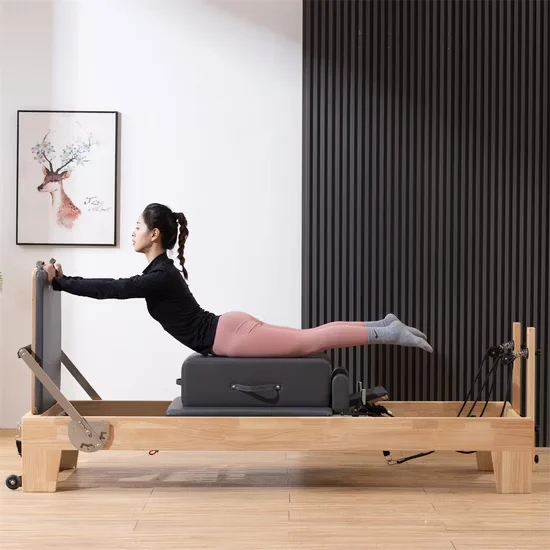
Solid Maple Frame Damping — Natural wood density absorbs vibration during repetitive spring-loaded movements, keeping carriage noise below audible thresholds in shared-wall studio environments.
Technical Specifications
| Parameter | Value |
|---|---|
| Product Type | Pilates Reformer |
| Model NO. | SRY-02 |
| Frame Material | Solid Maple |
| Specification | 2460730680mm |
| Net Weight | 100kgs |
| Included Accessories | Long Box / Jump Board / Platform |
| Color | Solid Color |
| Logo | Customized Is Allowed |
| Age / Gender | Adult / Unisex |
| Warranty Time | 3 Years |
| Production Capacity | 80 Pieces/Month |
Application Suitability
| Deployment Scenario | Typical Use |
|---|---|
| Boutique Pilates and yoga studio | Group reformer classes with high-frequency carriage cycling and spring transitions |
| Hotel and resort wellness center | Supervised core training sessions in shared-wall guest floor fitness areas |
| Corporate wellness room | Low-impact body core training for employees during breaks and after hours |
| Rehabilitation and wellness facility | Controlled spring-resistance movements for guided recovery programs |
| High-end residential home gym | Personal core training with minimal noise transfer to adjacent living spaces |
Why Carriage Noise Reaches the Studio Owner Before the Warranty Does
Frame material and bearing quality determine audible performance long before spring count matters.
Boutique studios lose members when reformer carriages squeak mid-class, spring tension drifts across sessions, or padding compresses within months of daily use. These failures trace back to frame density and wheel-rail alignment rather than cosmetic features. A maple frame naturally dampens vibration that metal or composite frames transmit through shared walls and floors [NEED_CITE: vibration transmission characteristics of solid hardwood vs. engineered wood in fitness equipment]. In mixed-use commercial buildings where Pilates studios share partitions with offices or hotel corridors, carriage noise during footwork sequences becomes the first complaint facility managers receive.
Where This Reformer Fits in a Commercial Studio Layout
The Commercial Pilates Maple Reformer covers full-range movement patterns from supine footwork through standing platform exercises, supporting both beginner foundational sessions and advanced spring-loaded progressions. In a studio cardio and strength zone, this unit complements mat-based equipment and tower apparatus by delivering adjustable resistance for isolated core engagement. Its 2460mm footprint suits dedicated reformer studios where units are spaced for instructor sightlines across group classes. The 100kg net weight and solid maple construction provide stability during jump board sequences without requiring floor anchoring, accommodating adult users across varied body types.
Continuous Studio Scheduling and Environmental Requirements
Studios running back-to-back group classes subject reformers to continuous carriage cycling for eight or more hours daily. Sealed bearing wheels on the rail system prevent dust accumulation from studio environments where chalk, lotion, and fiber debris collect on moving parts. Maple’s natural moisture response means deployment in climate-controlled spaces with stable humidity prevents frame warping that could compromise carriage alignment over time. Floor leveling matters: uneven surfaces create lateral carriage drift that accelerates wheel wear on one side of the rail. Facilities sharing walls with noise-sensitive tenants should verify clearance distances between reformer rails and partition surfaces [NEED_CITE: recommended clearance distances for vibration-sensitive equipment in mixed-use commercial buildings].
What Frame Density and Spring Configuration Actually Control
Solid maple delivers a density profile that plywood and metal frames cannot replicate for vibration absorption. When a user performs repetitive footwork or jump board sequences, the frame material either dampens oscillation or transmits it to the floor and adjacent walls. The multi-spring configuration on this commercial pilates maple reformer body core training unit allows incremental load adjustment, so instructors can progress resistance without abrupt tension changes between exercises. Factory-matched accessories — the long box, jump board, and platform — mount to pre-drilled rail positions, distributing load across the frame rather than concentrating stress at aftermarket attachment points. Sealed carriage bearings maintain glide consistency across thousands of repetitions, reducing the maintenance intervals that exposed bearings demand in high-use studio environments.
The Hidden Cost of Cutting Frame and Bearing Specifications
Studios that procure reformers with veneer-over-composite frames often discover within months that carriage noise escalates as the surface layer delaminates under repetitive load. Exposed bearings require frequent cleaning in studio environments, and neglected maintenance leads to audible grinding that disrupts class sessions. Spring tension that drifts between units in the same studio forces instructors to verbally compensate during group classes, undermining the consistency members expect. Aftermarket accessory mounts that do not match factory rail specifications create frame stress concentrations, leading to warranty disputes and premature equipment replacement [NEED_CITE: common warranty claim patterns in commercial Pilates equipment].
Why This Product Line Addresses Studio Procurement Risks
Sub-35dB operation verified in hotel deployments confirms the engineering discipline applied across this cardio and reformer range. The 10,000-hour durability testing protocol covers bearing and rail components, not just static frame loads. Full OEM customization extends to logo placement and finish specifications, allowing studios to maintain brand consistency across equipment. The six-series cardio family means facilities sourcing reformers can also procure treadmills and bikes from one supplier, simplifying maintenance contracts. Free 3D studio layout planning accounts for reformer spacing, instructor sightlines, and airflow between units during high-intensity group sessions. Technical support responds around the clock for calibration questions that arise during initial deployment.
Documentation & Test Records
- CE declaration of conformity covering full equipment safety requirements
- EN 957 test report validating structural and mechanical performance
- ISO 9001 certificate confirming quality management system compliance
- Noise level test report documenting carriage glide under full spring tension
- Durability test record for bearing and rail cycle performance
- Installation and commissioning guide with spare parts list
Installation, Commissioning & Maintenance
- Position each 2460730680mm unit with clearance for full carriage travel and instructor access on both sides
- Level the maple frame on solid flooring using adjustable feet to prevent lateral carriage drift
- Verify spring tension calibration on all springs before first class use
- Inspect sealed carriage bearings quarterly for dust accumulation in studio environments
- Wipe maple frame surfaces with pH-neutral cleaner to prevent sweat residue buildup
- Confirm accessory mounting hardware torque on long box, jump board, and platform after initial break-in period
Planning Your Studio Equipment Procurement
Provide your studio floor plan and target unit count to receive a 3D layout addressing reformer spacing, instructor sightlines, and member flow between sessions. Specify your daily class schedule so bearing duty cycles match your operational intensity. Confirm deployment floor level and adjacent room usage to validate noise transfer requirements. State your target market for any region-specific compliance documentation needed. Indicate whether console-integrated usage tracking is required for your facility management system.
Frequently Asked Questions
Q: Why does maple frame material matter for noise reduction in shared-wall studios?
A: Solid maple has a natural density and fiber structure that dampens vibration from repetitive carriage movement, unlike plywood or metal frames that transmit oscillation through floors and partitions. In studios adjacent to hotel rooms or offices, this material difference determines whether footwork sequences generate audible complaints from neighboring tenants or remain contained within the studio space.
Q: How does carriage bearing quality affect long-term glide smoothness?
A: Sealed bearings prevent studio dust, fiber debris, and moisture from entering the wheel mechanism, maintaining consistent glide resistance over thousands of cycles. Exposed bearings require regular cleaning and lubrication, and neglected maintenance introduces audible grinding and lateral drift that compromise exercise precision and increase warranty service requests.
Q: Multi-spring versus single-spring resistance: which suits commercial class formats?
A: Multi-spring configurations allow instructors to adjust load incrementally between exercises without abrupt tension jumps, supporting varied fitness levels within the same group class. This progression capability matters in commercial studios where class rosters include beginners and advanced practitioners who need reliable, repeatable resistance settings session after session.
Q: What accessory compatibility checks prevent frame damage?
A: Factory-matched accessories like the included long box, jump board, and platform mount to pre-engineered rail positions that distribute load evenly across the maple frame. Aftermarket add-ons that do not match rail specifications create stress concentrations at attachment points, potentially causing frame cracks that void warranties and require full unit replacement.
Q: How can buyers verify frame construction claims before bulk procurement?
A: Request cross-section documentation confirming solid maple throughout rather than veneer over composite core material. Ask for carriage glide noise test data recorded at full spring tension under load. Verify bearing specification sheets and cycle test records that demonstrate performance retention after simulated high-frequency studio use.


![Exercise Pilates Maple Beech Reformer Half Tower with Trapeze [WARN] draft identifier mismatch](https://bicksport.com/wp-content/uploads/2026/08/exercise-pilates-maple-beech-reformer-half-tower-with-trapeze-warn-draft-identifier-mismatch-3b95e6.webp)
