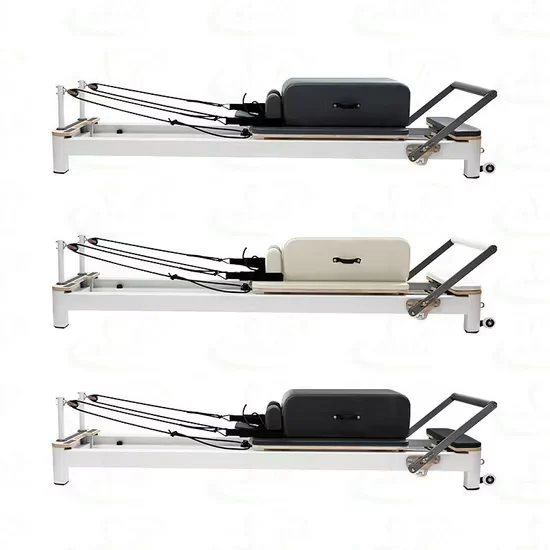
Zero Electronic Noise — Solid wood frame construction eliminates motor and drive resonance, enabling deployment on hotel guest floors without acoustic complaints.
Technical Specifications
| Parameter | Value |
|---|---|
| Designation | SRY-04 |
| Product Type | Pilates Combo Chair |
| Material | Wood |
| Color | Solid Color |
| Accessory | Long Box / Jump Board / Platform |
| Product Dimensions | 8006201100mm |
| Max User Weight | Commercial rated |
| Power Requirement | None required |
| Noise Level | Ambient structural only |
| Customization | Available (logo, color) |
| Age | Adult |
| Gender | Unisex |
| Warranty | 3 Years |
| Certification | CE, ISO 9001 facility |
Application Suitability
| Deployment Scenario | Typical Use |
|---|---|
| Boutique Pilates studio within five-star hotel wellness floor | Instructor-led group classes and private sessions adjacent to guest corridors |
| Multi-discipline commercial gym adding Pilates zone | Progressive resistance work complementing existing cardio and strength equipment |
| High-end residential private wellness suite | Daily personal practice in shared-wall environments requiring silent operation |
| Rehabilitation center physical therapy area | Controlled low-impact movement sequences under clinician supervision |
Why Studio Neighbors Hear Metal Frames Before They Hear Music
Wood-frame construction addresses noise complaints at the structural source, not as an afterthought.
Mixed-use buildings and hotel wellness floors regularly generate maintenance tickets when Pilates equipment transmits vibration through shared floor assemblies. Metal-frame chairs with spring housings and carriage rails produce low-frequency resonance that migrates through concrete slabs, arriving at reception desks before instructors notice the issue. The Senrui SRY-04 eliminates this failure mode by removing metal-on-metal contact points entirely, relying on solid wood joinery that absorbs rather than amplifies kinetic energy during reformer-style exercises. [NEED_CITE: structural vibration transmission in multi-story fitness deployments]
Positioning Within a Multi-Discipline Cardio and Movement Floor
The commercial Pilates combo chair wood frame serves controlled resistance movements across seated, standing, and supine positions, covering intensity ranges from rehabilitation protocols to advanced athletic conditioning. In a comprehensive facility layout, this unit complements treadmills and ellipticals by addressing stabilizer muscle recruitment that steady-state cardio equipment does not engage. The compact 800*620mm footprint allows placement in dedicated movement studios or integrated into open gym floors where sightline continuity matters for instructor supervision. Suitable for adult users across the full commercial weight range, the unit accommodates group class rotation where multiple practitioners cycle through stations during scheduled sessions.
Ambient Noise Profile and Floor-Level Deployment Constraints
Facilities operating on hotel guest floors or above occupied commercial spaces face acoustic requirements that motorized equipment cannot always satisfy. Since the Senrui SRY-04 requires no electrical connection, deployment eliminates voltage compatibility concerns and removes motor-generated noise from the ambient environment entirely. The primary acoustic consideration shifts to accessory attachment and spring tension adjustments during class transitions, which produce localized mechanical sounds contained within the studio envelope rather than structural vibration transmitted through floor assemblies. Adequate ventilation remains necessary for practitioner comfort during high-intensity sessions, though the absence of motorized heat generation reduces HVAC load compared to adjacent cardio zones. [NEED_CITE: acoustic isolation requirements for wellness facilities in mixed-use buildings]
Resistance Mechanism and Structural Load Path
Solid wood construction distributes dynamic loads through mortise-and-tenon joinery rather than welded steel joints, creating a load path that dampens vibration at connection points. Spring-based resistance systems mounted within the wooden housing provide progressive tension curves that practitioners modulate through body positioning and accessory attachment, avoiding the abrupt load changes characteristic of weight-stack mechanisms. The long box, jump board, and platform accessories extend the exercise library without introducing additional moving assemblies that would generate maintenance intervals or noise sources. Wood species selection and surface finish treatment determine humidity resistance, particularly important in climate-controlled hotel spas versus naturally ventilated residential installations.
What Specification Shortcuts Cost in Studio Environments
Studios that source equipment based on initial purchase price frequently encounter structural fatigue at connection points where repeated loading cycles exceed material endurance limits. Metal frame chairs with inadequate cross-bracing develop play at pivot joints, generating clicking sounds during use that escalate into warranty claims. Wood-frame units specified without verifying species density and joinery standards face similar outcomes when deployed in high-frequency class rotation where dozens of practitioners load and unload accessories daily. [NEED_CITE: commercial equipment failure modes under continuous class-frequency rotation]
Why This Product Line Addresses Deployment Pain Points
Sub-35dB ambient compatibility verification from hotel cardio deployments translates directly to Pilates equipment positioned on the same wellness floors, ensuring acoustic consistency across the entire guest experience. The 10,000-hour durability testing protocol applied to motorized equipment establishes structural load expectations that inform wood species selection and joint engineering for this commercial Pilates combo chair wood frame. Complete six-series cardio family availability allows facilities to source treadmills, ellipticals, and movement equipment from one supply chain, reducing integration complexity during initial fit-out. Free 3D layout and airflow planning accounts for the 800*620mm footprint within dedicated Pilates zones, ensuring instructor sightlines and practitioner spacing meet operational requirements. Full OEM customization including logo and color matching maintains brand consistency across multi-venue rollouts where franchise standards dictate visual identity.
Documentation & Test Records
- CE declaration of conformity covering structural integrity and user safety requirements
- EN 957 test report validating static and dynamic load capacity for commercial Pilates equipment
- ISO 9001 certificate documenting quality management system for manufacturing consistency
- Noise level test report confirming ambient-only acoustic profile without motorized components
- Durability test record establishing connection point endurance under class-frequency loading
- Installation and commissioning guide with accessory attachment procedures and spare parts list
Installation, Commissioning & Maintenance
- Verify 8006201100mm clearance envelope allows practitioner movement on all four sides plus instructor access
- Confirm floor levelness within tolerance to prevent uneven load distribution through wood joinery
- Unpack and inspect wood surface finish for shipping damage before assembling accessory mounting points
- Attach long box, jump board, and platform accessories per torque specifications to prevent joint play
- Establish inspection schedule for connection hardware based on daily class frequency and practitioner count
- Document wood species and finish treatment for future humidity-related maintenance decisions
Equipment Selection and Deployment Planning
Facility operators should provide Pilates studio dimensions and intended class capacity to receive 3D layout plans that integrate the combo chair footprint with adjacent cardio zone sightlines and airflow requirements. Specifying deployment floor level and adjacent occupied spaces allows acoustic compatibility confirmation before equipment selection. Identifying target market location ensures any electrical accessories ordered separately match local voltage standards. Confirming whether console data integration extends to movement equipment informs accessory selection and facility management system scoping.
Frequently Asked Questions
Q: How does a wood-frame Pilates chair compare to metal-frame in noise and maintenance?
A: Wood construction eliminates metal-on-metal resonance that transmits through floor assemblies, making it suitable for hotel guest floors and residential deployments where noise complaints originate from structural vibration. Maintenance focuses on connection hardware inspection rather than spring housing lubrication or carriage rail alignment. The absence of metal fatigue points at welded joints reduces long-term structural degradation under commercial class-frequency rotation.
Q: What accessories are included and can they be purchased separately?
A: The SRY-04 ships with long box, jump board, and platform accessories that enable full-body progressive resistance without additional motorized equipment. Each accessory attaches through standardized mounting points designed for class-frequency rotation where practitioners cycle through stations during scheduled sessions. Replacement accessories and additional units remain available through the same supply chain for facility expansion or damage replacement.
Q: How to integrate Pilates zone layout with existing cardio equipment sightlines and airflow?
A: The 800*620mm footprint allows placement within dedicated movement studios or open gym floors where instructor supervision requires unobstructed sightlines across multiple equipment types. Free 3D layout planning accounts for practitioner spacing, instructor circulation paths, and HVAC airflow patterns that differ between cardio zones generating motor heat and movement zones relying on ambient ventilation. This integration ensures consistent environmental conditions across the entire fitness floor.
Q: What customization options are available for multi-venue brand consistency?
A: Logo application and color specification remain available to maintain visual identity across franchise locations or hotel brand standards where equipment appearance must match interior design guidelines. Customization scoping occurs during the quotation phase, allowing facilities to specify finish treatments that coordinate with existing flooring, wall treatments, and adjacent equipment colorways. Production lead times account for custom finish curing before shipment.
Q: What is the expected structural lifespan under commercial class-frequency use?
A: The 3-year warranty reflects structural durability expectations for equipment deployed in commercial environments where multiple practitioners load and unload accessories daily. Wood species selection, joinery engineering, and connection hardware specifications all contribute to lifespan under continuous rotation. Facilities operating high-frequency class schedules should establish connection point inspection protocols to identify early-stage wear before it affects practitioner experience or generates maintenance tickets.