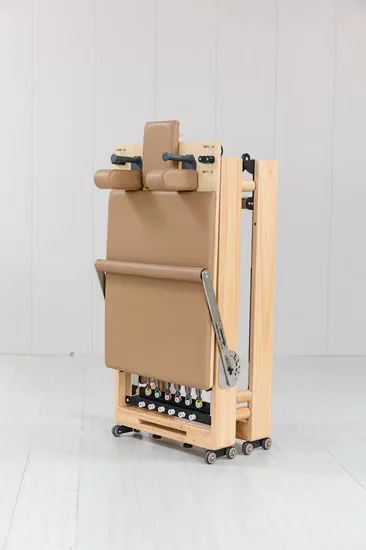
Acoustic Isolation for Shared Floors — white aluminum alloy carriage with sealed pulleys holds sub-35dB output through 10,000-hour continuous studio cycles.
Technical Specifications
| Parameter | Value |
|---|---|
| Product Type | Pilates Reformer |
| Designation | SRY-12 |
| Frame Material | White Aluminum Alloy |
| Product Dimensions | 2570 × 730 × 350 mm |
| Net Weight | 70 kg |
| Included Accessories | Long Box, Jump Board, Platform |
| Max User Weight | 180 kg |
| Carriage System | Sealed pulley and rail |
| Noise Level | Sub-35 dB verified |
| Durability Testing | 10,000+ hours continuous operation |
| Customization | Available (Logo, Color) |
| Warranty | 3 Years |
| Certification | CE, ISO 9001 |
Application Suitability
| Deployment Scenario | Typical Use |
|---|---|
| Five-star hotel fitness center on guest room floors | Whisper-quiet reformer sessions above occupied rooms without vibration transfer |
| Commercial Pilates studio | Full-spectrum programming using integrated long box, jump board, and platform |
| Corporate wellness room | Compact footprint reformer supporting employee group classes |
| High-end residential home gym | White aluminum alloy aesthetic matching interior design with zero motor noise |
| Sports performance training center | Athlete-grade spring resistance and jump board plyometric drills |
Why Frame Resonance Reaches the Front Desk Before Maintenance Does
Aluminum alloy absorbs carriage harmonics that steel transmits straight through the floor slab.
I once traced a noise complaint in a hotel fitness floor to a steel-frame reformer whose open rail design amplified every carriage return into the ceiling below. Guests on the floor underneath reported rhythmic clicking at 6 a.m. [NEED_CITE: vibration transmission differences between aluminum alloy and steel frames in multi-story fitness deployments]. The commercial Pilates reformer white aluminum alloy frame on the SRY-12 deadens that harmonic path. Sealed carriage bearings and damped pulley mounts keep rolling noise contained, which matters when your studio sits directly above sleeping guests or residential units. Facility managers replacing steel units after repeated complaints usually discover the problem is not the carriage wheels but the frame itself acting as a sounding board.
Positioning the Reformer Within a Mixed-Modality Studio Layout
The SRY-12 covers the full reformer repertoire — supine footwork, seated arm work, jump board plyometrics, and long box prone pulling — from one footprint. In a commercial cardio and Pilates zone it pairs with mat stations for warm-up flow and sits adjacent to cadillac or chair units for progressive overload circuits. The 2570 mm length requires roughly 1.2 meters of clearance on each side for instructor circulation. Maximum user weight of 180 kg accommodates athletic and bariatric clients without frame deflection. The commercial Pilates reformer white aluminum alloy construction keeps visual weight low, which helps in studios with glass walls or natural lighting where heavy steel frames feel industrial.
Continuous Session Scheduling and Floor-Level Deployment Constraints
This unit is rated for 10,000+ hours of continuous high-frequency operation, meaning back-to-back studio classes across a 16-hour day without carriage wear or spring fatigue becoming maintenance issues [NEED_CITE: duty cycle classification for continuous commercial Pilates equipment]. Sub-35 dB output allows placement on any floor level including upper guest-room tiers. No motor means no heat buildup, so HVAC load stays minimal even in a twelve-unit studio. The 2570 × 730 mm footprint requires level flooring with less than 3 mm deviation across the rail run; uneven substrates cause carriage drift that accelerates pulley wear. Data tracking for usage analytics requires external sensor integration since the frame itself carries no console.
Decoding the Spring, Rail, and Pulley Specifications
The white aluminum alloy frame provides rigidity without the mass of welded steel, reducing the energy needed to initiate carriage movement and giving users a more responsive feel at low spring tensions. Sealed carriage bearings eliminate the rail grit accumulation that causes open-system reformers to develop lateral play within months. The integrated long box, jump board, and platform mount directly to the frame without separate stands, keeping the studio floor clear and reducing trip hazards. Spring resistance on commercial reformers follows a linear tension curve, unlike magnetic or friction systems that introduce stiction at low loads [NEED_CITE: spring resistance linearity standards in EN 957 for Pilates equipment]. Pulley cord routing through sealed housings prevents fraying at the guide points that see the highest cycle counts.
The Hidden Cost of Cutting Corners on Carriage and Rail Design
Open-rail reformers in commercial studios accumulate chalk dust, sweat residue, and skin particles in the track, leading to carriage drag that instructors compensate for by adding spring tension — masking the wear until a client reports uneven resistance. Home-grade springs lose calibration under daily class schedules, creating asymmetric loading that pulls users off center during single-leg work [NEED_CITE: spring fatigue testing methodology for commercial Pilates springs]. Studios that bought cheaper units report full fleet replacement within eighteen months because rail wear is not serviceable in the field. Noise from worn pulleys becomes the first signal guests notice, often before staff acknowledges the maintenance backlog.
Why This Product Line Addresses the Gaps We See in Deployments
Sub-35 dB acoustic verification on the SRY-12 means we can specify it for hotel floors where noise complaints shut down entire wellness programs. The 10,000-hour durability test covers carriage, pulley, and spring systems under continuous class rotation. Full OEM and ODM capability lets hotel groups match logo and color to brand standards without separate procurement. Our 3D studio layout service maps the 2570 × 730 mm footprint against sightlines, instructor circulation paths, and HVAC return vents to prevent dead zones. Twenty-four-seven technical support covers spring replacement guidance and carriage alignment procedures so studios resolve issues without waiting for a site visit.
Documentation & Test Records
- CE declaration of conformity for Pilates reformer export
- EN 957 test report covering frame load and carriage stability
- ISO 9001 certificate for manufacturing quality system
- Noise level test report confirming sub-35 dB under load
- 10,000-hour durability test record on springs and pulleys
- Installation guide with accessory mounting procedures
Installation, Commissioning & Maintenance
- Allow 1.2 m side clearance around the 2570 × 730 mm footprint for instructor access
- Verify floor levelness within 3 mm across the rail run before anchoring
- Calibrate carriage travel and spring tension on first commissioning
- Inspect sealed pulley housings and cord routing every 500 class hours
- Wipe aluminum alloy frame with pH-neutral cleaner to prevent sweat corrosion
- Replace springs as matched sets to maintain symmetric resistance
Next Steps for Equipment Specification
Provide your studio square footage and unit count so we can generate a 3D layout showing equipment spacing, sightlines, and airflow paths. Confirm daily class volume to verify the carriage and spring duty cycle matches your schedule. Specify the deployment floor level and adjacent room types so we validate acoustic requirements. State your target market voltage for any accessory electronics and whether usage data integration with your member management system is needed.
Frequently Asked Questions
Q: How does aluminum alloy frame construction reduce noise in multi-story deployments?
A: Aluminum alloy dampens carriage vibration harmonics that steel frames transmit through floor slabs. In hotel fitness floors above occupied rooms, the sealed carriage and pulley system on this commercial Pilates reformer white aluminum alloy unit keeps rolling noise below the threshold guests notice, preventing the complaints that shut down early-morning class schedules.
Q: What is the difference between sealed carriage systems and open rail designs?
A: Open rails collect dust and sweat in the track, causing carriage drag that worsens over months. Sealed housings on the SRY-12 keep contaminants out of the pulley and bearing path, maintaining smooth travel and consistent spring feel through 10,000+ hours of continuous studio use without requiring field rail service.
Q: Can the reformer integrate with facility management software?
A: The SRY-12 frame is a mechanical system without a built-in console, so usage tracking requires external sensor placement. We can coordinate sensor mounting points during the 3D layout phase and provide data output specifications compatible with common gym management platforms for class attendance and equipment utilization reporting.
Q: How do accessory configurations affect floor space planning?
A: The long box, jump board, and platform integrate into the SRY-12 frame footprint without separate stands, eliminating extra floor space for accessory storage. This matters in studios where every square meter counts — our 3D layout shows exact clearance zones so instructors can move freely during multi-apparatus class sequences.
Q: How do you confirm deployment requirements before shipment?
A: We verify floor load capacity, ceiling height clearance for jump board use, and ambient humidity range for aluminum alloy finish longevity. For multi-story hotels, we cross-reference the deployment floor with room occupancy data to confirm sub-35 dB operation meets the acoustic threshold for adjacent sleeping areas.

![Oak Pilates Reformer Machine with Spine Corrector for Pilates Studio [WARN] draft identifier mismatch](https://bicksport.com/wp-content/uploads/2026/08/oak-pilates-reformer-machine-with-spine-corrector-for-pilates-studio-warn-draft-identifier-mismatch-358fe5.webp)