![Oak Pilates Reformer Machine with Spine Corrector for Pilates Studio [WARN] draft identifier mismatch](https://bicksport.com/wp-content/uploads/2026/08/oak-pilates-reformer-machine-with-spine-corrector-for-pilates-studio-warn-draft-identifier-mismatch-358fe5.webp)
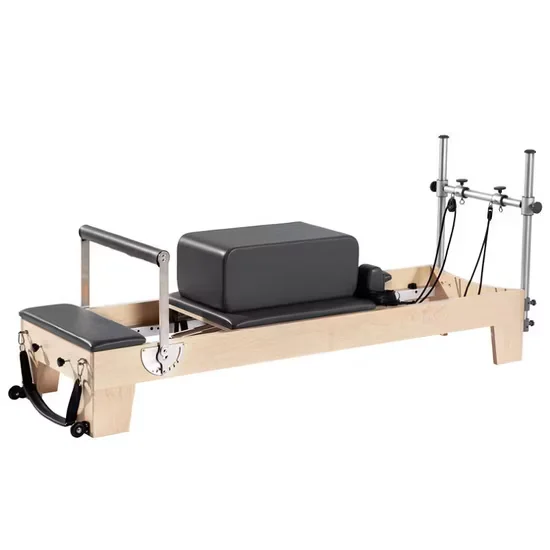
Whisper-Quiet Carriage Glide — Precision rail system and reinforced oak frame deliver silent, smooth operation verified in high-frequency studio environments.
Technical Specifications
| Parameter | Value |
|---|---|
| Product Type | Pilates Reformer |
| Model NO. | SRY-05 |
| Frame Material | Oak |
| Carriage System | Precision rail glide |
| Included Accessories | Long Box / Jump Board / Platform |
| Attachment | Spine Corrector |
| Product Dimensions | 960470360mm |
| Net Weight | 20kgs |
| Target User | Adult, Unisex |
| Logo | Customized Is Allowed |
| Color | Solid Color |
| Warranty | 3 Years |
| Certification | CE, ISO 9001 |
| HS Code | 9506911900 |
Application Suitability
| Deployment Scenario | Typical Use |
|---|---|
| Boutique Pilates studio | Full-class Reformer setups requiring quiet, durable carriages for back-to-back group sessions |
| Rehabilitation and physiotherapy center | Low-impact spinal alignment and core stabilization protocols using the Spine Corrector |
| Corporate wellness room | Employee flexibility and posture correction sessions in shared office environments |
| High-end residential home gym | Private daily practice with noise-sensitive household members nearby |
| Sports performance training center | Athlete mobility and core activation as part of conditioning programs |
Why Studio Operators Replace Reformers Before the Frame Shows Wear
Carriage drift and rail misalignment force early retirement more often than structural failure.
In commercial Pilates studios, the equipment that gets pulled from the floor first is rarely the one with a cracked frame. It is the unit whose carriage no longer tracks true, whose glide mechanism develops lateral play after months of repetitive loading, and whose springs lose tension consistency across the range. Operators discover that a Pilates Reformer Machine Oak Spine Corrector setup must endure thousands of articulation cycles per week [NEED_CITE: carriage mechanism duty cycle for commercial Pilates equipment]. When the carriage stutters or the rails develop uneven wear patterns, clients notice immediately — and they rebook elsewhere. The SRY-05 addresses this with reinforced rail geometry and carriage components tested for continuous studio-frequency use, so the glide remains predictable across the full travel length.
Where This Reformer Fits in a Studio Equipment Matrix
The SRY-05 occupies the primary workhorse position in a multi-apparatus studio layout. It pairs with the Cadillac for decompression sequences and the Wunda Chair for standing balance challenges, covering the full spectrum from supine core work to upright functional movement. Its compact footprint allows tighter row spacing for group classes while maintaining adequate lateral clearance for instructor circulation. The integrated Spine Corrector expands the exercise library without requiring a separate barrel, making it suitable for studios where floor space constrains apparatus count. The Pilates Reformer Machine Oak Spine Corrector accommodates adult users of varying proportions within its 960mm carriage travel.
Noise Transmission and Studio Environment Considerations
In a boutique studio operating six or more classes daily, mechanical noise from carriage movement accumulates across sessions. Metal-on-metal friction in aging glide systems generates audible grinding that carries through hardwood floors to adjacent treatment rooms. The SRY-05’s rail and wheel interface minimizes contact noise during high-repetition footwork and long-stretch series [NEED_CITE: acoustic standards for shared-wall fitness environments]. For rehabilitation centers sharing walls with quiet consultation rooms, this matters for client experience and professional perception. Deployment on upper floors requires standard vibration isolation pads beneath the feet. The 960*470mm footprint fits standard studio grid layouts, and the 20kg net weight allows repositioning for room reconfiguration without specialized equipment.
Rail Geometry and Carriage Engineering Decoded
The carriage glide system represents the most critical engineering interface on any reformer. Rail profile, wheel durometer, and bearing specification collectively determine whether the carriage tracks silently under load or develops lateral play within months. The SRY-05 uses a rail geometry designed for consistent contact pressure distribution, preventing the uneven wear patterns that cause carriage drift. The oak frame provides dimensional stability — hardwood maintains its geometry under humidity fluctuations better than composite alternatives, preserving rail parallelism over years of use. The included Long Box, Jump Board, and Platform each attach to the carriage through standardized mounting points, and attachment security depends on precise dimensional tolerance between carriage slot and accessory tab. The Spine Corrector integrates directly into the frame structure, providing a stable curved surface for spinal articulation work without requiring separate positioning or stabilization.
The Cost of Under-Specifying Glide Components
Studios that purchase reformers based on frame aesthetics alone often discover the cost difference six months later. Carriage mechanisms built for home-use frequency develop play under commercial cycling, requiring frequent adjustment or complete replacement. Spring sets that lack tension consistency force instructors to manually compensate during client sessions, degrading program quality. Rails that are not precision-machined develop wear channels that accelerate wheel degradation [NEED_CITE: rail wear pattern analysis in high-frequency Pilates studios]. These failures rarely appear in showroom demonstrations but emerge predictably under the repetitive loading of back-to-back classes. The cumulative cost of carriage rebuilds, spring replacements, and client attrition from inconsistent equipment feel often exceeds the initial savings from choosing a lighter-duty specification.
Why Operators Standardize on This Equipment Line
The SRY-05 belongs to a product family engineered for the acoustic and durability demands of commercial environments. The oak frame and precision glide components undergo testing protocols aligned with continuous studio operation. For operators planning multi-unit deployments, the 3D layout service covers reformer spacing, instructor circulation paths, and ventilation requirements specific to Pilates room dimensions. OEM customization extends to logo placement and color matching, allowing studio branding consistency across the equipment fleet without affecting lead times disproportionately. The three-year warranty covers structural and mechanical components, and spare parts availability ensures that maintenance does not require full-unit replacement. Every deployment includes installation documentation and a commissioning guide specific to the apparatus configuration.
Documentation & Test Records
- CE declaration of conformity for commercial Pilates apparatus
- EN 957 test report covering structural load and safety requirements
- ISO 9001 certificate for manufacturing quality management
- Noise level assessment for carriage glide operation
- Durability test record for rail and wheel interface lifecycle
- Assembly guide with accessory mounting verification checklist
Installation, Commissioning & Maintenance
- Maintain 600mm lateral clearance between SRY-05 units for instructor access during group sessions
- Install vibration isolation pads beneath all feet when deploying on upper floors above occupied spaces
- Verify rail parallelism and carriage tracking during initial commissioning before client use
- Inspect wheel bearings and rail contact surfaces quarterly under commercial-frequency operation
- Confirm Spine Corrector mounting security and accessory tab fit during each maintenance cycle
- Clean oak frame surfaces with pH-neutral products to preserve dimensional stability
Equipment Selection and Layout Planning
Provide your studio floor area and target reformer count to receive a 3D layout covering unit spacing, airflow, and instructor circulation paths. Specify daily class volume and expected usage frequency to confirm the SRY-05’s glide system matches your duty cycle. Indicate whether the deployment floor shares walls or ceilings with noise-sensitive spaces to verify acoustic suitability. State your target market for any applicable certification requirements, and note whether accessory packages or branding customization apply to your order.
Frequently Asked Questions
Q: Pilates Reformer vs. Cadillac vs. Chair — which apparatus suits my studio layout?
A: The Reformer handles the majority of supine and seated movement patterns and typically anchors the studio grid. The Cadillac adds overhead spring work and hanging sequences, requiring ceiling height clearance. The Chair addresses standing balance and functional loading in a smaller footprint. Most studios deploy multiple Reformers as primary stations, supplemented by one or two Cadillacs and Chairs for circuit variety.
Q: How should I maintain the carriage glide system under commercial use?
A: Inspect wheel bearings and rail surfaces quarterly for wear patterns or debris accumulation. Clean rails with a dry microfiber cloth to prevent grit embedding in the contact zone. Avoid petroleum-based lubricants on rail surfaces. Under high-frequency studio operation, schedule a full carriage disassembly and bearing inspection annually to catch lateral play before it affects client experience.
Q: What exercises does the Spine Corrector attachment support?
A: The Spine Corrector provides a curved surface for spinal articulation, thoracic extension, and hip flexor stretching sequences. It integrates into the reformer frame, allowing transitions between flat carriage work and curved-surface exercises without apparatus changes. This is particularly valuable in rehabilitation settings where controlled spinal mobilization is a primary programming goal.
Q: What customization options are available for branding and finish?
A: Logo placement is available on the frame, and color options cover solid finishes to match studio interiors. Customization lead times depend on order volume and specific finish requirements. Provide your branding files and color references during the quotation phase to confirm scope and production scheduling before the deposit stage.
Q: How should I plan reformer spacing for group class layouts?
A: Allocate sufficient lateral clearance between units for instructor circulation and client entry from both sides. Consider ceiling height for exercises involving overhead arm positions. Account for airflow paths to prevent stagnant air in densely configured rooms. A 3D layout plan covering square footage, sightlines, and ventilation helps optimize the arrangement before installation.
![Commercial Aluminum Alloy Pilates Reformer Bed for Studio [WARN] draft identifier mismatch](https://bicksport.com/wp-content/uploads/2026/08/commercial-aluminum-alloy-pilates-reformer-bed-for-studio-warn-draft-identifier-mismatch-c372fc.webp)