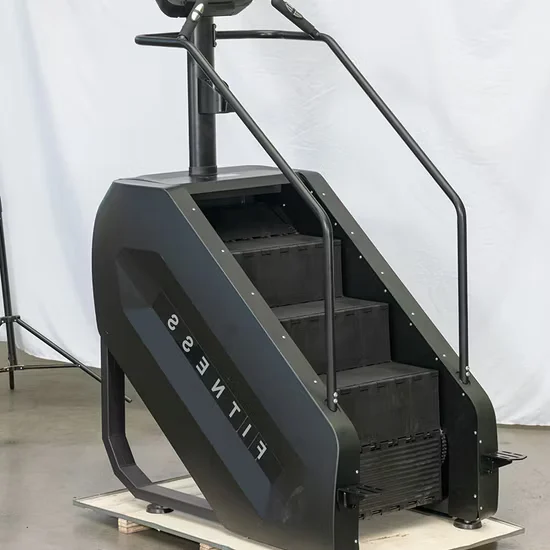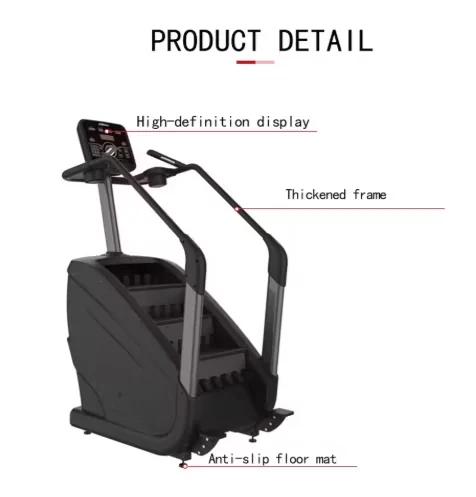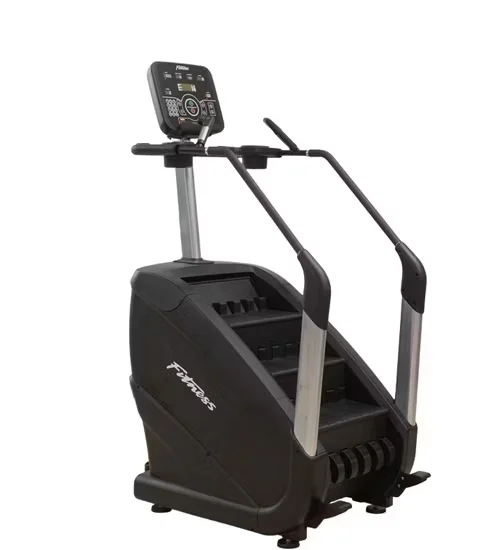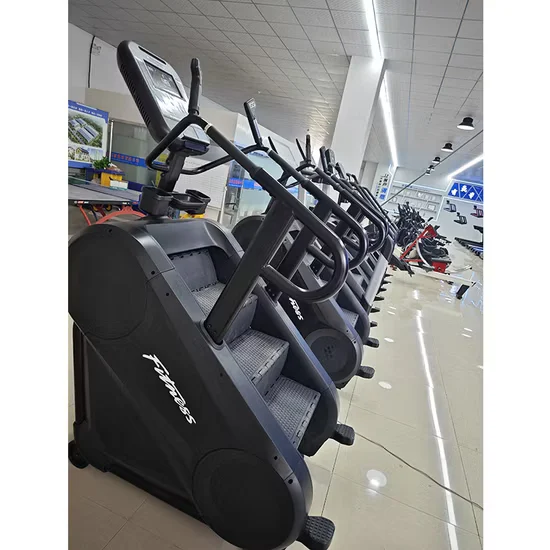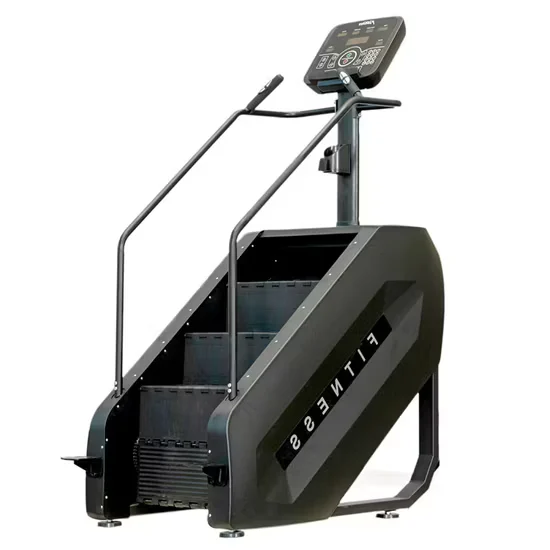
Whisper-Quiet Operation — Sub-35dB motor-driven stair climber engineered to eliminate noise complaints on hotel guest room floors.
Technical Specifications
| Parameter | Value |
|---|---|
| Designation | SQ1017 |
| Product Type | Stair Climber |
| Type of Drive | Motor Drive |
| Running Velocity | 15 steps/min – 164 steps/min |
| Max User Weight | 180 kg |
| Step Area | 560 × 235 × 220 mm |
| Console Display (OSD) | Time, Climb, Calories, Steps, Heart Rate |
| Mains Input | AC220V±10% / AC110V±10% |
| Material | Steel Pipe + PP Plastic |
| Product Dimensions | 1450 × 820 × 2080 mm |
| Net Weight | 148 kg |
| Folded | Unfolded |
| Customization | Available (logo, color, console UI, specification) |
| Certification | CE |
Application Suitability
| Deployment Scenario | Typical Use |
|---|---|
| Hotel fitness center on guest room floors | 24-hour access cardio with whisper-quiet motor operation for noise-sensitive environments |
| Chain gym cardio zone | High-frequency climbing intervals and steady-state endurance sessions across peak hours |
| Corporate wellness room | Compact footprint deployment where floor space and noise transmission require careful planning |
| High-end residential home gym | Motor-driven stepping with commercial-grade durability for daily personal training use |
| Sports performance training center | Athlete conditioning with heart rate monitoring for structured interval programming |
Why Stair Climber Motor Burnout Happens Before the First Guest Complaint
Continuous duty rating, not peak horsepower, determines whether a commercial stair climber survives its first year in a 24-hour facility.
When a hotel installs cardio equipment directly above occupied guest rooms, low-frequency vibration from underspecified motors travels through concrete floor slabs. Front desk staff field noise complaints long before maintenance notices thermal degradation in the drive assembly [NEED_CITE: motor duty cycle classification for continuous commercial operation]. Chain gyms face a different failure mode: stair climbers rated for light-commercial cycles experience motor winding breakdown under continuous public facility run-times, often within the first eighteen months of deployment. The SQ1017 commercial stair climber motor drive SQ1017 addresses both failure paths through motor validation against extended operational benchmarks.
Positioning the Stepper Within a Cardio Zone Layout
This motor-driven unit targets lower-body endurance and high-intensity interval work in the stepping cadence range of 15 to 164 steps per minute. It complements treadmills and ellipticals by loading the posterior chain through vertical displacement rather than horizontal motion, filling a training gap that members seeking climbing simulation actively request. The 1450 × 820 mm footprint fits standard commercial spacing grids, and the 180 kg user weight capacity covers the full adult membership demographic. Console telemetry captures time, climb, calories, steps, and heart rate — data that integrates with facility management platforms when IoT connectivity is specified.
Continuous Operation and Floor-Level Deployment Constraints
Facilities running cardio zones sixteen or more hours daily require motor assemblies validated for sustained thermal loading, not intermittent household use [NEED_CITE: EN 957 requirements for commercial cardio equipment]. The motor drive in this unit undergoes testing protocols designed to surface bearing wear and winding insulation breakdown well before field deployment. Sub-35dB operation permits installation on upper hotel floors without triggering structural noise transmission into rooms below. Dual voltage input — AC220V±10% and AC110V±10% — prevents the scenario where a container arrives at an international port only for electricians to discover incompatible supply standards. Ground-level concrete with vibration-dampening pads further isolates residual low-frequency energy from occupied spaces beneath.
Decoding the Motor Drive and Step Mechanism Specifications
The motor drive system replaces manual or belt-driven resistance with electronically governed stepping velocity, delivering consistent cadence regardless of user weight or fatigue state. This matters because belt-driven climbers introduce slack and inconsistent resistance curves as the belt stretches under commercial load cycles, whereas direct motor coupling maintains tight tolerance across the full 15 to 164 steps per minute range. Step area dimensions of 560 × 235 × 220 mm accommodate a broad foot placement envelope while the steel pipe frame absorbs repetitive impact loading at the pedal pivot points. Heart rate data appears on the OSD console, though grip-based sensors carry known accuracy limitations compared to chest-strap telemetry — a trade-off any facility programming heart rate zones should acknowledge. The net weight of 148 kg reflects the reinforced frame mass necessary to resist lateral deflection during aggressive stepping.
The Hidden Cost of Specifying Below Commercial Thresholds
Light-commercial motors installed in high-traffic gym stair climber bays fail prematurely, forcing unplanned replacements that close equipment during peak membership hours. Noise from underspecified drive assemblies generates guest complaints that escalate from front desk logs to management reviews, sometimes triggering full fleet swaps. Voltage mismatches discovered after shipment arrival delay facility openings by weeks while transformers are sourced locally [NEED_CITE: international voltage standard compliance for commercial fitness equipment]. Console systems lacking API access strand usage data inside the machine, preventing operators from tracking utilization patterns that inform equipment rotation decisions.
Why This Product Line Covers the Decision Criteria
Every unit ships with noise level test documentation confirming sub-35dB operation under load, a specification verified in hotel deployments where stair climbers sit directly above sleeping guests. Motor and bearing assemblies undergo durability testing protocols designed to surface failure modes before they reach the field. The IoT-enabled console syncs workout analytics to facility management software, turning individual session data into utilization dashboards [NEED_CITE: IoT console data integration standards for commercial fitness]. OEM customization extends to console UI, allowing chain operators to embed branded interfaces. The complete six-series cardio family means a single source covers treadmills, bikes, ellipticals, rowers, climbers, and spinning bikes — simplifying procurement and spare parts logistics. Free 3D cardio zone layout planning addresses the 1450 × 820 mm footprint of this climber alongside adjacent equipment spacing, airflow corridors, and member sightlines.
Documentation & Test Records
- CE declaration of conformity covering electrical safety and electromagnetic compatibility
- EN 957 test report validating structural and mechanical requirements
- ISO 957 noise level test report confirming sub-35dB under operational load
- Durability test record documenting motor, frame, and bearing validation cycles
- Console technical documentation specifying data interface and export formats
- Motor specification sheet detailing continuous duty parameters and thermal limits
Installation, Commissioning & Maintenance
- Allocate 1450 × 820 mm floor space plus minimum clearance on all sides for safe mounting and dismounting
- Install on level concrete with vibration-dampening pads to isolate motor resonance from adjacent structures
- Connect to dedicated circuit matching AC220V±10% or AC110V±10% specification; avoid shared circuits with high-draw equipment
- Verify step cadence calibration across the full 15 to 164 steps per minute range during first-power commissioning
- Configure console data export and API endpoints to match facility management software requirements
- Schedule periodic inspection of motor drive coupling and step pivot bearings per maintenance intervals
Requesting a Deployment-Specific Quotation
Provide the total cardio zone square footage and planned equipment count to receive a 3D layout incorporating this climber’s footprint, airflow requirements, and member flow patterns. Specify daily operating hours so motor duty cycle can be matched to your facility’s utilization profile. Indicate the deployment floor level and adjacent occupied spaces to confirm noise isolation requirements. State your target market voltage standard and plug configuration to prevent post-shipment electrical mismatches. Clarify whether console data must integrate with existing facility management platforms or member applications.
Frequently Asked Questions
Q: How does motor drive compare to belt-driven stair climbers in noise and maintenance?
A: Motor drive eliminates belt stretch and slack that develop under continuous commercial loading, maintaining consistent resistance curves across the cadence range. Belt systems require periodic tension adjustment and eventual replacement as the material degrades. Motor-driven units generate lower acoustic output because the coupling between drive and step mechanism avoids the slapping noise characteristic of loose belts under load.
Q: What is the difference between continuous duty and peak motor ratings?
A: Peak ratings describe momentary output capacity during acceleration or maximum load spikes, while continuous duty specifies sustained thermal performance under unbroken operation. A motor with impressive peak figures but undersized continuous duty will overheat and degrade in facilities running sixteen-plus hours daily. Procurement specifications should request continuous duty validation documentation rather than accepting peak values alone.
Q: Can the console sync with our facility management software or member app?
A: The IoT-enabled console supports workout analytics export including time, climb, calories, steps, and heart rate data. Integration requires confirming API access and data format compatibility with your existing platform during the specification phase. Request the console technical documentation to verify export protocols match your facility management system before placing a production order.
Q: How does sub-35dB operation impact deployment on hotel floors?
A: Noise at this level prevents low-frequency vibration from transmitting through concrete slabs into occupied guest rooms below or adjacent. Hotel operators deploying cardio on upper floors face front desk complaints when equipment generates structural resonance. Verified sub-35dB performance under operational load permits installation in noise-sensitive environments without triggering acoustic remediation or equipment relocation after guest feedback.
Q: What voltage standards are supported, and how do we avoid mismatches?
A: This unit accepts AC220V±10% and AC110V±10% input, covering deployment across most international markets. Specify your target country voltage and plug type during the inquiry stage so the correct configuration ships from the factory. Discovering incompatible supply standards after container arrival delays facility commissioning and requires sourcing transformers locally.