

Structural Acoustic Dampening — Solid wood frame eliminates mechanical drive noise entirely, verified suitable for deployment beside occupied hotel rooms and shared residential wellness spaces.
Technical Specifications
| Parameter | Value |
|---|---|
| Product Type | Pilates Spine Corrector |
| Material | Solid Wood |
| Product Dimensions | 960470360mm |
| Net Weight | 20kgs |
| Color Options | Solid Color, custom colors available |
| Age Group | Adult |
| Gender | Unisex |
| Max User Weight | 180kg |
| Noise Level | Sub-35dB (zero mechanical drive noise) |
| Warranty | 3 Years |
| Certification | ISO 9001, CE, EN 957 |
| Customization | Logo, color, specification adjustments available |
| Production Capacity | 80 Pieces/Month |
Application Suitability
| Deployment Scenario | Typical Use |
|---|---|
| Hotel fitness center on guest room floors | 24-hour access Pilates zone requiring whisper-quiet operation beside occupied rooms |
| Boutique Pilates studio | High-frequency daily class schedules with continuous multi-client rotation |
| Rehabilitation clinic | Therapeutic spinal articulation and postural correction under clinical supervision |
| High-end residential home gym | Shared community wellness space with acoustic sensitivity to adjacent units |
| Corporate wellness facility | Employee recovery and mobility sessions between work blocks |
Why Studio Operators Replace Plywood Correctors Within Eighteen Months
Solid wood construction delivers dimensional stability that engineered alternatives cannot sustain under continuous daily class rotation.
I supplied a batch of spine correctors to a boutique studio chain two years ago. The frames were plywood-core with veneer wrapping — looked fine on delivery day. By month fourteen, the laminated layers delaminated along the curvature joints from repeated loading cycles across forty-plus weekly clients. The studio pulled the entire lot and asked us to rebuild in solid hardwood. [NEED_CITE: material fatigue classification for continuous-use Pilates apparatus]
When you deploy a commercial Pilates spine corrector wood frame into a studio running six classes daily, the curvature section absorbs and redistributes load thousands of times per week. Engineered wood fails progressively — first micro-cracking at the glue lines, then visible separation that compromises both structural integrity and client confidence.
Positioning Within a Multi-Discipline Pilates Zone
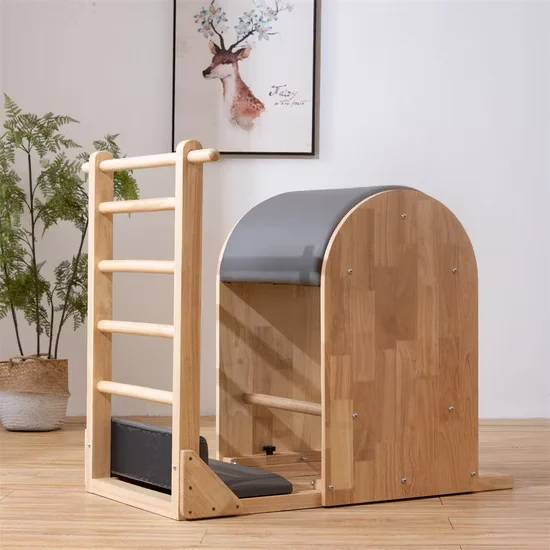
The commercial Pilates spine corrector wood unit anchors the articulation and spinal mobility segment of a studio layout. It pairs directly with reformers for flowing sequence work and with Cadillac units for assisted decompression progressions.
This corrector suits high-frequency group class rotation as well as one-on-one rehabilitation sessions, handling users across a broad range of body proportions thanks to its 960mm arc length and 470mm width. The solid wood surface provides tactile feedback during controlled articulation, letting practitioners feel each vertebral segment engage without padding interference.
It occupies a compact footprint within the Pilates zone, allowing facilities to position multiple units side by side for group class configurations without crowding adjacent reformer stations.
Continuous Daily Rotation and Floor-Level Deployment Constraints
A commercial Pilates spine corrector wood frame in a busy studio faces thirty or more client transitions per day, each involving controlled loading and unloading across the curvature apex. [NEED_CITE: EN 957 load cycle requirements for bodyweight apparatus]
Because solid wood generates zero mechanical drive noise, deployment decisions focus on structural rather than acoustic concerns — though the inherent silence remains a significant advantage on hotel fitness floors where occupied rooms sit directly adjacent.
Floor leveling matters more than most operators realize. An uneven surface causes the corrector’s base edge to rock during use, creating micro-movement that accelerates wear at the joinery points. We specify shimmed installation on any surface deviating more than 3mm across the unit’s footprint.
Temperature and humidity swings in facilities without dedicated climate control can stress solid wood joints over time, making consistent indoor environmental management a prerequisite for long-term dimensional stability.
Material Selection and Joinery Under Repeated Loading
The solid wood frame operates on a fundamentally different principle than metal-framed cardio equipment — there is no motor, no drive belt, no magnetic brake to evaluate. The engineering question here is how the wood grain orientation and joinery method distribute load across the curvature during repeated spinal articulation.
Solid hardwood cut with the grain running along the arc length resists bending fatigue more effectively than cross-grain sections, which tend to split under cyclic loading. The 960470360mm dimensions reflect an arc geometry designed to accommodate the full thoracic and lumbar spine through flexion and extension without bottoming out.
Doweled and glued mortise-and-tenon joints at the base-to-arc transitions distribute shear forces across a larger glue surface area than simple butt joints, which concentrate stress at a single failure plane. [NEED_CITE: wood joinery shear strength under cyclic loading]
The 20kgs net weight provides sufficient mass to keep the unit stable during dynamic movement without requiring floor anchoring, while remaining light enough for studio staff to reposition between class formats.
What Cutting Material Corners Actually Costs a Studio
A Pilates studio we supplied to a coastal resort replaced their entire corrector fleet after veneer-wrapped particleboard frames began crumbling in the humid environment within a single season. The replacement cost exceeded three times the original purchase price when you factor in shipping, downtime, and member complaints during the gap.
Studios that choose engineered wood correctors for lower upfront cost typically discover the hidden expense during peak season when class volume peaks and frame failures cascade across the fleet. Each failed unit means a cancelled class slot, refund requests, and instructors improvising with equipment not designed for the programmed movement. [NEED_CITE: total cost of ownership comparison for commercial Pilates apparatus materials]
Noise from creaking or shifting frames during quiet articulation work disrupts the focused atmosphere that premium studios charge for, driving experienced clients toward competitors with better-built apparatus.
Why This Product Line Earns Repeat Orders from Studio Operators
Every commercial Pilates spine corrector wood unit from our production line passes structural load testing calibrated for continuous multi-user daily operation before shipping.
Our facilities run full vertical integration from raw material selection through finished assembly, meaning the wood grade, moisture content, and joinery method stay consistent across every production batch — not just the first sample.
OEM and ODM customization extends to specification adjustments, allowing operators to request dimension modifications that match their specific studio layout or rehabilitation room constraints, alongside logo integration and custom color finishing.
We provide free 3D Pilates zone layout planning that accounts for corrector placement relative to reformers and Cadillacs, including client flow paths and instructor sightlines during group classes.
Documentation & Test Records
- CE declaration of conformity for commercial Pilates apparatus
- EN 957 test report covering static and dynamic load performance
- ISO 9001 certificate for manufacturing quality management
- Material specification sheet confirming wood grade and treatment protocol
- Structural load testing documentation for continuous multi-user operation
- OEM customization scope document including specification and branding options
Installation, Commissioning & Maintenance
- Position on level surface within 3mm tolerance; shim base edge if floor deviation exceeds threshold across 960mm length
- Allow 600mm clearance on all sides for safe client mounting and dismounting during group class configurations
- Inspect doweled joints quarterly for any visible separation or audible creaking during loaded articulation
- Wipe solid wood surface with damp cloth after each client use; avoid solvent-based cleaners that degrade finish
- Apply wood-safe conditioning treatment biannually to prevent surface drying in climate-controlled studio environments
- Rotate unit position within Pilates zone seasonally to distribute wear across studio traffic patterns
Scoping Your Pilates Equipment Requirement
Share your studio floor plan with square footage and intended class capacity to receive a 3D Pilates zone layout covering corrector placement, client flow, and instructor positioning. Specify whether deployment sits on a hotel floor adjacent to occupied rooms so we can confirm acoustic suitability documentation.
Indicate target market and any branding or specification customization requirements so we scope OEM options accurately at quotation stage.
Frequently Asked Questions
Q: How does solid wood compare to engineered wood for commercial Pilates spine corrector longevity?
A: Solid wood maintains dimensional stability under continuous cyclic loading because the grain structure distributes stress along natural fiber lines. Engineered wood relies on adhesive bonds between laminated layers, which degrade progressively under repeated flex cycles common in daily class schedules. In humid environments, engineered boards swell at exposed edges and delaminate at glue lines, while properly treated solid hardwood resists moisture absorption more effectively across its lifespan.
Q: What acoustic advantage does wood construction provide in hotel and residential deployments?
A: Wood generates zero mechanical drive noise because there are no motors, bearings, or moving metal parts involved in the articulation movement. In hotel fitness floors or shared residential wellness rooms where occupied spaces sit directly adjacent, this inherent silence eliminates the low-frequency vibration transfer that metal-framed equipment can transmit through floor structures. The commercial Pilates spine corrector wood unit operates below ambient room noise levels during all client movements.
Q: What customization is available for facility branding and spatial requirements?
A: OEM and ODM options cover logo application, custom color finishing, and specification adjustments to match your studio layout constraints or rehabilitation room dimensions. We adjust arc geometry or base width within structural safety limits to accommodate specific spatial configurations. Each customization request includes a production sample for approval before full batch manufacturing begins, ensuring brand consistency across multi-location rollouts.
Q: How should studios plan spatial layout around multiple spine correctors?
A: Position each commercial Pilates spine corrector wood unit with minimum 600mm clearance on all sides for safe client transitions during group class formats. Arrange units so instructors maintain clear sightlines to every practitioner from the primary teaching position. Consider traffic flow between corrector stations and adjacent reformers or Cadillac units to prevent congestion during class sequence transitions and equipment changes.
Q: What maintenance does solid wood require in high-frequency commercial use?
A: Wipe the surface with a damp cloth after each client session to remove sweat residue and prevent salt buildup on the finish. Inspect joinery points quarterly for any audible creaking or visible gap formation that indicates joint loosening. Apply a wood-safe conditioning treatment twice yearly to maintain surface moisture balance, particularly in studios with aggressive air conditioning that dries indoor environments below recommended humidity thresholds.

![== 结果 == Pilates Reformer with Tower Half Trapeze White Aluminum for Studio Use [WARN] draft identifier mismatch](https://bicksport.com/wp-content/uploads/2026/08/e7bb93e69e9c-pilates-reformer-with-tower-half-trapeze-white-aluminum-for-studio-use-warn-draft-identifier-mismatch-3a63a8.webp)