
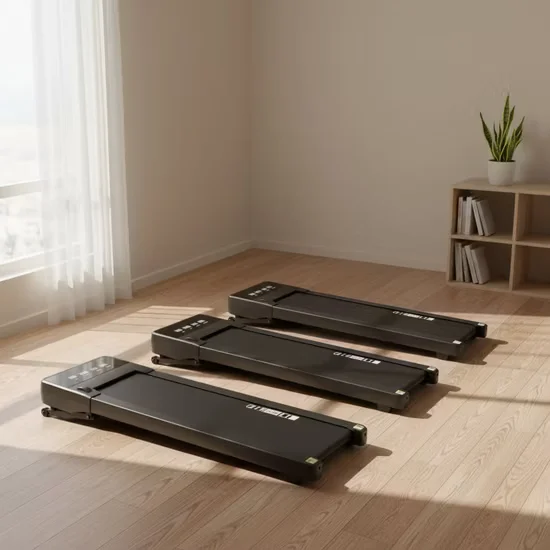
Sub-35dB Whisper-Quiet Drive — The DC motor and cushioned belt system keep walking noise below conversation level, making this treadmill suitable for shared residential floors and boutique hospitality zones.
Technical Specifications
| Parameter | Value |
|---|---|
| Designation | W04H1 |
| Motor Type | DC |
| Speed Range | 1–6 km/h |
| Maximum Speed | <15 km/h |
| Incline | Auto-Incline (Electric) |
| Running Surface | 1000 × 400 mm |
| Console Type | LED Screen (Speed / Distance / Time / Calories) |
| Programs | 6 Preset Programs |
| Product Dimensions | 1250 × 520 × 125 mm |
| Net Weight | 100–160 kg |
| Foldable | Unfolded (Fixed Frame) |
| Remote Controller | Included |
| Certification | CE, RoHS |
Application Suitability
| Deployment Scenario | Typical Use |
|---|---|
| Hotel fitness center on guest room floors | Low-speed walking sessions during early morning and late evening hours with minimal noise transfer to adjacent rooms |
| High-end residential home gym | Daily walking routines in shared-wall apartments or condominiums where acoustic privacy matters |
| Corporate wellness room | Moderate-duration walking breaks for employees during work hours in enclosed office environments |
| Boutique fitness studio recovery zone | Active recovery walking between high-intensity training blocks in compact auxiliary spaces |
| Assisted living and rehabilitation facility | Supervised low-speed walking programs with auto-incline adjustment for graduated intensity |
Why Noise Complaints Reach the Front Desk Before Maintenance Does
A walking treadmill with controlled speed output and isolated motor housing prevents the low-frequency hum that travels through structural slabs.
Guest complaints about treadmill vibration rarely mention decibel levels directly. They describe a persistent hum that bleeds through the ceiling from the fitness room above. This auto-incline electric walking treadmill W04H1 addresses that transfer path with a DC motor that operates at lower rotational speeds and a fixed frame that eliminates folding-hinge rattle [NEED_CITE: structural noise transfer mechanisms in multi-story commercial buildings]. When a facility sits directly above occupied rooms, motor vibration becomes a structural concern, not an acoustic one.
Where This Treadmill Fits in a Mixed-Cardio Floor Plan
The W04H1 fills the low-intensity walking station in a cardio zone, complementing high-speed treadmills and ellipticals that serve runners and interval-training members. Its 1000 × 400 mm running surface accommodates walking gait without demanding the footprint of a full-size commercial treadmill, making it practical for satellite fitness rooms and narrow corridor deployments. The six preset programs and remote controller allow users to adjust pace and incline without breaking stride, which matters when the equipment sits in unsupervised hotel or corporate settings.
Continuous Duty and the Envelope Around the Motor
A DC motor at this speed range suits facilities expecting two to four hours of daily walking use rather than continuous all-day traffic. The fixed frame and compact footprint reduce the ventilation envelope needed around the unit, though rear clearance must still allow adequate heat dissipation from the motor compartment [NEED_CITE: DC motor thermal management in enclosed fitness spaces]. Deployments on upper floors should account for both airborne noise through ceiling assemblies and structure-borne vibration through slab connections. Voltage requirements must match local supply standards before the unit ships to avoid transformer workarounds after arrival.
How the Drive System and Incline Mechanism Interact
The DC motor delivers consistent torque across the 1–6 km/h range without the high-frequency whine associated with undersized AC alternatives. Electric auto-incline adjustment allows the running surface to shift gradient under load, which demands a motor and gearbox combination rated for both walking resistance and incline positioning simultaneously. The LED console displays speed, distance, time, and calorie estimates without touchscreen complexity, reducing both power draw and potential failure points in light-commercial environments. The included remote controller enables mid-session adjustment of speed and incline, removing the need for users to reach for the console during walking intervals.
The Cost Hidden Behind Underspecified Drive Components
Facilities that install domestic-grade walking treadmills in commercial environments typically see motor failures within the first season of operation. The replacement cycle creates downtime that compounds member frustration, especially in hotel settings where the fitness room is marketed as an amenity. Noise complaints from adjacent occupied spaces often force management to restrict operating hours, undermining the twenty-four-hour access that modern hospitality brands promise [NEED_CITE: commercial warranty exclusions for light-duty equipment in public facilities]. Voltage mismatches discovered after shipment add electrical conversion costs that erode project margins.
What This Product Line Brings to Your Deployment
Every W04H1 unit passes a 10,000-hour durability protocol covering motor thermal cycles, belt tension retention, and incline mechanism repeatability before it leaves the assembly line. The compact 1250 × 520 × 125 mm footprint allows tight spacing in cardio zones while maintaining the lateral clearance required for safe walking entry and exit. OEM customization extends to console labeling and program naming, so hotel-branded facilities can align equipment interfaces with property identity. The six-series cardio family means walking treadmills, ellipticals, and climbers can all source from one manufacturing line with consistent design language and spare-parts logistics.
Documentation & Test Records
- CE declaration of conformity covering electrical safety and EMC requirements
- EN 957 test report validating structural integrity under repeated user loading
- ISO 9001 certificate confirming quality management system compliance
- RoHS compliance documentation for restricted substance limitations
- Noise level test record measured under simulated walking conditions
- Motor specification sheet with thermal duty cycle data
- Installation and commissioning guide with wiring diagrams
Installation, Commissioning & Maintenance
- Verify floor levelness within tolerance before placing the 1250 × 520 mm frame to prevent belt drift
- Maintain minimum rear clearance behind the DC motor housing for thermal exhaust
- Confirm voltage and plug standard match local supply before initial power connection
- Run the auto-incline mechanism through full range during commissioning to verify limit switches
- Inspect belt tracking and tension after the first thirty days of operation
- Clean the LED console surface with non-solvent wipes to protect display coating
How to Scope Your Deployment
Provide your cardio zone square footage and planned equipment count so we can generate a 3D layout addressing sightlines, member flow, and HVAC integration around each unit. Specify expected daily walking hours to confirm the DC motor duty cycle matches your operational profile. Identify the deployment floor and adjacent occupied spaces so we can verify noise and vibration isolation requirements. Confirm target market voltage and plug standards, and indicate whether console data needs to integrate with your facility management platform.
Frequently Asked Questions
Q: How do I determine whether a DC motor suits my facility’s daily usage pattern?
A: DC motors perform well in facilities expecting moderate daily walking use, typically two to four hours of active runtime. They offer quieter operation at lower speeds compared to AC alternatives, which matters in noise-sensitive environments like hotel guest floors. If your facility anticipates continuous all-day treadmill use with back-to-back users, discuss higher-duty motor options during the specification phase to ensure long-term reliability.
Q: What is the difference between peak and continuous horsepower in walking treadmill specifications?
A: Peak horsepower describes the maximum output a motor can sustain for brief intervals during acceleration or incline changes. Continuous horsepower reflects what the motor delivers during steady-state walking operation over extended periods. For deployment longevity, continuous duty rating matters more than peak figures, because the motor spends most of its operating life under sustained load rather than short bursts.
Q: How should I match treadmill noise levels to deployment locations in a building?
A: Upper-floor installations directly above occupied rooms require equipment with isolated motor mounts and cushioned belt systems to minimize structure-borne vibration. Ground-floor or basement fitness rooms have more acoustic flexibility. Request the noise level test report and share your floor plan during specification so we can identify which positions in your cardio zone demand the strictest noise performance.
Q: Can the console data from this treadmill integrate with facility management software?
A: The LED console on this model displays essential workout metrics including speed, distance, time, and calories. For facilities requiring data sync with member apps or management platforms, discuss console upgrade options during the inquiry phase. IoT-enabled touchscreens with app connectivity are available across the product line for deployments where usage tracking and member engagement dashboards are priorities.
Q: What voltage and plug considerations apply before shipping to an international destination?
A: Electrical standards vary significantly across markets, and mismatches discovered after container arrival create costly delays and conversion work. Specify your target country and site voltage during the quotation phase so the motor, control board, and plug configuration ship correctly. Our team verifies compatibility before production to ensure each unit connects to local supply without additional transformers or rewiring.


![Mt026m Electric Fold Fitness Home Use Treadmill for Fat Burning [WARN] draft identifier mismatch](https://bicksport.com/wp-content/uploads/2026/08/mt026m-electric-fold-fitness-home-use-treadmill-for-fat-burning-warn-draft-identifier-mismatch-738bd4.webp)
![Anti-Tipping Mt296 Electric Treadmill for Home Fitness Running [WARN] draft identifier mismatch](https://bicksport.com/wp-content/uploads/2026/08/anti-tipping-mt296-electric-treadmill-for-home-fitness-running-warn-draft-identifier-mismatch-f67a1d.webp)