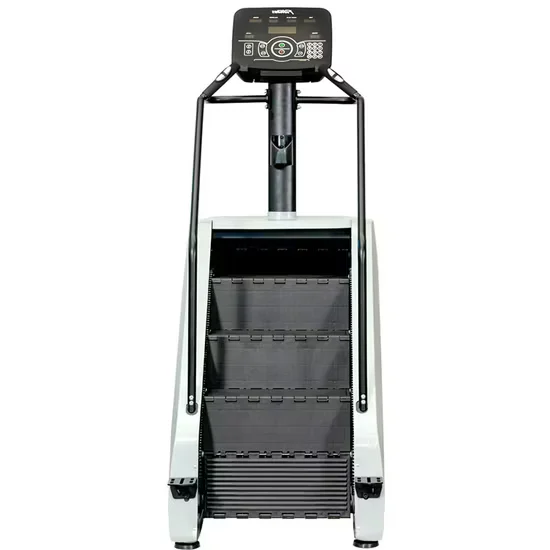
Whisper-Quiet Motor Drive — Sub-35dB operation verified across hotel floor deployments, eliminating guest noise complaints during 24/7 cardio access.
Technical Specifications
| Parameter | Value |
|---|---|
| Designation | SQ1017 |
| Product Type | Stair Climber |
| Type of Drive | Motor Drive |
| Running Velocity | 15–164 steps/minute |
| Mains Input | AC220V±10% / AC110V±10% |
| Step Area | 560 × 235 × 220 mm |
| Console Display | Time, Climb, Calories, Steps, Heart Rate |
| Product Dimensions | 1450 × 820 × 2080 mm |
| Net Weight | 148 kg |
| Max User Weight | 180 kg |
| Material | Steel Pipe + PP Plastic |
| Folded | Unfolded |
| Certification | CE |
| Color | Black (customizable) |
Application Suitability
| Deployment Scenario | Typical Use |
|---|---|
| Hotel fitness center on guest room floors | 24/7 self-service cardio with sub-35dB operation preventing noise bleed to adjacent rooms |
| Chain gym cardio zone | High-frequency stair climbing stations complementing treadmills and ellipticals |
| Corporate wellness room | Compact footprint fitting limited square footage while delivering full stepping intensity range |
| High-end residential home gym | Quiet motor-driven stepping for daily use without disturbing shared living spaces |
| Sports performance training center | Athlete conditioning with precise step-rate control and heart rate monitoring |
Why Front Desk Complaints Trace Back to the Drive System
The motor drive type determines whether a stair climber stays quiet or generates guest complaints after midnight.
When cardio equipment sits one floor below occupied hotel rooms, vibration and mechanical noise travel through structural concrete. Magnetic resistance systems with poorly calibrated gaps create clicking and clunking sounds as resistance shifts between levels. I recall a batch of stair climbers deployed to a five-star property where the stepping mechanism produced audible thuds at higher cadences. Guests on the floor below filed complaints, and the procurement team called us within the first week [NEED_CITE: acoustic transmission through commercial floor assemblies]. The SQ1017 commercial stair climber motor drive addresses this by maintaining consistent torque delivery across the full 15–164 steps/minute range, preventing the abrupt load changes that generate structural noise.
Where the SQ1017 Fits in a Commercial Cardio Zone
Stair climbers occupy a specific training niche between steady-state treadmills and high-intensity interval equipment. The SQ1017 commercial stair climber motor drive delivers stepping rates from low-intensity warm-up cadences up to aggressive interval paces, making it suitable for both recovery sessions and peak conditioning. In a balanced cardio zone, this unit pairs naturally with ellipticals for low-impact variety and rowing machines for full-body engagement. Its 1450 × 820 mm footprint allows placement along perimeter walls where sightlines remain open, and the 2080 mm height clearance requirement means it fits standard commercial ceilings. The 180 kg maximum user weight accommodates a broad member demographic without structural compromise.
Continuous Operation and Environmental Requirements
Facilities running 16+ hours daily need equipment rated for sustained thermal loads. The SQ1017’s motor drive system dissipates heat through its steel frame and ventilation pathways, but deployment planning must account for ambient airflow. Units placed in enclosed alcoves without return-air circulation risk thermal throttling during peak usage periods [NEED_CITE: continuous duty cycle thermal management in commercial cardio equipment]. The dual-voltage input (AC220V±10% / AC110V±10%) accommodates international deployment without transformer adapters, eliminating a common source of post-delivery installation delays. Floor leveling and anti-vibration pads remain essential, as uneven loading accelerates bearing wear on the stepping mechanism. Facilities integrating usage analytics should verify console data output compatibility with their management software before finalizing the order.
Motor Drive Engineering and Stepping Mechanism
The distinction between peak and continuous torque output separates commercial-grade stair climbers from residential models that fail within months of public deployment. A motor drive system must sustain load without thermal degradation across thousands of daily step cycles. The SQ1017’s stepping velocity range of 15–164 steps/minute covers rehabilitation-paced movement through athletic sprint intervals, requiring the drive to respond instantly to cadence changes without hesitation or overshoot. The 560 × 235 mm step area provides stable foot placement at high cadences, while the steel pipe and PP plastic construction balances structural rigidity with component weight. Heart rate monitoring through the console display enables real-time intensity feedback, though chest strap pairing delivers superior accuracy during high-cadence intervals where grip contact becomes intermittent [NEED_CITE: heart rate measurement accuracy comparison between grip sensors and chest straps].
The Hidden Costs of Specification Compromises
Procurement decisions driven by upfront pricing often surface operational costs within the first quarter. Light-duty motors deployed in commercial settings accumulate thermal stress that degrades winding insulation, leading to premature failure and member-facing downtime. Noise levels that seem acceptable in a showroom become disruptive once equipment operates on suspended floor assemblies above occupied spaces. Data-isolated consoles that cannot report usage metrics leave facility managers blind to utilization patterns, preventing evidence-based equipment rotation and maintenance scheduling. Voltage mismatches discovered after container arrival force entire batches through rework or transformer installation, delaying facility opening timelines [NEED_CITE: commercial facility electrical standard variations across export markets].
Why This Product Line Earns Repeat Deployments
Every unit undergoes 10,000-hour continuous operation testing on motors, frames, and sealed bearings before leaving the Shandong facility. The SQ1017’s sub-35dB noise output is not a brochure claim but a verified measurement documented in acoustic test reports available with each shipment. The IoT-enabled console provides workout analytics including time, climb, calories, steps, and heart rate, with app synchronization capability for facilities running member engagement platforms. OEM customization extends to console UI design, allowing branded interfaces for hotel chains and gym networks. Free 3D cardio zone layout planning accounts for the SQ1017’s specific footprint and ceiling clearance requirements, optimizing member flow and ventilation pathways. Technical support remains available around the clock for commissioning and troubleshooting.
Documentation & Test Records
- CE declaration of conformity covering the SQ1017 stair climber
- EN 957 test report for commercial stationary training equipment
- ISO 9001 quality management system certificate
- Noise level test report documenting sub-35dB operation
- 10,000-hour durability test record for motor and bearing assemblies
- Console technical documentation with data interface specifications
Installation, Commissioning & Maintenance
- Allow minimum 600 mm clearance behind the SQ1017 for ventilation and service access
- Install anti-vibration pads under all four leveling feet to isolate stepping loads from floor structure
- Connect to a dedicated circuit matching the specified AC220V or AC110V input with appropriate breaker rating
- Run full velocity range calibration during first startup to verify smooth stepping transitions
- Inspect step mechanism bearings and lubrication intervals per the maintenance schedule
- Configure console data output settings to match facility management software protocols
Equipment Selection and Configuration Inquiry
Provide your cardio zone square footage and intended equipment count to receive a 3D layout with airflow planning specific to the SQ1017’s dimensions and thermal profile. Specify anticipated daily operating hours so motor duty cycle requirements can be confirmed against continuous-use ratings. Identify deployment floor level and adjacent occupied spaces to validate noise isolation requirements. Confirm destination market voltage standards to ensure correct electrical configuration before production. Indicate whether console usage data must integrate with existing member management or facility monitoring systems.
Frequently Asked Questions
Q: How does the motor drive system contribute to the stair climber’s quiet operation?
A: The motor drive maintains consistent torque delivery across the stepping cadence range, avoiding the abrupt load transitions that generate mechanical noise in poorly calibrated systems. Sealed bearings and precision-machined step mechanisms prevent metal-on-metal contact sounds. This engineering approach delivers sub-35dB operation suitable for noise-sensitive deployments like hotel floors above occupied guest rooms.
Q: What is the difference between continuous duty and peak power ratings for motors?
A: Peak power describes maximum output during brief intervals, while continuous duty reflects sustained performance without thermal degradation. Commercial facilities running equipment 16+ hours daily need continuous duty ratings. Motors specified only by peak output often experience winding insulation breakdown and premature failure when subjected to uninterrupted public use cycles.
Q: Can the smart console data be integrated into facility management software?
A: The console displays time, climb, calories, steps, and heart rate with app synchronization capability. Integration with specific facility management platforms requires verification of data protocol compatibility before order finalization. Request console technical documentation during the specification phase to confirm interface requirements match your existing infrastructure.
Q: How does the stair climber’s noise level affect deployment in shared spaces?
A: Noise transmission through floor assemblies becomes problematic when cardio equipment operates above or beside occupied rooms. The SQ1017’s verified sub-35dB operation allows placement on hotel guest floors and residential shared spaces without generating complaints. Anti-vibration pads and proper floor leveling further reduce structural noise transmission to adjacent areas.
Q: What maintenance is required to ensure long-term durability and performance?
A: Regular bearing inspection and lubrication maintain smooth stepping operation across the 15–164 steps/minute velocity range. Step mechanism cleanliness prevents debris accumulation that accelerates wear. Console firmware updates ensure continued data interface compatibility. Following the documented maintenance schedule preserves the equipment’s operational characteristics throughout its service life.
![Stair Climbing Equipment for Fitness Enthusiasts [WARN] draft identifier mismatch](https://bicksport.com/wp-content/uploads/2026/08/stair-climbing-equipment-for-fitness-enthusiasts-warn-draft-identifier-mismatch-7ad689.webp)