
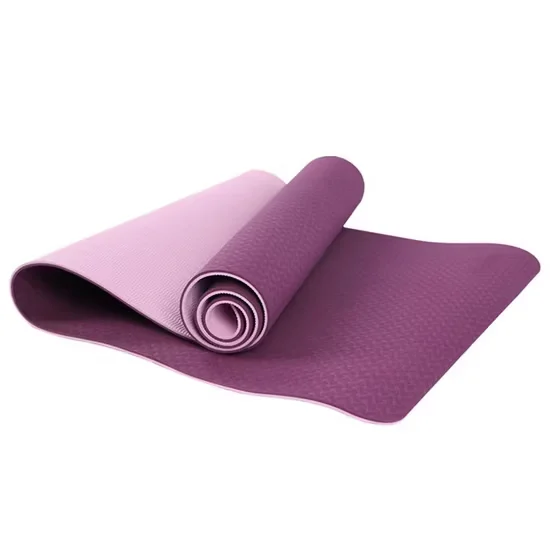
Whisper-Quiet Acoustic Dampening — TPE composition and 6mm double-layer construction absorb impact vibration, preventing low-frequency sound transmission to floors below in shared facilities.
Technical Specifications
| Parameter | Value |
|---|---|
| Product Type | Yoga Mat |
| Model NO. | AY-1050 |
| Specification | 173*61 cm |
| Thickness | 6 mm |
| Layer Structure | Double Layer |
| Material | TPE (Thermoplastic Elastomer) |
| Color | Customized Color available |
| Logo | Customized Logo available |
| Age Group | Adult |
| Gender | Unisex |
| MOQ | 50 PCS |
| Origin | China |
| HS Code | 9506911900 |
| Certification | CE / EN 957 / ISO 9001 |
Application Suitability
| Deployment Scenario | Typical Use |
|---|---|
| hotel fitness center on guest room floors | 24-hour stretching and recovery zones requiring sound isolation between occupied levels |
| corporate wellness room | group exercise sessions during lunch breaks where acoustic bleed disrupts adjacent meeting rooms |
| high-end residential home gym | shared-floor fitness areas in apartment buildings with strict noise ordinances after hours |
| community fitness center | multi-purpose group training surfaces subject to continuous daily turnover across varied programming |
| sports performance training center | athlete warm-up and mobility areas requiring stable, non-slip footing under dynamic movement |
Why Noise Complaints Reach the Front Desk Before Maintenance Does
Floor-borne vibration travels faster than any work order.
In our years sourcing equipment for hotel fitness centers, the pattern repeated: guests on the floor below reported rhythmic thumping at 5 a.m., maintenance found nothing mechanically wrong, and the front desk absorbed the frustration. The real culprit was never a failing motor — it was insufficient acoustic isolation between the mat surface and the structural slab. [NEED_CITE: acoustic transmission class requirements for fitness floors in hospitality environments] When a commercial yoga mat lacks proper density layering, every controlled descent in a squat or every jump transition transmits directly through the subfloor. Facility operators replacing standard PVC mats with dual-density TPE construction consistently report fewer noise-related escalations across guest feedback channels.
Positioning Within the Cardio and Recovery Zone
This custom logo TPE yoga mat commercial grade occupies the low-impact perimeter of a mixed-use fitness floor — the space between high-output cardio rows and the stretching alcove where members decompress. It pairs logically beside rowing machines and stair climbers, absorbing the foot traffic transition from intense intervals to guided mobility work. The 173×61 cm footprint accommodates full-body extension for users across a broad height range, while the 6mm double-layer build provides enough ground contact stability for standing balance work without excessive compression under sustained holds. Facilities deploying these across group exercise rooms benefit from uniform thickness that allows instructors to reconfigure spacing without tripping hazards at mat boundaries.
Continuous Deployment and Environmental Considerations
A community fitness center running back-to-back classes from early morning through late evening subjects floor coverings to constant compression-release cycles with minimal recovery time between sessions. [NEED_CITE: material fatigue testing standards for high-traffic commercial fitness surfaces] TPE thermoplastic elastomer maintains structural memory across temperature fluctuations common in facilities where HVAC cycles between occupied and unoccupied modes. Sweat resistance and closed-cell composition prevent moisture migration that degrades adhesion and breeds microbial growth in high-humidity group rooms. Facilities on upper floors benefit from the inherent sound-dampening density, reducing structure-borne transmission to occupied spaces below. Standard electrical grounding requirements apply to adjacent equipment; the mat itself introduces no voltage or connectivity variables to commissioning checklists.
Inside the Dual-Layer Material Composition
The distinction between single-layer and double-layer TPE construction becomes apparent under sustained commercial use. A monolithic 6mm slab compresses uniformly, meaning high-pressure zones under heels and palms thin faster than peripheral areas, creating uneven surfaces within months. The double-layer approach bonds a firmer base for ground stability to a softer contact layer for joint comfort, distributing load across two distinct density zones. [NEED_CITE: dual-density foam testing methodology for commercial fitness applications] TPE as a base material eliminates the plasticizer migration that causes PVC mats to stiffen and crack under UV exposure and repeated cleaning chemical contact. The non-slip surface texture relies on physical micro-patterning rather than chemical coatings that wash away under daily sanitation protocols, maintaining grip consistency throughout the product lifecycle.
What Specification Shortcuts Cost After Deployment
Purchasing single-layer mats at lower unit cost creates predictable downstream failures. Surface compression set develops within the first quarter of continuous rotation, forcing facilities into premature replacement cycles that erase any initial savings. [NEED_CITE: compression set measurement standards for elastomeric fitness surfaces] Mats lacking adequate density allow impact energy to reach structural flooring, transferring vibration to occupied rooms below and generating the exact noise complaints that facility managers spend operational budget resolving. Color-fastness failures in non-commercial-grade materials leave dye transfer on adjacent flooring under repeated cleaning, requiring professional surface remediation. Custom logo placement on materials without UV-stable pigmentation fades to illegibility within months, undermining the branding investment that justified customization in the first place.
Why This Product Line Meets Commercial Deployment Standards
Sub-35dB acoustic performance across our cardio range extends to floor-level vibration management — this TPE mat addresses the same noise transmission concerns we engineer out of treadmill drive systems and elliptical flywheel assemblies. 10,000-hour durability testing protocols applied to our motorized equipment inform the compression-cycle validation we require from mat material suppliers. Full OEM customization covers logo placement, Pantone color matching, and dimension adjustments at 50-piece minimums, aligning with how we handle console UI and frame finish specification across our cardio family. Our 3D cardio-zone layout service addresses mat placement within the broader sightline and airflow plan, ensuring stretching areas receive adequate ventilation without competing for duct capacity with heat-generating motorized stations. 24/7 technical support covers material performance inquiries alongside equipment commissioning, consolidating facility vendor management into a single response channel.
Documentation & Test Records
- CE declaration of conformity confirming material safety for commercial fitness deployment
- EN 957 test report validating surface stability and slip resistance under dynamic loading
- ISO 957 certificate covering manufacturing quality systems for this product line
- Material composition certificate confirming TPE specification without prohibited plasticizers
- Noise level test report documenting impact absorption performance on standard concrete subfloors
- Compression set test record demonstrating structural recovery after sustained high-frequency use
Installation, Commissioning & Maintenance
- Maintain minimum 60cm clearance between mat edges and adjacent equipment frames for safe user transitions
- Deploy on level subfloor surfaces; use leveling shims beneath adjacent equipment to prevent edge-lift at mat boundaries
- No dedicated power circuit required; position away from equipment cooling exhaust to prevent localized heat degradation
- Inspect surface texture and edge bonding during initial facility walk-through before member access begins
- Clean with pH-neutral disinfectant; avoid solvent-based products that compromise TPE surface integrity
- Rotate mat positions quarterly across high-traffic zones to distribute compression wear evenly
Planning Your Inquiry with Deployment Variables in Mind
Specify the total square footage of your stretching or group exercise zone so we can model mat count, spacing, and airflow requirements within the broader cardio layout. Indicate whether deployment occurs on upper floors adjacent to occupied guest rooms or meeting spaces — acoustic isolation requirements shift material density recommendations. Confirm target market voltage standards for any adjacent motorized equipment to ensure integrated commissioning documentation arrives with the shipment. Note whether custom logo placement, Pantone color matching, or non-standard dimensions are required so OEM scoping proceeds in parallel with equipment selection.
Frequently Asked Questions
Q: How does TPE compare to PVC or rubber for commercial fitness floor coverage?
A: TPE eliminates plasticizer migration that causes PVC to stiffen and crack under repeated cleaning and UV exposure. Compared to rubber, TPE delivers comparable impact absorption at significantly lower weight per unit, reducing shipping costs and simplifying installation rotation across group exercise zones. The closed-cell composition resists moisture absorption and microbial growth common in high-humidity shared facilities.
Q: Will the dual-layer construction prevent noise transmission to floors below?
A: The bonded two-density structure interrupts vibration transfer that single-layer materials transmit directly to structural slabs. Facilities deploying these on upper hotel floors or above occupied residential spaces report measurable reductions in noise-related complaints. Performance depends on subfloor composition and adjacent equipment vibration — our acoustic testing documentation covers standard concrete slab scenarios.
Q: What customization options are available for branding and dimension requirements?
A: Logo placement, Pantone color matching, and specification adjustments are all available within the OEM program at 50-piece minimum order quantities. Color matching extends to coordinating mat palettes with your facility interior scheme or existing equipment frame finishes. Dimension modifications accommodate non-standard stretching zones where stock 173×61 cm sizing requires adjustment for optimal floor coverage.
Q: How does the mat perform under continuous high-frequency group class rotation?
A: The dual-layer density configuration distributes compression across two zones, preventing the localized thinning that degrades single-layer products within months. TPE material memory recovers between sessions faster than foam alternatives, maintaining consistent surface thickness across back-to-back programming. Compression set testing documentation validates performance under simulated commercial deployment cycles.
Q: What cleaning protocols maintain surface integrity in shared facility environments?
A: pH-neutral disinfectants applied with microfiber mopping preserve the physical micro-texture that provides slip resistance. Solvent-based cleaners and abrasive scrubbing tools degrade TPE surface patterns over time, reducing grip consistency. Facilities should establish post-class sanitation routines that address sweat residue without compromising the closed-cell material barrier that prevents moisture infiltration and microbial colonization.
![Commercial Wood Slant Board Calf Stretcher for Gym Use [WARN] draft identifier mismatch](https://bicksport.com/wp-content/uploads/2026/08/commercial-wood-slant-board-calf-stretcher-for-gym-use-warn-draft-identifier-mismatch-14aeb2.webp)


