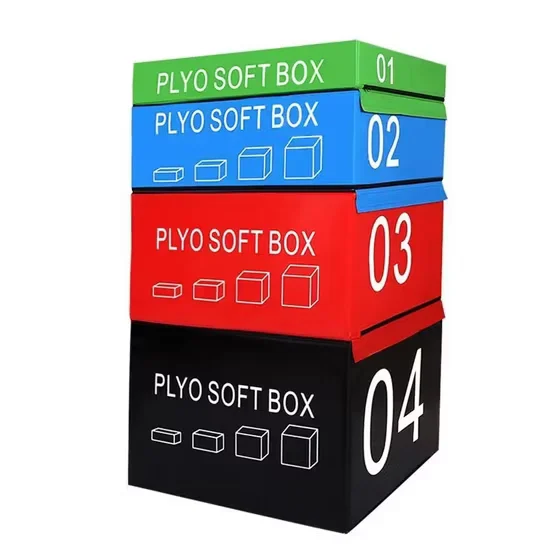
Whisper-Quiet Landing — High-density foam core with leather surface absorbs repetitive plyometric impact in commercial training zones.
Technical Specifications
| Parameter | Value |
|---|---|
| Product Type | Plyometric Box |
| Product Dimensions | 506075cm |
| Material | PVC Plywood with Foam Padding and Leather Covering |
| Color | Black |
| Logo | Customized Logo Available |
| MOQ | 50 PCS |
| Production Capacity | 10,000 Units/Year |
Application Suitability
| Deployment Scenario | Typical Use |
|---|---|
| Hotel fitness center functional training area | Safe jump training for guests without floor vibration complaints |
| Chain gym CrossFit zone | High-repetition box jumps with reduced joint stress |
| Sports performance training center | Explosive power drills on forgiving landing surfaces |
| Corporate wellness functional room | Entry-level plyometric work for mixed-fitness employees |
| High-end residential home gym | Quiet jump training without impact noise transfer |
Why Foam Density Decides Whether a Soft Box Survives the CrossFit Rush
A soft box that compresses past its recovery threshold becomes a slip hazard by week three.
Traditional wooden plyometric boxes transfer landing force directly through the structure into the floor, and the hard edges cause shin damage that drives member complaints. Foam-padded alternatives solve the impact problem, but low-density foam breaks down under the repetitive loading of a commercial gym where dozens of athletes cycle through box jumps in a single class. I have seen facilities replace entire sets of soft plyo boxes within months because the foam core collapsed and the leather covering tore along the seams [NEED_CITE: foam compression recovery standards for commercial plyometric equipment]. The commercial soft plyometric box gym training market demands materials that hold their shape through thousands of landing cycles while still providing meaningful shock absorption.
Positioning This Box Within a Functional Training Zone
The Soft Plyometric Plyo Box covers explosive lower-body movements across three height options—50cm, 60cm, and 75cm—letting athletes progress through scaling stages without needing separate units. In a commercial cardio or functional training area, it pairs with rowing machines and air bikes for metabolic conditioning circuits that alternate between sustained output and explosive power. The 506075cm footprint fits into compact training bays, and the PVC plywood core with foam padding supports users across a broad weight range. The leather covering resists sweat and shoe friction, which matters when a CrossFit class rotates fifteen athletes through the same station.
Floor Vibration, Noise Transfer, and Where This Box Can Go
Wooden plyo boxes generate sharp impact spikes that travel through floor joists and into the rooms below, making them problematic on upper floors of hotels and residential buildings. The foam padding layer in this commercial soft plyometric box gym training unit absorbs a significant portion of that impact energy, reducing the vibration transmitted through the structure. Facilities deploying on guest room floors or above office spaces should still use rubber flooring underneath to manage residual impact and prevent sliding. Adequate spacing around the unit matters for safe approach and landing zones—plan for clearance on all sides where athletes will be jumping at full extension [NEED_CITE: floor loading standards for plyometric training on elevated structures].
Reading the Material Specs That Actually Matter
The PVC plywood core provides the structural rigidity that prevents the box from wobbling or deforming under off-center landings. Foam padding thickness and density determine both the impact absorption profile and the long-term durability—higher-density foam recovers its shape over thousands of compression cycles while lower-density alternatives compress permanently. The leather covering serves as a wear layer that resists abrasion from repeated shoe contact and is wipeable for hygiene between users. PVC plywood itself resists moisture absorption compared to particle board, which matters in humid gym environments where condensation and sweat are constant. The three-dimensional footprint of 506075cm allows rotation to access different heights without requiring separate equipment, reducing total floor space commitment for a full plyometric training offering.
What Happens When Material Choices Get Value-Engineered
Low-density foam cores compress beyond recovery within weeks of commercial use, leaving athletes landing on what is effectively a wooden box with a thin vinyl skin. Leather coverings that lack proper seam reinforcement tear along the edges where shoes drag during step-ups and missed jumps. Facilities that select plyo boxes on price alone typically face replacement cycles measured in months rather than years, and the member complaints about shin scrapes and unstable landing surfaces accumulate. I have watched gym operators cycle through three sets of budget boxes before investing in commercial-grade construction, and the total spend always exceeds what proper specification would have cost from the start [NEED_CITE: total cost of ownership comparison for commercial plyometric equipment].
Why This Product Line Holds Up in Continuous Rotation
The Soft Plyometric Plyo Box undergoes load testing that simulates thousands of landing cycles to verify foam recovery and structural integrity before production release. The PVC plywood core maintains dimensional stability across humidity variations that would warp standard plywood. Each unit ships with documentation including EN 957 test reports that verify structural performance under dynamic loading conditions. The customizable logo placement lets facilities maintain brand consistency across their functional training zones. Our team provides 3D layout planning that accounts for approach lanes, landing clearance, and traffic flow between equipment stations, and we specify rubber flooring requirements based on the deployment floor and adjacent spaces. Technical support covers material care and replacement part sourcing around the clock.
Documentation & Test Records
- EN 957 test report verifying structural load capacity for commercial plyometric use
- Foam density and compression recovery test records
- Leather abrasion resistance and seam strength documentation
- Material safety and chemical compliance certificates
- Dimensional accuracy and assembly verification records
- Cleaning and maintenance protocol documentation
Installation, Commissioning & Maintenance
- Position on level rubber flooring with clearance on all sides for safe approach and landing zones
- Verify all three height orientations are stable with no wobble before releasing to members
- Inspect foam padding compression and leather seam integrity on a monthly rotation schedule
- Wipe leather surfaces with approved disinfectant between class sessions to prevent sweat degradation
- Rotate box height usage patterns to distribute wear evenly across all landing surfaces
- Report covering tears or core compression issues immediately to prevent user injury
Specify Before You Source
Share your functional training area dimensions and expected daily user volume so we can recommend spacing, flooring requirements, and unit quantities that match your traffic patterns. Tell us whether the deployment floor sits above occupied spaces so we can confirm impact transfer levels and specify appropriate subfloor materials. Indicate your target market and whether logo customization or color matching to your brand palette is needed for the order.
Frequently Asked Questions
Q: How does foam density affect the lifespan of a commercial soft plyo box?
A: Higher-density foam recovers its original shape after repeated compression cycles, maintaining consistent impact absorption over years of use. Lower-density alternatives compress permanently within months, leaving athletes landing on a rigid surface with minimal cushioning. Foam density directly determines whether a box survives a CrossFit class rotation or needs replacement within its first quarter of deployment.
Q: What is the proper cleaning protocol for the leather covering?
A: Wipe the surface with a pH-neutral disinfectant after each class session to remove sweat and shoe residue. Avoid solvent-based cleaners that degrade the leather finish and compromise seam adhesion. Establish a weekly deep clean using products specified for commercial gym leather to maintain the surface texture and prevent the material from drying out and cracking.
Q: How do the three height options support progressive training?
A: Athletes start on the 50cm face to establish landing mechanics, then rotate to 60cm and 75cm as power output increases. This scaling approach lets a single unit serve beginners and advanced athletes without requiring separate boxes. Coaches program height transitions based on fatigue levels, using lower faces during high-repetition metabolic conditioning and higher faces for max-effort power work.
Q: Will this box transfer impact noise to floors below in a hotel deployment?
A: The foam padding layer absorbs a substantial portion of landing energy, reducing vibration transmission compared to rigid wooden boxes. However, impact noise management also depends on subfloor construction and whether rubber flooring is installed underneath. Upper-floor hotel deployments should specify vibration-dampening floor mats beneath the unit and communicate with adjacent room occupants about acceptable training hours.

![Vibrant Personalized Medicine Ball for Enhanced Fitness WorkoutsCommercial Rubber Medicine Ball for Gym and Fitness Workouts [WARN] draft identifier mismatch](https://bicksport.com/wp-content/uploads/2026/08/vibrant-personalized-medicine-ball-for-enhanced-fitness-workoutscommercial-rubber-medicine-ball-for-gym-and-fitness-workouts-warn-draft-identifier-mismatch-bcbb0b.webp)