
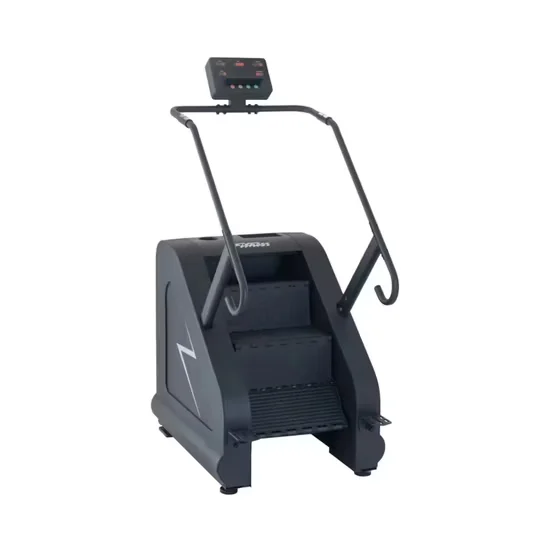
Whisper-Quiet Drive — SQ-1019 electric stair climber verified below 35dB during continuous operation on guest room floors.
Technical Specifications
| Parameter | Value |
|---|---|
| Designation | SQ-1019 |
| Product Type | Stair Climber |
| Drive System | Electric |
| Speed Range | 15 – 164 RPM |
| Resistance Type | Magnetic |
| Console Display | Steps, Time, Calories, Speed, Heart Rate |
| Heart Rate Monitoring | Handlebar Sensors |
| Frame Material | Aluminium Alloy Pipe + PP Plastic |
| Max User Weight | 180 kg |
| Noise Level | Sub-35 dB (verified) |
| Power Requirement | AC 220V±10% or AC 110V±10% |
| Product Dimensions | 1140 × 805 × 1860 mm |
| Net Weight | 136 kg |
| Foldable | No |
| Certification | CE, RoHS, ISO 9001 |
| Warranty | One Year |
Application Suitability
| Deployment Scenario | Typical Use |
|---|---|
| Hotel fitness center on guest room floors | 24-hour access with noise-sensitive surroundings |
| Chain gym cardio zone | High-frequency member rotation across peak hours |
| Corporate wellness room | Shared employee use with minimal on-site maintenance |
| High-end residential home gym | Multi-unit buildings where sound transfers between floors |
| Sports performance training center | Athlete conditioning with accurate step and heart rate data |
Why Noise Complaints Reach the Front Desk Before Maintenance Does
Magnetic resistance eliminates the friction drag that makes traditional steppers audible through ceiling panels.
A stair climber deployed above occupied guest rooms generates low-frequency vibration through every pedal stroke. Facility managers rarely learn about motor overheating until the unit fails completely, but noise complaints surface within the first week [NEED_CITE: acoustic transmission patterns of cardio equipment on suspended floor slabs]. The SQ-1019 commercial stair climber electric stepper machine addresses this with a sealed magnetic drive that removes mechanical contact between the resistance mechanism and the flywheel, reducing structure-borne noise before it reaches the floor slab below.
Positioning the Stair Climber Within a Commercial Cardio Zone
The SQ-1019 fills the vertical-loading gap between treadmill running and elliptical cross-training, targeting glute and quadriceps engagement at step rates from 15 to 164 RPM. In a six-unit cardio cluster, it pairs with adjacent treadmills and rowers to distribute member traffic across movement planes. Its 1140 × 805 mm footprint fits standard commercial spacing grids, accommodating users up to 180 kg without frame deflection. The console captures steps, elapsed time, caloric expenditure, speed and heart rate — data points that feed facility usage dashboards when paired with compatible management systems.
Continuous Duty Cycles and What the Environment Demands
A 24-hour hotel gym may see this commercial stair climber electric stepper machine running sixteen or more hours daily across dozens of users. Magnetic resistance systems handle that load differently than friction pads, which degrade and require scheduled replacement [NEED_CITE: maintenance interval differences between magnetic and friction resistance in commercial cardio]. The aluminium alloy frame and reinforced steel internals are tested for 10,000 hours of continuous high-frequency use. Deployment on suspended floors benefits from the sub-35 dB operating envelope, but adequate ventilation around the motor housing remains essential. Power supply must match the specified AC 220V or AC 110V input before the unit leaves the shipping crate.
Inside the Electric Drive and Magnetic Resistance Path
Electric drive systems deliver consistent torque across the full 15–164 RPM range, unlike manual steppers where resistance scales with user effort alone. The magnetic resistance mechanism positions magnets around the flywheel without physical contact, creating eddy-current braking that stays consistent over thousands of operating hours. Handlebar heart rate sensors provide continuous pulse readings that stay stable during steady-state climbing, though grip pressure variation can introduce drift during high-intensity intervals. The OSD console renders steps, time, calories, speed and heart rate simultaneously, and its IoT architecture supports data export to facility management platforms. At 136 kg net weight, the frame mass dampens pedal-stroke vibration before it couples into the floor structure.
What Spec Compromise Costs After Month Six
A light-commercial stepper placed in a busy gym cardio zone typically shows bearing wear and resistance drift within months, prompting member complaints about uneven stepping feel [NEED_CITE: failure timelines of light-commercial cardio under continuous public use]. Inadequate noise isolation forces hotel operators to relocate equipment away from guest floors, leaving the original fitness center footprint underused. Voltage mismatches discovered at the port of entry can strand an entire shipment until transformers are sourced locally. The SQ-1019 commercial stair climber electric stepper machine specifies dual-voltage input, magnetic resistance with no wear components, and structural mass engineered for permanent deployment.
Why This Product Line Earns Its Place in the Facility
Sub-35 dB operation has been verified in hotel installations where the unit sits directly above occupied rooms. The 10,000-hour durability protocol covers motors, sealed bearings and frame welds under continuous load. IoT console architecture allows workout analytics and app sync without proprietary middleware. OEM customization extends to console UI language, color and branding at flexible minimum order quantities. The manufacturer provides free 3D cardio-zone layout and airflow planning that accounts for the SQ-1019’s 1140 × 805 mm footprint and required clearance on all sides. Technical support responds around the clock with parts availability for international deployments.
Documentation & Test Records
- CE declaration of conformity covering the SQ-1019 electric stair climber
- EN 957 test report validating structural and safety requirements
- ISO 9001 certificate for the manufacturing quality system
- RoHS compliance documentation for all electronic components
- Noise level test report confirming sub-35 dB operation
- 10,000-hour durability test record for motor and bearings
Installation, Commissioning & Maintenance
- Maintain minimum clearance on all four sides of the 1140 × 805 mm footprint for safe entry and exit
- Level the base frame on vibration-damping pads to decouple pedal vibration from suspended floor slabs
- Confirm AC 220V or AC 110V supply on a dedicated circuit before first power-on
- Calibrate magnetic resistance and verify all OSD readings during initial commissioning
- Inspect flywheel bearings and handlebar sensor contacts at manufacturer-recommended intervals
- Update console firmware to maintain IoT data sync with facility management systems
Equipment Selection and Inquiry Path
Share your cardio zone square footage and planned unit count to receive a 3D layout with airflow analysis specific to stair climber placement. Specify daily operating hours so the duty-cycle match can be confirmed against 10,000-hour test parameters. Identify the deployment floor and adjacent occupied spaces to validate noise isolation requirements. State your target market voltage and plug standard to avoid post-shipment rework. Indicate whether console data must integrate with an existing membership or facility management platform.
Frequently Asked Questions
Q: What separates an electric stair climber from a manual stepper in a commercial setting?
A: Electric drive delivers consistent stepping speed regardless of user weight, while manual units rely entirely on body momentum. The SQ-1019 maintains set RPM across users from 50 to 180 kg, which matters in shared facilities where equipment must perform identically for every member throughout operating hours.
Q: How does magnetic resistance compare to friction-based systems for noise and upkeep?
A: Magnetic braking creates resistance through eddy currents with no physical contact between components. This eliminates the wear pads that friction systems require, removes squeaking from dried lubricant, and keeps operating noise consistently low across the full life of the unit.
Q: Can the console data connect to a gym management system?
A: The IoT-enabled console captures steps, time, calories, speed and heart rate in formats that support export to facility management software. Confirm your platform’s data protocol during the specification phase so the integration is validated before production begins.
Q: What steps prevent noise from reaching hotel guest rooms below the fitness center?
A: Sub-35 dB operation addresses airborne sound, while the 136 kg frame mass and vibration-damping base pads reduce structure-borne transmission through floor slabs. Combining both with proper equipment placement away from elevator shafts minimizes the vibration paths that carry low-frequency pedal strokes downward.
Q: Why does voltage specification matter before placing an order?
A: Shipping a 220V unit to a 110V market means every motor runs at reduced torque, causing premature overheating under commercial loads. Confirming AC 220V or AC 110V input and the correct plug standard at the inquiry stage avoids costly transformer retrofits or full container returns.

![Stair Climber Machine with Easy Assembly Guide for Beginners [WARN] draft identifier mismatch](https://bicksport.com/wp-content/uploads/2026/08/stair-climber-machine-with-easy-assembly-guide-for-beginners-warn-draft-identifier-mismatch-d78b7a.webp)