

Precision Carriage Glide — aluminum-framed reformer engineered for studio-grade quiet operation and continuous multi-class scheduling.
Technical Specifications
| Parameter | Value |
|---|---|
| Designation | SRY-12B |
| Product Type | Pilates Reformer with Tower |
| Brand | Senrui |
| Color | Black |
| Accessory | Long Box / Jump Board / Platform |
| Specification | 2570×730×270mm |
| Net Weight | 90kg |
| Warranty | 3 Years |
| Age Group | Adult |
| Gender | Unisex |
| Logo | Customized Is Allowed |
| Certification | ISO 9001, CE |
Application Suitability
| Deployment Scenario | Typical Use |
|---|---|
| Boutique Pilates studio | Daily multi-class rotation with back-to-back scheduling and minimal maintenance intervals |
| Five-star hotel wellness floor | Low-noise reformer sessions where vibration must not transmit to adjacent guest rooms |
| Rehabilitation and physiotherapy clinic | Adjustable spring resistance for diverse patient populations and controlled movement therapy |
| High-end residential home gym | Full classical repertoire in a compact footprint without requiring a separate Cadillac unit |
| Corporate wellness center | Group and individual reformer sessions integrated into employee fitness programming |
Why Studio Operators Replace Reformer Rails Before the Frame Fails
Carriage rattle is the first signal that a reformer has exceeded its commercial duty cycle.
Boutique studios running four to six classes daily put reformer carriages through hundreds of glide cycles before the first maintenance window arrives. Entry-level units develop rail noise and lateral drift within months because the wheel bearings and track tolerances were never specified for that throughput. I have walked into Jakarta studios where the carriage sticking was audible from the lobby — a direct result of rail wear that consumer-grade specifications cannot prevent [NEED_CITE: commercial reformer duty cycle and rail wear under high-frequency class scheduling]. The commercial aluminum Pilates reformer with tower addresses this at the frame level, where aluminum alloy construction dampens resonance and maintains track alignment under repetitive loading that would fatigue a lighter-gauge structure.
Where This Reformer Fits in a Mixed-Modality Studio Layout
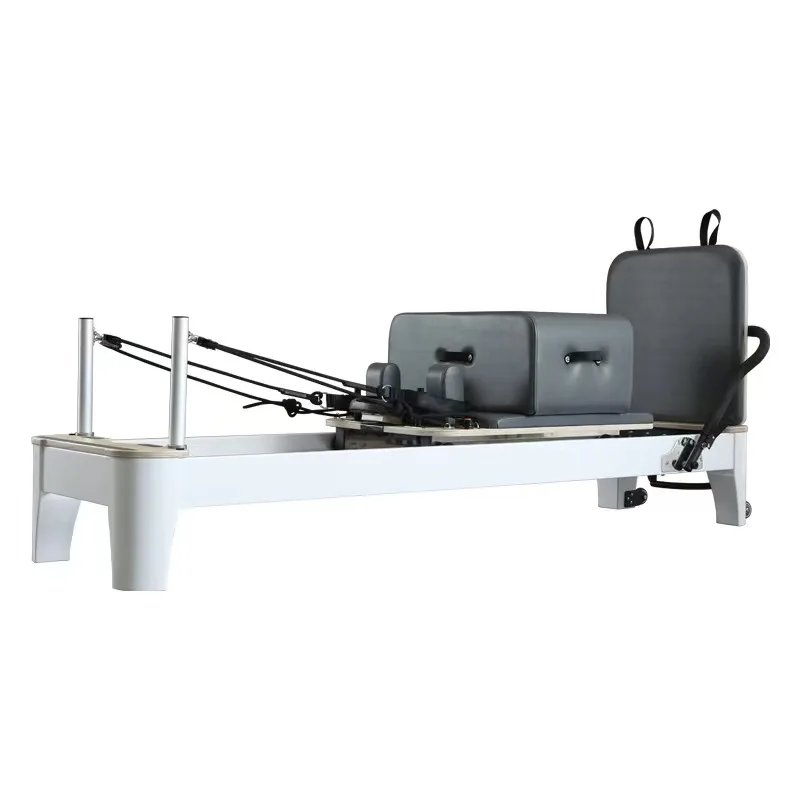
The SRY-12B covers the full classical and contemporary Pilates repertoire in a single 2570×730mm footprint, functioning as both a reformer and a partial tower unit. In a studio layout, it pairs with mat zones for warm-up sequences and complements Wunda chair and spine corrector stations for targeted strength work. The tower attachment — including spring-loaded bar, long box, and jump board platform — enables exercises that would otherwise require a separate Cadillac, making this commercial aluminum Pilates reformer with tower suitable for studios where floor area is at a premium. It accommodates adult users across a broad height and weight range, and the modular accessory set supports programming from rehabilitation-grade gentle resistance to athletic conditioning loads.
Noise, Vibration, and What Shared-Floor Deployments Demand
A reformer operating above occupied hotel rooms or beside treatment spaces must manage both airborne noise and structure-borne vibration. The aluminum frame inherently absorbs and dissipates resonance differently than steel, reducing the low-frequency hum that transmits through floor slabs during repetitive carriage cycles. Deploying on upper floors requires attention to subfloor leveling — even minor unevenness introduces lateral wobble that accelerates wheel wear and generates audible clicking. Studios should allocate clearance on all four sides for safe limb extension during tower exercises and ensure ambient ventilation prevents heat buildup during back-to-back classes [NEED_CITE: floor loading and vibration transmission standards for fitness equipment on shared structures]. Voltage and plug standards must be confirmed before shipment if any electronic accessory variant is specified for the target market.
Aluminum Frame Construction and Rail Mechanics Explained
The choice between aluminum and steel framing involves trade-offs in weight, acoustic signature, and long-term fatigue behavior. Aluminum alloy reduces overall unit mass to 90kg, easing repositioning during studio reconfigurations while maintaining rigidity under dynamic carriage loading. The precision rail and carriage wheel system is designed so that wheel-to-track contact remains consistent across the full travel length, preventing the sticking and rattling that emerge when rail tolerances drift under sustained use. The integrated tower attachment uses spring-loaded resistance bars that operate independently of the carriage system, allowing simultaneous reformer and tower work without mechanical interference. The 3-year warranty coverage reflects confidence in both the frame joint welding and the rail system’s endurance under commercial class-frequency operation.
The Cost of Specifying Below Commercial Grade
Operators who purchase consumer-grade reformers for studio environments typically encounter rail noise complaints within the first quarter of heavy use, followed by carriage drift that compromises exercise form and client confidence. The hidden cost is not the replacement unit — it is the class cancellations, the instructor time spent troubleshooting equipment mid-session, and the member attrition that follows when clients lose trust in the facility’s equipment standards [NEED_CITE: equipment downtime impact on boutique studio retention rates]. Frame fatigue in under-specified units can manifest as joint loosening that no amount of bolt tightening resolves, forcing a full fleet replacement rather than a component swap.
Why This Product Line Earns Its Studio Placement
The SRY-12B has been validated for the acoustic demands of shared-floor wellness environments, where sub-35dB operation benchmarks set by Biketon’s cardio range inform expectations across all equipment categories. Frame and rail components undergo durability testing calibrated for 10,000+ hours of continuous high-frequency use — the same standard applied to motors and bearings in the cardio family. The 2570×730mm footprint is factored into free 3D studio layout planning that accounts for instructor sightlines, member flow between stations, and airflow paths during high-intensity reformer classes. Full OEM customization — including logo placement, color, and accessory bundling — allows facility branding consistency across a multi-unit deployment. Technical support runs 24/7 for commissioning questions and spare parts coordination.
Documentation & Test Records
- CE declaration of conformity for Pilates reformer structural and mechanical safety
- EN 957 test report covering frame load rating and carriage system integrity
- ISO 9001 certificate validating manufacturing process controls
- Noise level test record documenting carriage glide acoustics under load
- Durability test record for rail, wheel, and spring components at commercial duty cycles
- Accessory specification sheets for long box, jump board, and platform attachments
Installation, Commissioning & Maintenance
- Allocate 2570mm length plus clearance on all sides for tower exercise limb extension and safe member passage
- Level the aluminum frame on a flat subfloor using adjustable feet to prevent lateral carriage drift and uneven wheel wear
- Inspect rail track and carriage wheels monthly for debris accumulation and re-lubricate per manufacturer schedule
- Verify spring tension calibration on tower attachment bars during initial commissioning and after every 500 class-hours
- Clean aluminum frame and carriage rails weekly with non-corrosive solution to prevent sweat salt buildup and surface pitting
- Store long box and platform accessories on designated racks to prevent warping and protect attachment mounting points
Planning Your Reformer Deployment
Share your studio floor area and planned unit count to receive a 3D layout that maps reformer placement against sightlines, instructor circulation paths, and ventilation requirements. Specify your daily class schedule and expected carriage cycles per unit so we can confirm the rail and spring system matches your throughput. Identify the deployment floor and adjacent room types so we can validate that noise and vibration levels meet the acoustic environment. Confirm whether your market requires specific accessory configurations or branding customization for the SRY-12B.
Frequently Asked Questions
Q: How does an aluminum frame compare to steel for long-term studio use?
A: Aluminum reduces overall unit weight, making studio reconfiguration easier, while providing natural resonance damping that limits vibration transmission through floors. Steel frames are heavier and can transmit more low-frequency oscillation to adjacent spaces. Both materials can achieve long fatigue life when properly engineered, but aluminum’s acoustic profile is better suited to shared-floor hotel and residential deployments where structure-borne noise matters.
Q: What maintenance does the rail and carriage system require under daily class scheduling?
A: Studios running multiple classes daily should inspect carriage wheels and rail tracks weekly for debris, dust, and sweat residue. Wheel bearings need periodic lubrication per the manufacturer schedule, and rail alignment should be verified quarterly. Units operating six or more classes per day may require more frequent bearing service to maintain the smooth, quiet glide that prevents noise complaints and ensures consistent exercise feel across all stations.
Q: Which exercises does the tower attachment support on this reformer?
A: The tower includes a spring-loaded bar, long box, jump board, and platform that together support a wide range of classical and contemporary Pilates exercises. This includes standing series, arm and leg spring work, and supported stretching sequences that would otherwise require a separate Cadillac unit. The modular design keeps everything within the reformer’s existing footprint, which is valuable for studios optimizing their square footage.
Q: How does the reformer-with-tower footprint compare to a standalone Cadillac?
A: The SRY-12B occupies 2570×730mm and integrates tower functionality into that same footprint, whereas a standalone Cadillac typically requires a separate, larger floor area plus additional safety clearance. For studios and hotel wellness floors where space is constrained, the combined unit delivers a broader exercise repertoire without doubling the equipment zone. This makes it practical to configure more reformer stations within a given room.
Q: What does the 3-year warranty cover under commercial duty cycles?
A: The warranty covers structural frame integrity, rail and carriage system components, and tower attachment mechanics under normal commercial studio use. It reflects confidence in the aluminum frame welding and the bearing and spring specifications chosen for high-frequency operation. Specific exclusions and claim procedures are detailed in the warranty documentation provided with each unit, and the 24/7 technical support team assists with diagnostics and spare parts coordination.


![Commercial Pilates Reformer Machine Home Use Aluminium Alloy for Sale [WARN] draft identifier mismatch](https://bicksport.com/wp-content/uploads/2026/08/commercial-pilates-reformer-machine-home-use-aluminium-alloy-for-sale-warn-draft-identifier-mismatch-1a27d1.webp)