
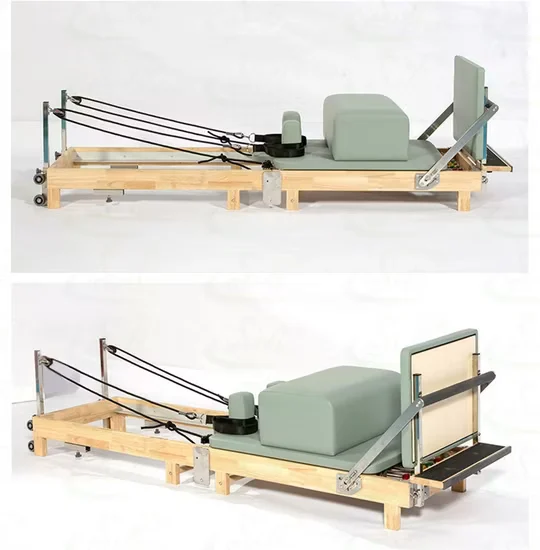
Acoustic Damping by Design — Solid wood chassis construction inherently suppresses structure-borne vibration during carriage travel, eliminating metallic resonance transfer to floors below in multi-occupancy deployments.
Technical Specifications
| Parameter | Value |
|---|---|
| Product Type | Pilates Reformer |
| Designation | SRY-11 |
| Material | Wood |
| Color | Solid Color |
| Accessory | Long Box / Jump Board / Platform |
| Foldable | Yes |
| Specification | 2400600350mm |
| Net Weight | 100kgs |
| Max User Weight | Commercial grade |
| Warranty | 3 Years |
| Age | Adult |
| Gender | Unisex |
| Logo | Customized Is Allowed |
| Customization | Available |
| HS Code | 9506911900 |
| Production Capacity | 80 Pieces/Month |
Application Suitability
| Deployment Scenario | Typical Use |
|---|---|
| Boutique Pilates studio | Group reformer classes with multiple units operating simultaneously |
| Hotel guest fitness center | Self-guided reformer sessions in wellness suites and spa recovery zones |
| High-end residential wellness suite | Private reformer practice with foldable storage between sessions |
| Rehabilitation and physiotherapy clinic | Controlled resistance exercises for mobility recovery and post-injury programs |
Why Carriage Rumble Reaches the Studio Owner Before the Technician Does
Solid wood framing eliminates the metallic vibration pathway that steel chassis units transmit into shared floor structures.
When Pilates reformers operate in multi-occupancy buildings, carriage movement and spring oscillation generate structure-borne noise that travels through steel frames into concrete slabs. Tenants on floors below report low-frequency rumble, particularly during jump board work where impact loads compound spring resonance. Wood’s natural acoustic damping properties address this at the chassis level rather than relying on afterthought isolation pads [NEED_CITE: structure-borne noise transmission pathways in multi-story fitness deployments]. Studios retrofitting from steel-framed units report noticeable reduction in neighbor complaints once wood chassis reformers replace the existing fleet.
Where This Reformer Fits in a Mixed-Discipline Studio Layout
This foldable wood pilates reformer occupies the controlled-resistance zone alongside tower units and cadillacs, serving users who require variable spring tension across full-body exercise sequences. The 2400mm length accommodates tall users performing supine and prone movements, while the accessory ecosystem — long box, jump board, and platform — expands the exercise library without consuming additional floor space. In a multi-unit studio layout, spacing these reformers at standard intervals allows instructor sightlines across the room during group sessions. The unit supports adult users across a broad weight range, making it suitable for commercial studios serving diverse client demographics.
Deployment Environment Requirements for Continuous Studio Operation
Daily studio schedules running four to six group sessions demand equipment that maintains dimensional stability across temperature and humidity swings typical of HVAC-cycled spaces. Wood species selection and surface treatment must resist warping in tropical or coastal installations where ambient moisture fluctuates throughout the year [NEED_CITE: wood dimensional stability under varying humidity in commercial fitness environments]. Floor-leveling requirements for the 2400mm frame demand attention to substrate flatness, as rail alignment directly affects carriage travel smoothness. Studios deploying on upper floors must verify structural load capacity for the 100kg unit weight plus dynamic user loads. Adequate ventilation around the frame prevents moisture accumulation in the foldable hinge mechanism, extending service intervals between maintenance checks.
Reading the Material and Mechanical Specifications
Solid wood frame construction delivers inherent vibration damping that welded steel cannot replicate — the cellular structure of wood absorbs and dissipates vibrational energy rather than conducting it through the frame. The foldable mechanism requires reinforced hinge points that maintain rail flatness when the unit transitions between stored and deployed positions, ensuring carriage wheel alignment stays true across repeated folding cycles. Spring resistance progression depends on gauge consistency across the full spring set; uneven calibration between units in a multi-machine studio creates perceptible differences that clients notice when rotating between stations. Carriage wheel material and rail surface finish determine travel smoothness and long-term noise generation — harder wheel compounds reduce friction but transmit more vibration, while softer compounds dampen sound at the cost of accelerated wear.
The Hidden Cost of Underspecified Frame Construction
Studios that procure reformers based on price-point comparisons discover frame inadequacy within the first six months of commercial deployment. Steel-framed units in upper-floor installations generate complaint cycles that lead to wholesale replacement rather than repair, as vibration isolation retrofits cannot address chassis-level resonance conduction [NEED_CITE: commercial Pilates equipment replacement cycles in shared-occupancy buildings]. Foldable mechanisms on budget units develop hinge play that throws carriage alignment out of tolerance, creating uneven spring feel and accelerated rail wear. Units without proper wood treatment specification absorb ambient moisture, swelling critical joints until carriage movement binds. These failures manifest as client attrition rather than equipment downtime — practitioners simply stop booking sessions on machines that feel inconsistent or produce distracting noise.
Why This Product Line Earns Studio Floor Space
Every unit undergoes rail flatness verification and carriage cycle testing before shipping, ensuring the wood pilates reformer foldable commercial configuration arrives deployment-ready. The three-year warranty reflects confidence in wood species selection and joinery methods tested across varied climate installations. Custom logo and color options allow studio chains to maintain brand consistency across multi-location rollouts. The foldable design reduces storage footprint for facilities that reconfigure space between class formats. Our engineering team provides 3D layout planning that accounts for instructor circulation paths, mirror sightlines, and client entry flow around each reformer station. Technical support responds within 24 hours for alignment calibration questions or spring replacement guidance.
Documentation & Test Records
- Material specification sheet detailing wood species, treatment process, and humidity tolerance range
- Structural load test report confirming frame capacity under dynamic user loading
- Rail flatness tolerance documentation with carriage alignment verification records
- Foldable mechanism cycle test results showing hinge durability under repeated deployment
- Spring resistance calibration records documenting tension consistency across the full range
- Assembly and commissioning guide with rail alignment check procedures
Installation, Commissioning & Maintenance
- Verify floor flatness across the 2400mm footprint before positioning, shimming as needed for rail level
- Maintain minimum 600mm clearance on all sides for instructor access during group sessions
- Lubricate carriage wheels and rail surfaces at intervals specified in the commissioning guide
- Inspect foldable hinge latch engagement before each deployment cycle to confirm secure lockup
- Calibrate spring resistance quarterly using tension gauge to maintain consistency across studio fleet
- Wipe wood surfaces with manufacturer-approved cleaner to prevent moisture damage from perspiration
Inquiry Guidance for Facility Planners
Provide your studio floor area and planned unit count so our team can generate a 3D layout addressing instructor sightlines and member circulation flow. Specify deployment floor level and adjacent occupied spaces to confirm acoustic suitability for your building configuration. Indicate your climate zone and HVAC specifications so we can recommend appropriate wood treatment for dimensional stability. Confirm whether your facility requires custom logo application or color matching for brand integration across multiple locations.
Frequently Asked Questions
Q: How does solid wood frame construction compare to welded steel for commercial studio deployment?
A: Solid wood provides natural acoustic damping that absorbs vibration energy rather than conducting it through the frame into floor structures. This makes wood-framed reformers suitable for upper-floor studios where steel chassis units generate structure-borne noise complaints from tenants below. Wood also resists the harmonic resonance that amplifies spring oscillation during jump board exercises, though it requires proper humidity treatment for long-term dimensional stability in tropical or coastal installations.
Q: Does the foldable mechanism affect carriage alignment over repeated use?
A: The foldable hinge incorporates reinforced pivot points designed to maintain rail flatness across thousands of deployment cycles. However, all foldable mechanisms require periodic inspection of latch engagement and pivot wear. Studios should include hinge verification in their weekly maintenance checklist, confirming secure lockup before client use and checking for lateral play that could indicate pivot wear requiring adjustment.
Q: How do you ensure spring resistance feels consistent across multiple reformers in a studio?
A: Each spring undergoes gauge verification and tension calibration during assembly, with resistance progression documented in the shipping records. Studios operating multiple units should perform quarterly tension checks using a calibrated gauge, as springs can settle slightly during their initial break-in period. Rotation scheduling — moving clients between stations regularly — helps identify any unit developing perceptible resistance differences before they affect client satisfaction.
Q: What considerations apply when integrating jump board and platform accessories?
A: The accessory mounting points are positioned to maintain rail clearance throughout the full carriage travel range. When installing the jump board, verify that attachment hardware seats fully without creating interference points that could damage the rail surface during high-impact exercises. Platform installation requires confirming that the attachment does not shift the center of gravity beyond the frame’s stable footprint, particularly when deployed on the foldable configuration.
Q: How does ambient humidity affect wood reformer performance in tropical installations?
A: Wood naturally absorbs and releases moisture in response to ambient humidity changes, which can cause dimensional shifts affecting rail alignment and carriage travel smoothness. Our treatment process includes moisture-resistant finishing that slows this exchange rate, but studios in tropical or coastal environments should maintain climate control within the recommended humidity range specified in the documentation. Seasonal inspection of critical joints helps identify any swelling before it impacts carriage operation.

![Pilates Reformer Yoga White Maple Chair for Professional Studio [WARN] draft identifier mismatch](https://bicksport.com/wp-content/uploads/2026/08/pilates-reformer-yoga-white-maple-chair-for-professional-studio-warn-draft-identifier-mismatch-c568a1.webp)

![Pilates Reformer Aluminum Training Yoga Exercise Bed Reformer Pilates for Studio [WARN] draft identifier mismatch](https://bicksport.com/wp-content/uploads/2026/08/pilates-reformer-aluminum-training-yoga-exercise-bed-reformer-pilates-for-studio-warn-draft-identifier-mismatch-fa5e59.webp)