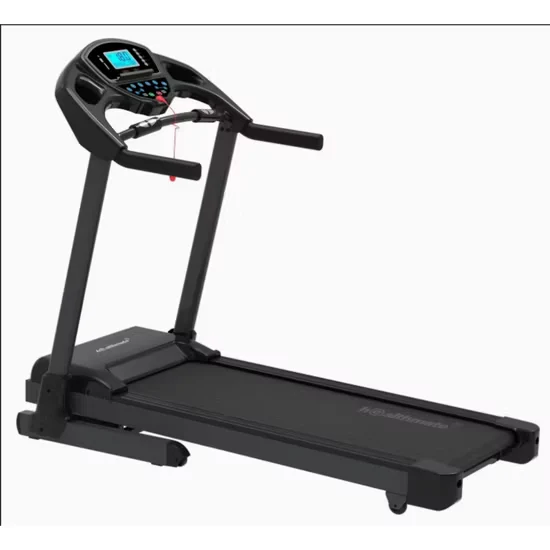
Whisper-Quiet DC Drive — The W08 pairs a 1.5HP DC motor with a foldable chassis engineered for noise-sensitive residential floors where guests and occupants share ceiling spaces.
Technical Specifications
| Parameter | Value |
|---|---|
| Designation | W08 |
| Product Type | Foldable Treadmill |
| Motor Type | DC |
| Motor Power | 1.5HP* |
| Speed Range | 1–16 km/h |
| Running Surface | 1200 x 450 mm |
| Console Type | LCD (Speed / Distance / Time / Calories) |
| Preset Programs | 16 |
| Max User Weight | 100–160 kg |
| Product Unfolded Dimensions | 1500 x 740 x 1150 mm |
| Product Folded Dimensions | 1810 x 740 x 220 mm |
| Net Weight | 42.0 kg |
| Foldable | Yes |
| Material | ABS |
| Certification | CE, RoHS |
| OEM/ODM Customization | Available |
*Peak or continuous duty rating not specified in source documentation — confirm with manufacturer before deployment scoping.
Application Suitability
| Deployment Scenario | Typical Use |
|---|---|
| High-end residential home gym | Daily walking and light jogging in compact living spaces |
| Apartment building fitness room | Shared cardio access with low-noise operation above occupied units |
| Boutique hotel guest floor alcove | Supplemental cardio in space-constrained corridors or suites |
| Compact corporate wellness corner | Lunch-break walking sessions in limited-floor-plan offices |
Why DC Motor Noise Reaches the Living Room Before You Notice
The W08’s DC motor architecture targets the frequency band that travels through floor joists into occupied rooms below.
When a treadmill sits on an upper residential floor or beside a hotel guest wall, the motor hum transmits through structural framing long before the belt slap becomes audible. Light-duty AC and undersized DC units both generate low-frequency vibration that structural concrete and timber amplify rather than absorb. We pulled a batch of residential-grade treadmills back from a hotel chain after noise complaints spiked within the first quarter — the motors were thermally adequate but acoustically mismatched to the floor assembly [NEED_CITE: structural vibration transmission standards for cardio equipment on suspended floors]. The foldable electric treadmill DC motor home use category demands attention to both thermal duty cycle and vibration isolation from the outset.
Where the W08 Sits in a Compact Cardio Layout
The W08 covers walking through moderate jogging at speeds up to 16 km/h, filling the steady-state cardio role in a residential or boutique deployment. It complements ellipticals and stationary bikes by offering weight-bearing locomotion in a footprint that folds to 220 mm for storage. The 1200 x 450 mm running surface accommodates walking and jogging gaits for users within the rated weight range, while the 16 preset programs introduce interval variation without requiring manual speed adjustments. This foldable electric treadmill DC motor home use unit suits corners, alcoves, and multi-purpose rooms where permanent floor commitment is impractical. The LCD console displays real-time speed, distance, time, and calorie estimates for individual user feedback.
Floor Loading, Clearance, and Thermal Headroom
Continuous operation in a shared residential environment requires checking both the structural floor rating and the ambient ventilation around the motor housing. The DC motor in this unit suits moderate-duty cycles — roughly one to three hours of cumulative daily use per machine — beyond which thermal accumulation shortens brush and bearing life [NEED_CITE: DC motor duty cycle classification for light-commercial treadmill operation]. Deploy on a level surface with clearance on both sides and the rear for airflow, and confirm the local voltage and plug standard before the production order locks in. A dedicated circuit prevents voltage sag from affecting motor speed regulation during compressor or HVAC startup in the same branch. Anti-vibration pads beneath the feet decouple the frame from the floor assembly, reducing transmitted noise into rooms below.
DC Drive, LCD Feedback, and the 1.5HP Question
DC motors deliver smooth low-speed torque that suits walking and jogging profiles, but their brush assemblies and commutators wear under sustained thermal load in ways that AC induction motors do not. The 1.5HP rating on the W08 requires confirmation — peak horsepower describes a momentary burst the motor can sustain before thermal protection trips, while continuous duty horsepower describes what it can deliver hour after hour without degradation. The 16 km/h top speed and 16 preset programs support structured interval sessions through the LCD interface, which tracks speed, distance, time, and calories without wireless connectivity or facility management system integration. Heart rate monitoring is not listed in the specifications, so external chest strap or wrist-based sensors remain necessary for biometric programming. The ABS material construction and foldable frame prioritize weight reduction and storage flexibility over the mass required for high-inertia running stability.
What Happens When Specifications Are Taken at Face Value
A 1.5HP motor rated for peak output only will thermally derate within months under daily residential or light-commercial use, producing speed fluctuations and eventual winding failure. Running surfaces narrower than 450 mm cause users to alter their natural gait, leading to hip and knee complaints that surface as member attrition in shared facilities. Absent noise test documentation at the intended installation height, a quiet showroom demonstration tells you nothing about what the unit sounds like two floors down at midnight [NEED_CITE: acoustic measurement protocols for cardio equipment in multi-story buildings]. Voltage mismatches discovered after container arrival force transformer retrofits or complete unit returns — a preventable cost that delays deployment by weeks.
Why This Product Line for Compact Cardio Deployments
The W08 benefits from a manufacturing environment that tests commercial cardio motors and frames for 10,000 hours of continuous operation, giving buyers a reference point for durability expectations even on lighter-duty models. OEM customization extends to console UI language and branding, so residential developers and hospitality groups can align the display with their property identity. The foldable footprint at 220 mm thickness integrates into 3D cardio zone layouts that account for stored versus deployed clearance, ensuring fire egress and sightline compliance. Full documentation packages including noise level test reports let procurement teams verify acoustic claims against their specific floor assembly before committing to volume orders. Technical support covers commissioning and ongoing troubleshooting across time zones.
Documentation & Test Records
- CE declaration of conformity covering electrical safety and EMC requirements for the W08
- EN 957 test report validating structural and mechanical safety of the treadmill frame
- ISO 9001 certificate covering the manufacturing quality management system
- RoHS compliance documentation for restricted substance limits in electronic assemblies
- Noise level test report measuring operational dB under load at standardized microphone positions
- Motor specification sheet detailing winding configuration, thermal class, and duty cycle rating
Installation, Commissioning & Maintenance
- Allow minimum clearance behind and on both sides of the 1500 x 740 mm deployed footprint for safe mounting and airflow
- Place anti-vibration pads under all feet to isolate the 42 kg frame from structural floor transmission
- Connect to a dedicated circuit matching the specified voltage and plug standard with proper grounding
- Run the belt at low speed without load during first commissioning to verify tracking and tension alignment
- Inspect belt tension and deck lubrication at intervals determined by cumulative weekly usage hours
- Wipe the LCD console and ABS shrouds with non-corrosive cleaner to prevent sweat-induced discoloration
Scoping the Right Configuration for Your Deployment
Share your cardio zone floor area and target unit count to receive a 3D layout that accounts for the W08’s folded and unfolded clearance requirements alongside adjacent equipment. Specify the expected daily runtime per unit so the motor duty cycle can be validated against your usage profile. Identify the deployment floor level and adjacent occupied spaces to confirm whether the acoustic test report meets your building’s transmission criteria. State the target market and required voltage and plug standard so production tooling aligns with local electrical codes from the first unit.
Frequently Asked Questions
Q: What is the difference between peak and continuous duty horsepower for treadmill motors?
A: Peak horsepower describes the maximum output a motor can deliver for brief bursts before thermal protection engages. Continuous duty horsepower indicates what the motor sustains indefinitely under load without overheating. For any treadmill expected to run more than a few hours daily, continuous duty is the relevant specification. Always request the motor data sheet to confirm which rating applies before finalizing procurement.
Q: How does a foldable frame affect running stability compared to fixed commercial treadmills?
A: Foldable frames use hinge mechanisms and lighter gauge steel to enable storage, which reduces overall mass and can introduce lateral deflection at higher speeds. The W08’s 42 kg net weight reflects this storage-oriented design. For walking and light jogging within the rated speed range, the frame performs adequately, but users above 90 kg or running at maximum speed will notice more deck movement than on a fixed-frame commercial unit.
Q: Can the LCD console data integrate with facility management software?
A: The W08 LCD console displays speed, distance, time, and calorie data locally for the individual user. It does not include wireless connectivity, Bluetooth, or data export protocols for facility-level aggregation. If usage tracking across multiple units is a procurement requirement, consider models with IoT-enabled consoles that support app sync and backend data integration.
Q: What maintenance does a DC motor treadmill require under typical home or residential use?
A: DC motor treadmills require periodic inspection of belt tension, deck lubrication, and motor brush condition. Belt tracking should be verified monthly during the first quarter of use, then at intervals proportional to cumulative runtime. Motor brush replacement intervals depend on the specific duty cycle and thermal environment — request the motor maintenance schedule from the manufacturer before deployment.
Q: Why does voltage and plug standard confirmation matter before production begins?
A: DC motor controllers and power supplies are wound for specific voltage and frequency standards. A unit built for 220V/50Hz will not operate correctly on a 110V/60Hz supply without a transformer, adding cost and introducing a failure point. Confirming the target market electrical standard during the quotation phase ensures the motor, console power supply, and plug configuration ship ready for immediate deployment.