
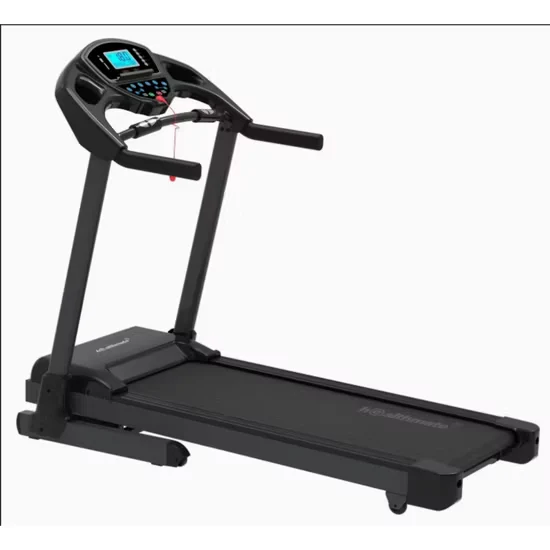
Whisper-Quiet Operation — DC motor paired with a foldable chassis keeps noise low enough for residential floors without sacrificing the 1320 × 480 mm stride surface.
Technical Specifications
| Parameter | Value |
|---|---|
| Designation | MT166 |
| Motor Type | DC |
| Motor Power | DC 2.5HP (peak or continuous not specified in source) |
| Speed Range | 1–18 km/h |
| Running Surface | 1320 × 480 mm |
| Console Type | LCD (Speed / Distance / Time / Calories / Pulse) |
| Programs | 12 preset programs |
| Heart Rate | Handgrip pulse sensor |
| Foldable | Yes |
| Product Dimensions | 1735 × 770 × 1330 mm (unfolded) |
| Net Weight | 63.0 kg |
| Max User Weight | not specified in source — verify against manufacturer catalog |
| Noise Level | not specified in source — verify against manufacturer catalog |
| Color Options | Multicolor |
| Certification | CE, RoHS |
Application Suitability
| Deployment Scenario | Typical Use |
|---|---|
| High-end residential home gym | Daily personal training in private or apartment fitness spaces |
| Apartment complex shared fitness room | Low-traffic cardio access where noise and footprint are constrained |
| Corporate wellness room | Light-duty employee fitness during break and off-peak hours |
Why Residential Noise Complaints Start at the Front Desk
The foldable DC motor treadmill home use category often fails because builders spec peak horsepower without checking sustained duty output.
When a DC treadmill sits above occupied living space, every footstrike transmits vibration through the slab. Residents hear a rhythmic thudding before they hear motor whine, which means deck isolation and speed-range tuning matter more than raw power. I have seen apartment gym operators replace an entire batch of under-specced units within six months because the motor rating was quoted at peak rather than continuous, and the daily three-hour occupancy window pushed the windings past thermal limits [NEED_CITE: motor duty cycle classification for continuous residential operation].
MT166 Positioning in a Compact Cardio Zone
This unit targets intermittent-use environments where the cardio footprint competes with living or working space. The 1320 × 480 mm belt accommodates walking through moderate-paced running, complementing lighter equipment such as stationary bikes or ellipticals in a mixed-layout room. The foldable frame lets a residential operator reclaim floor area between sessions, and the 12 preset programs cover steady-state and interval patterns without requiring a phone tether. The LCD panel reports speed, distance, time, calories, and pulse, keeping the foldable DC motor treadmill home use user within a self-contained feedback loop. Body-weight tolerance should be confirmed with the manufacturer before deploying in shared facilities where user mass varies widely.
Continuous Runtime and Floor-Level Deployment
DC motors in this output band perform well under intermittent duty but require cooldown intervals when sessions stack back-to-back, so plan occupancy schedules accordingly. Upper-floor residential deployment demands a vibration-damping mat and verified sub-slab isolation to prevent structure-borne noise from reaching the unit below [NEED_CITE: structure-borne vibration standards for multi-story fitness deployment]. Ventilation around the motor housing must remain unobstructed; the foldable design does not eliminate the need for clearance at the rear and sides during operation. Standard household voltage powers the unit, but operators targeting export markets must confirm plug type and frequency match before the container ships. The handgrip pulse sensor draws minimal current, yet the LCD console still requires a stable circuit free of shared heavy-load appliances.
Inside the Drive and Control Architecture
DC motors deliver strong low-end torque, which makes initial belt acceleration smooth, but their thermal envelope narrows under sustained load compared to AC equivalents. The listed DC 2.5HP figure is not confirmed as continuous output, so treat it as a peak reference and request a duty-cycle certificate before high-occupancy deployment. The LCD console provides real-time numeric feedback without network connectivity, a deliberate simplification that removes firmware-update liability in environments lacking IT support. Handgrip pulse sensors read adequately at rest and low cadence, though motion artifact rises with running speed, making chest-strap telemetry preferable for structured interval work. The 12 preset programs are stored in onboard memory, eliminating dependency on external servers. Belt-driven transmission keeps the drivetrain quieter than chain alternatives and removes the need for periodic lubrication of roller chains [NEED_CITE: belt versus chain maintenance intervals in commercial cardio].
What Under-Speccing Costs in Shared Residential Gyms
Residential operators who select peak-rated DC motors for continuous shared use often face winding burnout inside the first warranty year. Noise complaints escalate from isolated emails to building-wide petitions, forcing bulk equipment swaps that cost far more than the initial savings. A deck that lacks adequate cushioning transfers impact to joints, and member attrition follows when runners migrate to outdoor paths. Voltage mismatches discovered after arrival strand inventory at the dock while adapters are sourced and tested. The foldable DC motor treadmill home use segment suffers disproportionately from these issues because the compact footprint tempts buyers to treat light-commercial specs as full-commercial substitutes [NEED_CITE: failure-rate data for light-commercial cardio in shared residential deployment].
Why This Product Line Holds Up Under Scrutiny
The MT166 inherits a chassis philosophy tested across our commercial range: magnetic resistance and cushioned belt systems tuned for low acoustic output, verified in hotel-floor installations. Motors in the broader line undergo 10,000-hour continuous-run validation, and although the MT166 targets intermittent duty, that same test protocol informs bearing selection and thermal design. The six-series cardio family lets a facility source every discipline from one engineering standard, simplifying spare-parts inventory. OEM customization covers logo, color, and console UI so a residential developer can align the unit with interior finishes. Our team provides free 3D cardio-zone layout and airflow planning that accounts for the foldable footprint and ceiling clearance when the deck is raised. Technical support responds around the clock, which matters when a shared gym goes offline at night.
Documentation & Test Records
- CE declaration of conformity covering the MT166 DC motor and control assembly
- EN 957 test report validating mechanical safety and stability under load
- ISO 9001 certificate for the manufacturing facility producing this unit
- RoHS compliance statement for all electronic components and wiring
- Motor specification sheet detailing peak and continuous duty ratings
- Console technical documentation with LCD function mapping and program list
Installation, Commissioning & Maintenance
- Maintain minimum clearance around the unfolded 1735 × 770 × 1330 mm envelope for safe mounting and dismounting
- Place a high-density vibration mat under the 63.0 kg frame to attenuate structure-borne noise on upper floors
- Connect to a dedicated 220–240 V or 110–120 V circuit matching the motor nameplate frequency
- Run the belt at low speed for five minutes on first power-up to verify tracking and tension alignment
- Inspect belt tension and deck lubrication every 90 days under shared residential use patterns
- Wipe the LCD console and handgrip sensors after each session to prevent sweat-induced corrosion
Planning the Right Deployment
Provide the room dimensions and planned unit count so we can return a 3D cardio-zone layout that respects the foldable clearance arc and sightline requirements. State the expected daily occupancy hours to confirm whether the DC motor’s duty cycle matches your traffic pattern. Specify the deployment floor and the room directly below so we can recommend isolation pads that meet the acoustic expectations of adjacent living spaces. Confirm the target-market voltage and plug type, and indicate whether the LCD console needs to report data to a building management system.
Frequently Asked Questions
Q: How do I verify whether the DC 2.5HP rating is peak or continuous output?
A: Request the manufacturer’s motor duty-cycle certificate, which lists continuous horsepower at a defined ambient temperature and runtime. Peak figures describe short bursts during acceleration, not sustained belt speed under load. Comparing the two values reveals whether the motor can handle your expected session length without thermal throttling or premature winding degradation.
Q: Is the foldable frame stable at the upper end of the 1–18 km/h speed range?
A: Foldable designs introduce hinge points that can transmit lateral oscillation if the locking mechanism wears. Verify the deployment weight limit against your user population and inspect the frame lock pins quarterly. At higher cadences, any residual play becomes audible as a rhythmic click, signaling the need for hinge adjustment before the issue reaches occupants in adjacent rooms.
Q: What data limitations does the LCD console have compared to IoT-enabled touchscreens?
A: The LCD displays speed, distance, time, calories, and pulse but lacks wireless connectivity and third-party app sync. Workout history stays local to the session, so facility operators cannot pull usage analytics remotely. If your deployment requires member tracking or over-the-air program updates, specify an IoT console variant during the quotation phase.
Q: How accurate is the handgrip pulse sensor during running intervals?
A: Handgrip sensors read reliably during walking and light jogging when palm contact is steady. At running speeds, grip pressure fluctuates and motion artifact introduces reading drift. For structured interval programming where heart-rate zones must be precise, recommend a chest-strap telemetry accessory and confirm that the console supports the corresponding receiver module.
Q: What noise level should I expect in a shared residential deployment?
A: The product catalog does not publish a tested decibel figure, so request a noise-level test report at the speeds most relevant to your users. Structure-borne vibration often matters more than airborne noise on upper floors, making a high-density isolation pad essential. Conduct a nighttime commissioning run with an occupant in the room below to validate real-world acoustic performance before full deployment.
![Home Gym Fitness Machine Stairmaster Stepper Stair Climber [WARN] draft identifier mismatch](https://bicksport.com/wp-content/uploads/2026/08/home-gym-fitness-machine-stairmaster-stepper-stair-climber-warn-draft-identifier-mismatch-3db19b.webp)


![W08 Folding Electric Walking Treadmill for Home Gym Use [WARN] draft identifier mismatch](https://bicksport.com/wp-content/uploads/2026/08/w08-folding-electric-walking-treadmill-for-home-gym-use-warn-draft-identifier-mismatch-3b265a.webp)