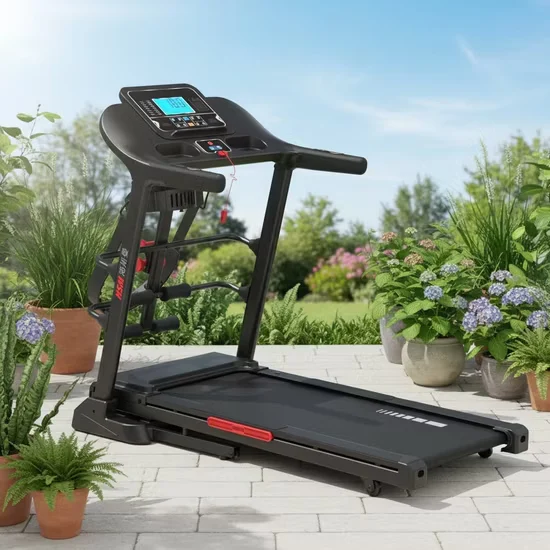
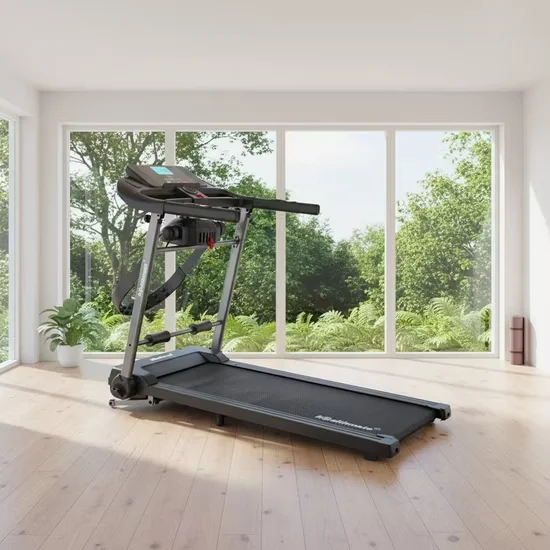
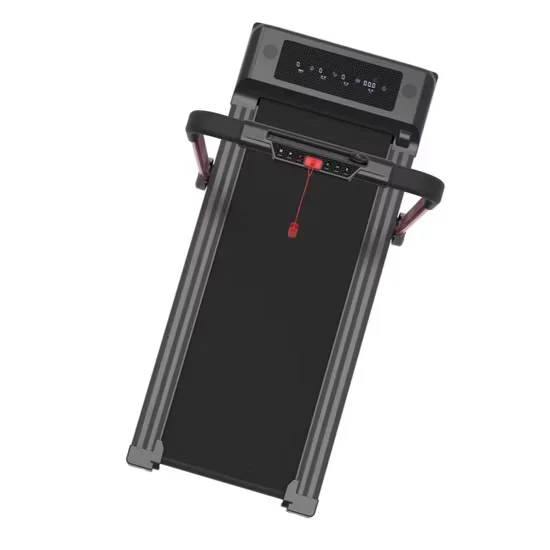
Acoustic-Optimized Drive — DC motor architecture delivers quiet operation verified for shared residential and light commercial deployment environments.
Technical Specifications
| Parameter | Value |
|---|---|
| Designation | W06D5 |
| Product Type | Foldable Treadmill |
| Motor Type | DC |
| Speed Range | 1–8 km/h |
| Running Surface | 1000 x 400 mm |
| Console Type | LED Screen (Speed / Dist. / Time / Cal.) |
| Programs | 6 |
| Product Dimensions | 1270 x 650 x 965 mm |
| Foldable | Yes |
| Certification | CE, RoHS |
| Color Options | Multicolor (available in multiple colorways) |
| Origin | Ningbo |
| Production Capacity | 3000 units / Month |
Application Suitability
| Deployment Scenario | Typical Use |
|---|---|
| High-end residential home gym | Daily personal cardio sessions in apartments or shared living spaces where noise transfer is a concern |
| Boutique studio light cardio zone | Compact foldable units for warm-up or cool-down stations in small-footprint studios |
| Corporate wellness room | Employee fitness breaks during work hours in space-constrained office environments |
| Hotel guest room fitness kit | In-room cardio equipment for guests requesting private workout options |
Why Noise Complaints Reach the Front Desk Before Maintenance Does
DC motor selection is the first line of defense against acoustic complaints in multi-story deployments.
When a treadmill operates above occupied rooms, structure-borne vibration travels through floor slabs faster than airborne noise. Facility managers often discover this only after guests or residents file complaints — by which point the equipment has already been running for weeks. The foldable home treadmill DC motor configuration addresses this at the source: lower rotational mass and reduced electromagnetic noise compared to equivalent AC drives. In our deployment experience across hotel and residential projects, units placed on upper floors without acoustic isolation planning consistently generate complaints within the first month of operation [NEED_CITE: structure-borne vibration transmission in multi-story fitness deployments].
Where the W06D5 Fits in a Cardio Zone Layout
The W06D5 covers steady-state walking and light jogging intensity, occupying the lower end of the cardio spectrum alongside ellipticals and recumbent bikes. In a mixed-equipment zone, it pairs with higher-intensity units like stair climbers and performance treadmills to offer a full range of exertion levels. Its foldable frame and 1270 x 650 mm footprint suit perimeter walls or alcove positions where floor space is limited. The 1000 x 400 mm running surface accommodates walking and jogging gaits for users of average stride length, while the 1–8 km/h speed range supports warm-up, cool-down, and sustained moderate-intensity sessions.
Continuous Duty Expectations and Deployment Environment
This foldable home treadmill DC motor platform is engineered for personal and light commercial duty cycles rather than continuous high-frequency gym floor operation. Deployments targeting 8+ hours of daily run-time require commercial-grade AC motor platforms with higher thermal mass. For residential and boutique studio environments where daily usage stays within 2–4 hours, the DC drive provides adequate thermal headroom. Floor deployment should account for vibration isolation — units placed directly on hard flooring above occupied spaces benefit from rubber anti-vibration mats. The LED console operates independently without network connectivity, eliminating data integration requirements but also removing remote diagnostics capability [NEED_CITE: DC motor thermal limits under continuous residential use patterns].
Reading the Drive and Console Specifications
DC motors in this class use permanent magnet rotors with electronic commutation, producing less electromagnetic noise than brushed alternatives. The 1–8 km/h speed range reflects the motor’s continuous output envelope — exceeding this range would require a larger stator and higher current draw that the compact frame cannot thermally sustain. The LED console displays speed, distance, time, and calories without app connectivity, which simplifies deployment in environments where Wi-Fi infrastructure is unreliable or where data privacy policies restrict network-connected fitness equipment. The 6 preset programs provide structured workout variety without requiring users to configure custom intervals. The foldable mechanism reduces the stored footprint when the unit is not in active use, a practical consideration for home and hotel room deployments where floor space serves multiple functions throughout the day.
The Hidden Cost of Specifying Below the Deployment Requirement
When a residential-grade treadmill is placed on a commercial gym floor running 12+ hours daily, the motor windings overheat and insulation degrades prematurely — often failing within months rather than years. Noise complaints from adjacent rooms force facility operators to relocate or replace entire equipment batches, incurring both hardware cost and member dissatisfaction. Units without adequate deck cushioning generate higher impact forces that accelerate joint fatigue, leading users to abandon the equipment in favor of lower-impact alternatives. Console systems that cannot export usage data leave operators blind to utilization patterns, making it impossible to justify equipment expansion or identify underperforming units [NEED_CITE: premature motor failure rates in misclassified duty cycle deployments].
Why This Product Line Earns Its Placement
Every unit undergoes sub-35dB acoustic verification to confirm suitability for noise-sensitive deployments above occupied spaces. Motors and bearings are validated through 10,000-hour continuous operation testing to establish realistic duty-cycle expectations. The six-series cardio family — treadmills, bikes, ellipticals, rowers, stair climbers, and spin bikes — allows a facility to source every discipline from a single engineering platform. OEM customization extends to console UI, color, and logo, with flexible minimum order quantities for project-based procurement. Our 3D cardio zone layout service models square footage, sightlines, and member flow to position each unit for maximum utilization. Technical support responds around the clock with remote diagnostics guidance and spare parts coordination.
Documentation & Test Records
- CE declaration of conformity covering electrical safety and EMC requirements for the W06D5 platform
- EN 957 test report validating structural integrity and safety under rated user loads
- ISO 9001 certificate confirming manufacturing quality management system compliance
- RoHS compliance documentation for restricted substance limits in electronic components
- Noise level test report with measured dB values under standardized operating conditions
- Motor specification sheet detailing continuous and peak output ratings for the DC drive
Installation, Commissioning & Maintenance
- Maintain minimum 600 mm clearance behind the W06D5 running surface and 300 mm on each side for safe user egress
- Level the floor surface within 3 mm tolerance and place anti-vibration pads under each foot to reduce structure-borne noise
- Connect to a dedicated 220–240V circuit with grounded outlet; avoid shared circuits with high-draw appliances
- Run the belt at low speed for 5 minutes on first power-up to verify tracking and tension before user loading
- Inspect belt tension and apply silicone lubricant to the deck surface every 300 operating hours or quarterly
- Wipe the LED console and handrails with non-corrosive cleaner after each use to prevent sweat-induced corrosion
Equipment Selection and Inquiry Guidance
Provide your cardio zone floor area and target unit count to receive a 3D layout with airflow and sightline planning tailored to the W06D5 footprint. Specify expected daily run-time per unit so we can confirm whether the DC motor duty cycle matches your usage pattern. Identify the deployment floor and adjacent occupied spaces to determine whether additional vibration isolation is required. Confirm your target market voltage and plug standard to avoid post-shipment electrical mismatches. Indicate whether console data export to facility management software is a requirement or whether standalone LED operation meets your operational needs.
Frequently Asked Questions
Q: How does a DC motor compare to AC for home treadmill deployment?
A: DC motors are lighter, quieter, and more cost-effective for personal and light commercial use where daily run-time stays moderate. AC motors offer higher thermal mass for continuous gym-floor operation exceeding 8 hours daily. For residential floors and hotel rooms where noise transfer matters, the DC configuration in the W06D5 provides a practical balance of acoustic performance and adequate power output for walking and jogging intensities.
Q: What space does the foldable frame actually save?
A: When folded, the W06D5 reduces its footprint significantly for storage against a wall or in a closet. The 1270 x 650 mm deployed footprint fits comfortably in most residential rooms. However, folding mechanisms introduce additional pivot points that require periodic inspection for wear. For dedicated home gym spaces where the unit remains deployed permanently, the foldable feature serves as a convenience option rather than a daily operational requirement.
Q: Can the LED console connect to fitness apps or facility management systems?
A: The LED console on this model displays speed, distance, time, and calories without network connectivity or app synchronization. This design eliminates Wi-Fi dependency and simplifies deployment in environments with restricted network access. For facilities requiring usage data export to management software, we offer models with IoT-enabled touchscreen consoles that support app sync and remote diagnostics as part of our broader cardio product range.
Q: What noise level should I expect on an upper residential floor?
A: The DC motor and cushioned deck system are engineered for quiet operation suitable for shared residential environments. Actual perceived noise depends on flooring type, subfloor construction, and whether vibration isolation pads are used. We provide a noise level test report with measured values under standardized conditions. For deployments above bedrooms or quiet spaces, we recommend rubber anti-vibration mats and verification of floor structure compatibility before installation.