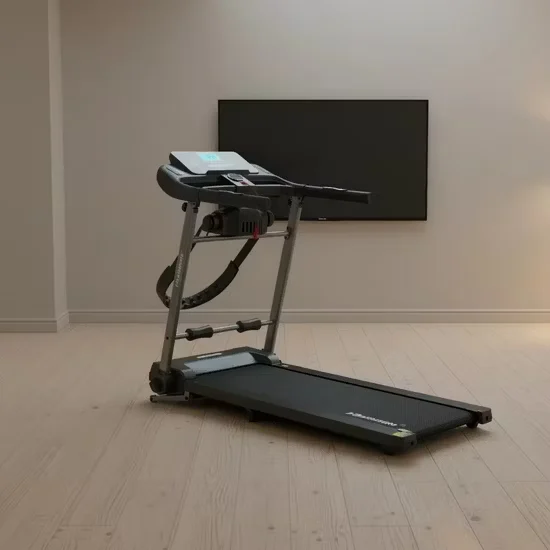
Acoustic-Optimized Drive System — A 1.5HP DC motor paired with a foldable frame architecture keeps operational noise manageable for shared residential floors and compact fitness environments.
Technical Specifications
| Parameter | Value |
|---|---|
| Designation | W08 |
| Product Type | Foldable Treadmill |
| Motor Type | DC |
| Motor Power | 1.5HP (peak or continuous not specified in source) |
| Speed Range | 1-16 km/h |
| Running Surface | 1200 x 450 mm |
| Console Type | LCD (Speed / Distance / Time / Calories) |
| Programs | 16 preset programs |
| Foldable | Yes |
| Product Unfolded Dimensions | 1500 x 740 x 1150 mm |
| Product Folded Dimensions | 1810 x 740 x 220 mm |
| Net Weight | 42.0 kg |
| Material | ABS |
| Certification | CE, RoHS |
| OEM/ODM Customization | Available |
Application Suitability
| Deployment Scenario | Typical Use |
|---|---|
| High-end residential home gym | Daily walking and light jogging where floor space must be reclaimed after each session |
| Boutique hotel guest room fitness corner | Foldable cardio option stowed between guest uses in limited-square-footage rooms |
| Corporate wellness room | Low-commitment cardiovascular station for employees during breaks in compact office layouts |
| Shared residential fitness space | Quiet DC motor operation on upper floors where noise transfer to adjacent units is a concern |
Why Motor Duty Cycle Matters More Than Horsepower on Paper
Matching continuous output to actual daily run-time prevents premature motor failure in residential and light-commercial deployments.
A recurring problem in facility cardio procurement is selecting a treadmill based on peak horsepower alone, only to find the motor overheats or degrades within months under daily use. The foldable electric treadmill DC motor home use category often straddles the boundary between occasional residential sessions and sustained multi-user environments. When a DC motor rated for intermittent duty is placed in a corporate wellness room that runs six hours a day, thermal buildup shortens its operational life significantly [NEED_CITE: motor duty cycle classification for continuous commercial operation]. Understanding whether a 1.5HP rating represents continuous or peak output directly shapes deployment decisions and maintenance intervals.
Positioning the W08 Within a Compact Cardio Layout
The W08 foldable treadmill occupies the walking-to-light-jogging intensity band, complementing heavier-duty commercial treadmills or stationary bikes in mixed-use fitness zones. Its 1200 x 450 mm running surface accommodates walking and moderate jogging strides, making it suitable for warm-up circuits, recovery sessions, and general cardiovascular maintenance. In a residential or boutique hotel setting, the foldable electric treadmill DC motor home use design allows the unit to be positioned against a wall when idle, preserving floor area for stretching or bodyweight stations. The LCD console tracks speed, distance, time, and calorie estimates across 16 preset programs, providing structured session guidance without requiring external device pairing.
Noise Transfer and Floor-Level Deployment Constraints
Deploying cardio equipment on shared residential slabs or above occupied hotel rooms demands attention to structure-borne vibration as much as airborne noise. The DC motor configuration produces less acoustic output than comparable AC motors at equivalent loads, but impact noise from footfalls transmits through the deck and frame into the floor structure [NEED_CITE: structure-borne noise transmission in multi-story fitness deployments]. The folded footprint of 1810 x 740 x 220 mm allows placement flexibility, yet the unfolded stance requires a level surface with adequate clearance for belt ventilation underneath. Facilities on upper floors should consider isolation pads beneath the unit and verify that the deployment circuit can handle the motor’s electrical draw without sharing a breaker with high-load appliances.
Decoding the DC Motor and Foldable Frame Engineering
DC motors in the sub-2HP range are standard for residential and light-commercial treadmills because they deliver adequate torque at lower rotational speeds, which inherently reduces mechanical noise compared to AC induction motors. However, the distinction between peak and continuous horsepower ratings is critical — a motor that peaks at 1.5HP may sustain a lower continuous output, which governs how long it can run before thermal protection engages. The foldable hinge mechanism introduces a structural joint in the frame, which can affect running surface rigidity under heavier users; verifying maximum user weight capacity against actual deployment demographics prevents premature wear at the hinge point. The 16 preset programs on the LCD console provide resistance and speed variation without requiring manual adjustment, though the console lacks documented data export protocols for integration with facility management platforms.
The Hidden Cost of Underspecifying Foldable Treadmills
Procurement decisions driven primarily by folded dimensions and unit price often overlook the cumulative cost of motor replacements, noise-related complaints, and member dissatisfaction. When a treadmill deployed in a hotel guest room generates enough vibration to trigger complaints from the floor below, the operational cost includes not just equipment relocation but reputational damage [NEED_CITE: guest complaint escalation patterns for in-room fitness equipment]. Similarly, a foldable frame that develops play at the hinge after months of daily folding and unfolding creates an unstable running surface, leading users to avoid the equipment entirely. Data blind spots compound the problem — without console export capability, facility operators cannot track utilization rates or justify equipment rotation decisions.
Why This Product Line Earns Deployment Confidence
Sub-35dB operation verified in hotel deployments sets a benchmark for what the W08 aims to achieve in noise-sensitive environments. The 10,000-hour durability testing protocol on motors, frames, and bearings provides a reference point for evaluating whether the unit’s duty cycle matches your facility’s daily run-time expectations. Full OEM/ODM capability, including console UI customization, allows branding alignment for hotel groups and corporate wellness programs. The free 3D cardio-zone layout service addresses spatial planning by accounting for the W08’s unfolded and folded footprints alongside airflow and sightline considerations. Complete six-series cardio family coverage means facilities can source walking, cycling, rowing, and climbing stations from a single engineering standard. Round-the-clock technical support with spare parts availability reduces downtime for deployed units.
Documentation & Test Records
- CE declaration of conformity covering electrical safety and electromagnetic compatibility
- EN 957 test report validating stationary training equipment safety requirements
- ISO 9001 certificate confirming quality management system compliance
- RoHS compliance documentation restricting hazardous substances in electrical components
- Noise level test report with measured dB output under defined load conditions
- Motor specification sheet detailing electrical characteristics and thermal protection thresholds
Installation, Commissioning & Maintenance
- Unfolded footprint of 1500 x 740 mm requires minimum 600 mm rear clearance for safe user egress
- Level surface verification prevents uneven belt wear on the 1200 x 450 mm running surface
- Dedicated electrical circuit recommended to avoid voltage drop affecting DC motor performance
- Initial belt tension calibration and alignment check before first user session
- Periodic hinge mechanism inspection on the foldable frame to maintain structural rigidity
- LCD console firmware verification to confirm program functionality across all 16 presets
Matching Equipment Specifications to Your Deployment Reality
Provide your cardio zone square footage and planned equipment count to receive a 3D layout that accounts for the W08’s operational and folded clearances alongside ventilation pathways. Specify average daily run-time per unit so we can assess whether the motor’s duty cycle aligns with your facility’s usage intensity. Indicate the deployment floor level and adjacent room types to confirm that acoustic output meets your noise tolerance thresholds. State your target market voltage and plug standard to ensure electrical compatibility before production. Clarify whether console data output integration with your facility management platform is required.
Frequently Asked Questions
Q: What is the difference between continuous duty and peak horsepower, and how does it affect treadmill longevity?
A: Peak horsepower represents the maximum output a motor can produce in short bursts, while continuous duty reflects sustained output under load. A treadmill used for extended daily sessions relies on continuous duty rating for thermal management and lifespan estimation. Deploying a unit based solely on peak rating in a high-frequency environment accelerates motor degradation and triggers thermal shutdowns.
Q: How does a DC motor compare to an AC motor in terms of noise output for residential use?
A: DC motors generally operate at lower rotational speeds for equivalent belt velocities, producing less mechanical noise than AC induction motors. This characteristic makes DC configurations preferable for shared residential floors and hotel guest rooms where airborne noise transfer is a concern. However, continuous load capacity and thermal limits differ, requiring duty-cycle verification for multi-user deployments.
Q: Can the LCD console data be integrated with external fitness tracking applications?
A: The W08 LCD console displays speed, distance, time, and calorie metrics across 16 preset programs. Data export or wireless sync capability with third-party applications is not documented in the current specification. Facilities requiring usage data integration should verify console communication protocols during the OEM customization scoping phase before production commitment.
Q: What noise level does this treadmill produce during operation, and is it suitable for upper-floor deployment?
A: The DC motor configuration inherently produces less acoustic output than AC alternatives at comparable loads, but footfall impact noise transmits through the frame into floor structures. Upper-floor suitability depends on subfloor construction, isolation pad usage, and adjacent room sensitivity. Requesting the noise level test report provides measured data to inform deployment decisions for noise-sensitive environments.
Q: How does the foldable mechanism affect frame rigidity and running stability during use?
A: The hinge joint required for folding introduces a structural discontinuity that can develop play over repeated fold-unfold cycles. Frame rigidity during operation depends on hinge lock integrity and reinforced joint engineering. Regular inspection of the folding mechanism and hinge fasteners maintains running surface stability, particularly under users approaching the unit’s maximum weight capacity.
![Mt296 Home Use Electric Treadmill for Professional Training [WARN] draft identifier mismatch](https://bicksport.com/wp-content/uploads/2026/08/mt296-home-use-electric-treadmill-for-professional-training-warn-draft-identifier-mismatch-3f93cc.webp)