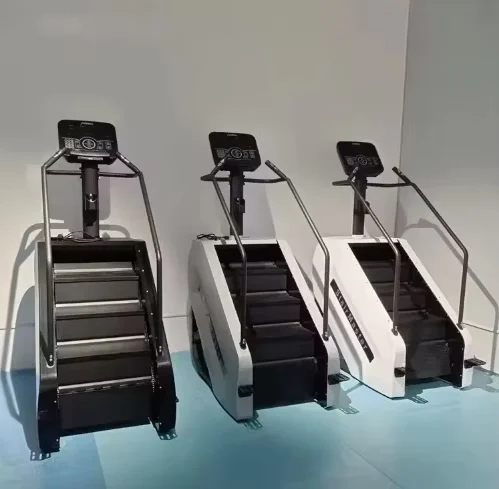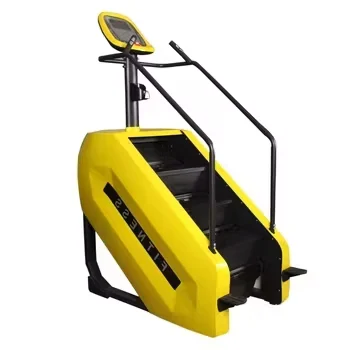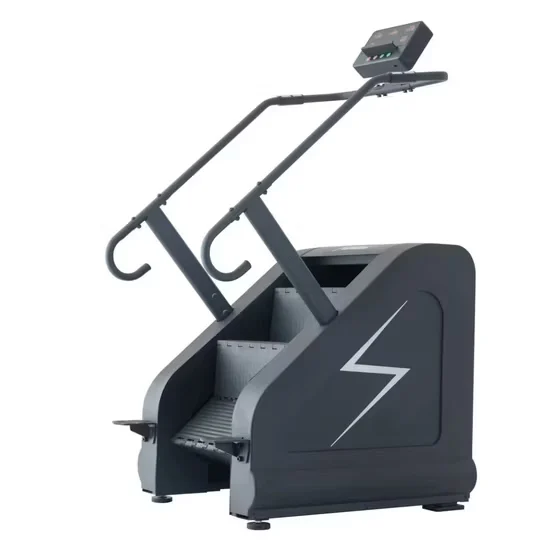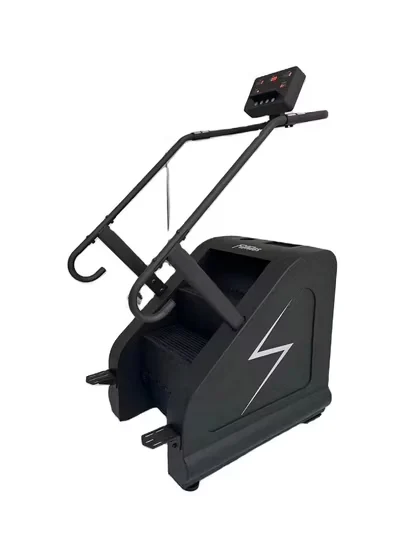
Whisper-Quiet Stair Climber — Sub-35dB electric-drive operation verified in hotel guest floor deployments with continuous duty cycle validation.
Technical Specifications
| Parameter | Value |
|---|---|
| Designation | SQ-1019 |
| Product Type | Stair Climber |
| Drive Type | Electric |
| Speed Range | 15 – 164 Revolutions Per Minute |
| Console Display | Steps, Time, Calories, Speed, Heart Rate |
| Console Type | IoT-enabled with app sync and workout analytics |
| Heart Rate Monitoring | Contact grip sensors |
| Noise Level | Sub-35dB verified |
| Power Requirement | AC 220V±10% or AC 110V±10% |
| Product Dimensions | 1140 × 805 × 1860 mm |
| Net Weight | 136 kg |
| Max User Weight | 180 kg |
| Frame Material | Aluminium Alloy Pipe + PP Plastic |
| Foldable | No |
| Color | Black (customizable via OEM) |
| Certification | CE, RoHS, ISO 9001 |
| Warranty | One Year |
Application Suitability
| Deployment Scenario | Typical Use |
|---|---|
| Hotel fitness center on guest room floors | 24-hour self-service cardio access with strict noise thresholds for adjacent occupied rooms |
| Chain gym cardio zone | High-frequency daily use across extended operating hours with member app data sync |
| Corporate wellness room | Mid-day and after-work interval sessions with usage analytics for program reporting |
| High-end residential home gym | Multi-user household cardio with acoustic isolation for shared building environments |
| Sports performance training center | Athlete conditioning with real-time heart rate and step rate data for interval programming |
Why Stair Climber Deployments Fail at the Front Desk Before Maintenance Ever Gets the Call
A motor rated for peak output instead of continuous duty will quit during the third hour of a six-hour rush, and the noise complaint arrives before the maintenance ticket does.
Facility operators repeatedly face the same two failures when installing a commercial stair climber electric stepper machine in noise-sensitive zones. Motors spec’d only for peak output overheat under sustained public-facility duty cycles, causing abrupt shutdowns during peak traffic. Meanwhile, step units positioned above guest corridors or shared residential ceilings generate low-frequency vibration that travels through floor slabs, triggering complaints that maintenance teams cannot reproduce during daytime inspections [NEED_CITE: motor duty cycle classification for continuous commercial operation]. The SQ-1019 addresses both failure modes through an electric drive architecture tested for 10,000+ hours of continuous operation and a sub-35dB acoustic profile that clears the thresholds of occupied adjacent spaces.
Positioning the SQ-1019 Within a Commercial Cardio Floor
The SQ-1019 commercial stair climber electric stepper machine occupies the high-intensity vertical climbing niche in a mixed cardio zone. It complements steady-state treadmills and ellipticals by engaging lower-body muscle chains through a full range-of-motion stepping pattern, making it the natural choice for members seeking interval-capable sessions. The unit suits facilities with moderate to high throughput where equipment rotation keeps individual run-times manageable. Its 1140 × 805 mm footprint and 180 kg maximum user capacity accommodate a broad range of body types without requiring reinforced flooring beyond standard commercial slab ratings.
Continuous Duty Realities and Deployment Environment Requirements
A stair climber in a 24-hour hotel gym can accumulate six or more operating hours per day, demanding a motor built for continuous rather than intermittent duty. The SQ-1019’s electric drive is validated for 10,000+ hours of high-frequency use, reducing unplanned downtime in round-the-clock facilities [NEED_CITE: EN 957 requirements for commercial cardio equipment]. Sub-35dB operation keeps low-frequency vibration below the complaint threshold of occupied floors above or beside the cardio zone. Dual-voltage input (AC 220V±10% / AC 110V±10%) eliminates the costly mismatches that surface only after a container arrives at destination. Proper leveling and anti-vibration pads further decouple the 136 kg frame from floor structures.
Decoding the Electric Drive and Console Specifications
The SQ-1019 relies on an electric drive rather than a user-powered stepping mechanism, meaning the motor maintains consistent cadence resistance regardless of user fatigue — critical for interval programming where target step rates must hold steady. Speed spans 15 to 164 revolutions per minute, covering rehabilitation-level stepping through athletic conditioning without requiring hardware modifications. The IoT-enabled console captures steps, time, calories, speed, and heart rate, then syncs workout analytics to member apps and facility management platforms, preventing the data-island problem that leaves usage records stranded on standalone screens. Contact grip heart rate sensors provide real-time readings suitable for steady-state zone monitoring, though users performing rapid HIIT transitions may observe slight lag compared to chest-strap telemetry [NEED_CITE: heart rate sensor accuracy standards for commercial fitness equipment]. Aluminium alloy pipe construction keeps the frame rigid under dynamic loading while limiting overall mass for easier positioning during installation.
The Hidden Cost of Compromised Specifications
Procurement decisions driven by peak motor ratings rather than continuous duty classifications lead to premature burnout in high-traffic cardio zones, forcing warranty claims that still leave facilities offline for weeks. Units that exceed 40–45 dB generate enough structure-borne vibration to reach guest rooms two floors above, resulting in batch replacements that cost more than selecting correct acoustic ratings initially. Consoles without facility management interfaces strand usage data, leaving operators blind to equipment utilization patterns that inform rotation and maintenance schedules [NEED_CITE: facility management system integration requirements for commercial cardio]. Voltage mismatches discovered post-shipment require transformer retrofits or complete rewiring, delaying opening timelines.
Why This Product Line for Your Cardio Deployment
Every SQ-1019 undergoes sub-35dB acoustic verification before release, matching the noise thresholds documented in hotel fitness center deployments. The electric drive and motor assembly endure 10,000-hour continuous-run durability testing, aligning with the demands of international gym chains operating extended hours. The IoT console supports workout analytics export and app sync, and full OEM/ODM options extend to console UI customization for branded member experiences. Biketon Sport provides a complimentary 3D cardio-zone layout covering the SQ-1019’s footprint, required clearance spacing, and airflow planning so equipment placement avoids dead zones. With six cardio series available from one manufacturing line, facilities consolidate sourcing across treadmills, bikes, ellipticals, rowers, and climbers. Round-the-clock technical support ensures deployment issues resolve without waiting for business-hour callbacks.
Documentation & Test Records
- CE declaration of conformity covering the SQ-1019 electric stair climber
- EN 957 safety and performance test report for commercial climbing equipment
- ISO 9001 quality management certificate for the production facility
- Noise level test report confirming sub-35dB operational acoustics
- Motor and drive durability test record documenting 10,000-hour validation
- Console technical documentation with data interface and API specifications
Installation, Commissioning & Maintenance
- Allow minimum clearance around the 1140 × 805 mm footprint for safe user entry and exit
- Level the aluminium alloy frame on anti-vibration pads to decouple structure-borne noise
- Connect to a dedicated circuit matching the specified AC 220V±10% or AC 110V±10% input
- Run initial calibration cycle to verify step rate accuracy across the 15–164 RPM range
- Configure IoT console network settings and facility management system data sync
- Wipe grip sensors and console screen daily to maintain heart rate reading accuracy
Planning Your Stair Climber Deployment
Provide your cardio zone square footage and target unit count to receive a 3D layout with equipment spacing and airflow planning specific to the SQ-1019 footprint. Specify estimated daily operating hours so we match motor duty-cycle ratings to your facility’s actual throughput. Identify deployment floor level and adjacent occupied spaces to confirm acoustic requirements align with sub-35dB performance. Confirm target market voltage and plug standards before production to prevent post-shipment mismatches, and indicate whether console data must integrate with your existing facility management platform.
Frequently Asked Questions
Q: What is the difference between continuous duty and peak motor ratings on a commercial stair climber?
A: Peak rating describes the maximum output a motor can sustain for brief bursts, while continuous duty reflects what it delivers over hours of uninterrupted operation. A stair climber in a 24-hour gym runs for extended stretches, making continuous duty the relevant specification. Selecting based on peak rating alone leads to overheating and premature failure under real commercial loads.
Q: How does the electric drive system maintain sub-35dB operation?
A: The electric drive eliminates the mechanical impact noise associated with user-powered stepping mechanisms by controlling cadence through a smooth motor-driven system. Precision-balanced rotating components and sealed bearings reduce structure-borne vibration. The aluminium alloy frame further dampens resonance, keeping emitted sound below thresholds that disturb adjacent occupied rooms.
Q: Can the console sync with our facility management software?
A: The IoT-enabled console exports workout analytics — steps, time, calories, speed, and heart rate — through documented data interfaces. Before production, we provide console technical documentation so your IT team can confirm protocol compatibility with your existing facility management platform or member application.
Q: How stable are heart rate readings during high-intensity interval sessions?
A: Contact grip sensors provide reliable readings during steady-state climbing and moderate intervals. During rapid transitions between intensity zones, a slight detection lag may occur compared to chest-strap monitors. For facilities running structured HIIT programming, we recommend supplementing grip data with chest-strap telemetry where absolute real-time precision is required.
Q: How do we confirm voltage and plug standards before shipment?
A: The SQ-1019 supports dual input voltage (AC 220V±10% and AC 110V±10%). During the order scoping stage, specify your target market so production matches the correct voltage configuration and plug type, preventing mismatches that otherwise surface only after the container arrives at destination.
![Professional Large Step Area Stair Climber for Fitness CentersSQ1017 Commercial Motor Drive Stair Climber for Fitness Centers [WARN] draft identifier mismatch](https://bicksport.com/wp-content/uploads/2026/08/professional-large-step-area-stair-climber-for-fitness-centerssq1017-commercial-motor-drive-stair-climber-for-fitness-centers-warn-draft-identifier-mismatch-547172.webp)