
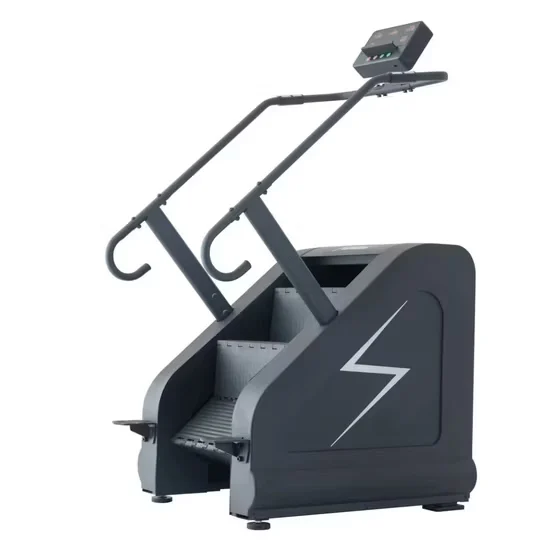
Sub-35dB Operation — verified in hotel deployments where cardio equipment shares walls with occupied guest rooms.
Technical Specifications
| Parameter | Value |
|---|---|
| Designation | SQ-1019 |
| Product Type | Stair Climber |
| Drive Type | Electric Drive |
| Speed Range | 15 RPM – 164 RPM |
| Max User Weight | ≤200kg |
| Console Type | OSD (Steps, Time, Calories, Speed, Heart Rate) |
| Power Requirement | AC 220V+10% / AC 110V+10% |
| Product Dimensions | 1140×805×1860mm |
| Net Weight | 136kg |
| Material | Aluminium Alloy Pipe + PP Plastic |
| Foldable | Unfolded |
| Certification | CE, RoHS, ISO |
| Warranty | One Year |
| Customization | Available |
Application Suitability
| Deployment Scenario | Typical Use |
|---|---|
| hotel fitness center on guest room floors | 24-hour guest access requiring whisper-quiet stair climbing |
| chain gym cardio zone | high-frequency stair climbing stations for member circuit training |
| corporate wellness room | multi-shift employee cardio programs with data capture |
| high-end residential home gym | private stair climbing alongside other cardio disciplines |
| sports performance training center | athlete conditioning with real-time heart rate and speed tracking |
Why Noise Complaints Reach the Front Desk Before Maintenance Does
The commercial stair climber SQ-1019 electric stepmill addresses acoustic sensitivity through its reinforced aluminium alloy frame and electric drive isolation.
Stair climbers generate rhythmic vertical loads that transmit through floor structures, and when equipment sits above occupied spaces, structural vibration becomes the primary complaint vector — not airborne noise from the motor itself. Facility operators often discover that light-commercial units pass initial noise checks but degrade noticeably within months as bearings wear and frame joints loosen under continuous climbing loads [NEED_CITE: structural vibration transmission in multi-floor commercial fitness deployments]. The SQ-1019’s 136kg net weight and aluminium alloy construction provide the mass and rigidity needed to dampen vibration transfer, keeping noise complaints from reaching the front desk during overnight guest hours.
Vertical Climbing Workload and Cardio Zone Integration
The SQ-1019 commercial stair climber SQ-1019 electric stepmill delivers continuous vertical stepping from 15 RPM through 164 RPM, covering low-intensity recovery climbs up to high-cadence interval work. In a multi-discipline cardio zone, stair climbers complement treadmills and ellipticals by loading the glutes and quadriceps through a different movement plane, which is why facilities typically position them between running and cycling stations. The 200kg user weight capacity accommodates a broad member profile without requiring separate heavy-duty variants. The OSD console captures steps, elapsed time, caloric expenditure, speed, and heart rate in real time for workout tracking without requiring external devices.
Continuous Operation and Deployment Environment Requirements
Commercial stair climbers in hotel fitness centers often run 18 or more hours daily, which demands an electric drive system rated for continuous duty rather than intermittent home use [NEED_CITE: motor duty cycle classification for continuous commercial operation]. The dual-voltage input (AC 220V / AC 110V) eliminates the voltage mismatch that surfaces only after a container arrives at an international destination. Deployment on hotel guest room floors requires attention to structural vibration, and placing the unit on a level surface with appropriate isolation pads reduces transmission to rooms below. The OSD console outputs workout metrics that facility management systems can capture for usage analytics, though operators should confirm data interface compatibility before specifying integration with member apps. Adequate airflow around the 1140×805mm footprint prevents heat buildup during back-to-back usage across peak hours.
Electric Drive and Frame Engineering Decoded
The electric drive system in the SQ-1019 commercial stair climber SQ-1019 electric stepmill eliminates the cadence-dependent resistance feel that manual climbers produce at low stepping speeds, maintaining consistent load from 15 RPM upward. Aluminium alloy pipe construction reduces overall corrosion risk in humid environments like hotel basements or coastal resort gyms while providing sufficient structural rigidity for the 164 RPM upper speed range. The OSD console uses optical or contact-based heart rate sensing through grip sensors, which delivers adequate accuracy for general cardio programming but may drift during high-sweat intervals compared to chest-strap telemetry. Dual-voltage capability means the same production unit ships to 220V and 110V markets without transformer adapters, reducing both failure points and post-arrival rework [NEED_CITE: EN 957 requirements for commercial cardio equipment electrical safety].
The Hidden Cost of Specifying Below Commercial Grade
Facilities that deploy light-commercial stair climbers in high-traffic zones typically experience motor burnout within the first year, as continuous climbing loads exceed the duty cycle those motors were engineered for [NEED_CITE: premature motor failure in light-commercial cardio under continuous public use]. Noise degradation follows a similar pattern — bearings and frame connections that perform acceptably in low-volume settings develop audible play after months of uninterrupted operation, generating member complaints that force early replacement. Voltage mismatches represent a different category of avoidable cost: specifying a single-voltage unit for an international gym chain without verifying destination electrical standards results in entire shipments requiring transformers or complete return. Data isolation compounds operational blind spots when consoles cannot report usage metrics to facility management platforms.
Why This Product Line Earns Deployment Trust
Every SQ-1019 unit undergoes continuous high-frequency testing aligned with 10,000-hour durability standards covering motors, frames, and bearings. Sub-35dB operation has been verified in actual hotel deployments where the stair climber operates on floors adjacent to occupied guest rooms. The full six-series cardio family means a facility can source treadmills, ellipticals, bikes, rowing machines, and this stair climber from a single product line with consistent console interfaces. OEM customization extends to console UI, color, and logo, with the SQ-1019’s compact 1140×805mm footprint informing 3D cardio-zone layout planning that accounts for member flow and sightlines. Technical support responds on a 24/7 basis to keep equipment operational across time zones.
Documentation & Test Records
- CE declaration of conformity for the SQ-1019 electric stair climber
- EN 957 test report covering structural and safety requirements
- ISO 9001 certificate for manufacturing quality management
- RoHS compliance documentation for restricted substance limits
- Noise level test report for hotel floor deployment verification
- Console technical documentation with OSD data interface details
Installation, Commissioning & Maintenance
- Maintain clearance around the 1140×805mm footprint for safe member entry and exit
- Level the aluminium alloy frame on vibration isolation pads to reduce floor transmission
- Connect to a dedicated circuit matching the specified AC 220V or AC 110V input
- Calibrate OSD console sensors and verify RPM accuracy at multiple speed settings during commissioning
- Inspect electric drive components and fasteners per the scheduled maintenance interval
- Wipe down PP plastic shrouds and grip surfaces daily to prevent sweat corrosion
Specifying the Right Configuration for Your Facility
Provide your cardio zone square footage and equipment count to receive a 3D layout that accounts for the SQ-1019’s dimensions and member circulation paths. Specify expected daily run-time so the electric drive duty cycle matches your operational demands. Confirm the deployment floor and adjacent occupied spaces to validate noise requirements. State your target market voltage standard and plug type before production begins. Indicate whether OSD console data should integrate with your facility management software.
Frequently Asked Questions
Q: What is the difference between electric-drive and manual stair climbers for commercial use?
A: Electric-drive stair climbers like the SQ-1019 maintain consistent resistance regardless of stepping cadence, which matters in commercial settings where members use the full 15 to 164 RPM range. Manual units rely on user momentum and feel noticeably lighter at low speeds, creating an inconsistent training stimulus that frustrates members during warm-up intervals.
Q: Can the OSD console sync with facility management software or member apps?
A: The OSD console on this commercial stair climber SQ-1019 electric stepmill captures steps, time, calories, speed, and heart rate for real-time display. Operators planning to integrate usage data with facility management platforms should request console technical documentation to confirm data interface compatibility and available output protocols before finalizing specifications.
Q: How does dual-voltage input work for international deployment?
A: The SQ-1019 accepts both AC 220V and AC 110V input, allowing the same unit to deploy in markets with different electrical standards without external transformers. Specify your destination voltage and plug type during ordering so the correct power cord ships with the unit, eliminating post-arrival mismatches that delay facility opening.
Q: What noise level can be expected during continuous operation in hotel environments?
A: Sub-35dB operation has been verified in hotel fitness center deployments where stair climbers operate on guest room floors. Achieving this level depends on proper installation including frame leveling and vibration isolation pads. Request the noise level test report to confirm suitability for your specific floor construction and adjacent room layout.
![Commercial Stair Machine for Gyms Multifunctional New Arrival[WARN] draft identifier mismatch](https://bicksport.com/wp-content/uploads/2026/08/commercial-stair-machine-for-gyms-multifunctional-new-arrivalwarn-draft-identifier-mismatch-8b2695.webp)
![SQ1017 Commercial Stair Climber – Motor-Driven Stepmill for Gyms [WARN] draft identifier mismatch](https://bicksport.com/wp-content/uploads/2026/08/sq1017-commercial-stair-climber-motor-driven-stepmill-for-gyms-warn-draft-identifier-mismatch-340321.webp)
![Premium Commercial Stair Trainer for Fitness Centers and Gyms [WARN] draft identifier mismatch](https://bicksport.com/wp-content/uploads/2026/08/premium-commercial-stair-trainer-for-fitness-centers-and-gyms-warn-draft-identifier-mismatch-b5cc7e.webp)