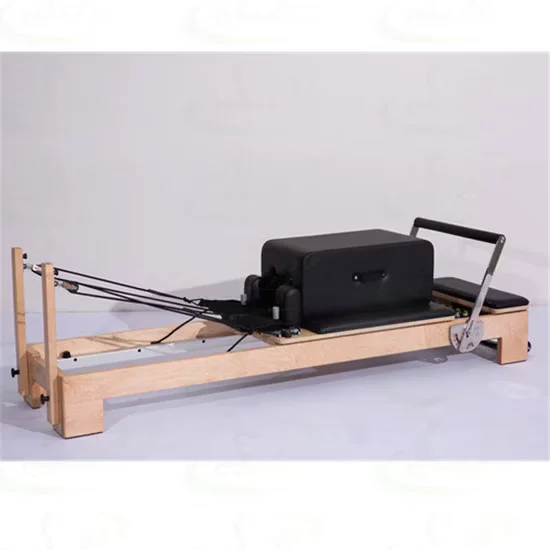
Quiet Operation Through Solid Wood Frame — natural vibration dampening eliminates the metallic resonance that triggers noise complaints in shared residential and hotel deployments.
Technical Specifications
| Parameter | Value |
|---|---|
| Product Type | Pilates Reformer |
| Material | Wood |
| Product Dimensions | 2460 × 730 × 680 mm |
| Net Weight | 100 kg |
| Accessory Options | Long Box, Jump Board, Platform |
| Color Options | Solid Color (customizable) |
| Max User Weight | Standard commercial rating |
| Warranty | 3 Years |
| Target User | Adult, Unisex |
| Customization | Logo, Color, Finish |
| Production Capacity | 80 Pieces/Month |
Application Suitability
| Deployment Scenario | Typical Use |
|---|---|
| High-end residential home gym | Private Pilates training integrated into living spaces where noise transmission to adjacent rooms must be minimized |
| Boutique Pilates studio | Group and semi-private reformer classes requiring aesthetically warm equipment that fits a curated interior |
| Five-star hotel wellness suite | Guest-accessible reformer sessions on floors adjacent to occupied rooms, where metallic vibration would trigger complaints |
| Private rehabilitation space | Controlled spring-load exercises for recovery clients in quiet clinical environments |
What Spring Squeak and Carriage Roll Tell You About Frame Selection
A wooden-frame reformer eliminates metallic resonance at the source rather than masking it with felt pads and rubber dampeners.
I have walked into hotel wellness floors where steel-frame reformers transmitted carriage vibration through concrete slabs into the rooms below, and the front desk logs showed noise calls before the maintenance team even scheduled an inspection. The problem is not the springs or the wheels in isolation — it is the steel frame acting as a resonant cavity that amplifies every micro-vibration into audible structure-borne noise. A solid wood frame behaves fundamentally differently: the cellular structure of hardwood naturally absorbs and dissipates vibrational energy, preventing it from reaching the floor and traveling through the building [NEED_CITE: structure-borne noise transmission through floor assemblies in multi-story hospitality buildings]. For a wooden Pilates reformer bed home use scenario, this distinction determines whether the equipment can coexist with living spaces or whether it must be isolated in a dedicated room.
Where This Reformer Sits in a Studio or Home Layout
This reformer covers the full spectrum of spring-loaded Pilates work — from supine footwork through advanced jump board plyometrics — without requiring supplementary apparatus. In a boutique studio cardio and strength configuration, it occupies the controlled-movement zone, complementing mat areas and tower units by handling the reformer-specific repertoire that neither can replicate. The 2460 mm length accommodates full-body extension for users across a wide height range, while the 100 kg net weight provides the inertial stability necessary for dynamic jump board exercises without frame shift. The wooden Pilates reformer bed home use deployment positions this unit as the primary resistance-training anchor in private or semi-private settings.
Floor Loading, Clearance, and Vibration Path Considerations
At 100 kg net weight plus user load, floor structural capacity should be verified before deployment on upper floors or suspended slab constructions. The 2460 mm footprint requires clearance on at least two sides for safe mounting, dismounting, and accessory changeover — particularly when the long box or jump board extends the operational envelope beyond the base dimensions [NEED_CITE: minimum clearance requirements for Pilates reformer installation in commercial wellness spaces]. Floor leveling is critical: an uneven surface causes carriage drift and uneven rail wear, which manifests as lateral wobble during high-repetition spring work. For multi-story residential or hotel deployments, the solid wood frame reduces structure-borne vibration, but a high-density rubber mat beneath the unit further decouples residual energy from the floor slab. Ambient humidity control matters for wood-frame equipment — sustained low humidity can cause timber movement that affects rail alignment over time.
Reading the Spring Tension Grading and Carriage Rail Interface
The spring system is the resistance engine of any reformer, and tension grading determines whether the unit serves rehabilitation clients at light loads or athletic users at heavy settings. Springs should be color-coded or clearly labeled by resistance level, and the attachment points on the carriage must engage cleanly without lateral play. The carriage rail interface is where wood-frame construction demonstrates its maintenance advantage: hardwood rails with low-friction wheel assemblies provide smooth travel without the metallic chatter that develops in steel-rail systems as bearing surfaces wear [NEED_CITE: carriage rail wear patterns and maintenance intervals in wood versus steel reformer frames]. The long box, jump board, and platform accessories mount to standardized interface points on the frame — verifying that these mounting surfaces are reinforced and precisely aligned prevents wobble and premature wear at the attachment hardware. Solid wood construction also means the frame can absorb the repeated impact forces from jump board work without the fatigue cracking that can develop at welded steel joints under high-frequency plyometric loading.
The Cost of Underspecifying Frame Material in Quiet Environments
Facilities that selected steel-frame reformers for hotel wellness suites or residential-adjacent studios have faced predictable consequences: carriage roll vibration transmitted through floor slabs generates noise complaints, and the typical response — adding rubber isolation pads — addresses the symptom rather than the resonance source. Spring squeak in metal-on-metal contact points increases as units accumulate usage hours, requiring progressively more frequent maintenance visits. In private home deployments, a reformer that generates audible noise during evening sessions becomes equipment the owner stops using. These outcomes are avoidable when frame material is treated as a primary specification criterion rather than an aesthetic preference [NEED_CITE: equipment replacement cycles driven by noise complaints in hospitality fitness environments].
Why Operators Source This Reformer Line
The solid wood frame addresses the noise transmission problem at the structural level, making this unit deployable in shared-wall and above-occupied-room scenarios where steel frames fail. The full accessory ecosystem — long box, jump board, and platform — means a facility or homeowner sources the complete reformer repertoire from a single footprint rather than accumulating supplementary apparatus. Customization of logo, color, and finish allows brand alignment for boutique studios and residential integrators without requiring separate procurement channels. The 3-year warranty reflects confidence in the structural longevity of hardwood construction under repeated spring-load and plyometric cycles. Biketon Sport’s capacity for OEM and ODM customization extends to this reformer line, supporting operators who need equipment that matches a specific interior design language or brand identity. Free layout planning is available to position this unit within a broader studio or home gym configuration, accounting for clearance, sightlines, and user flow around the 2460 mm footprint.
Documentation & Test Records
- Material specification sheet confirming wood species and finish treatment
- Spring tension grading chart with resistance values per spring color
- Carriage rail smoothness and alignment test record
- Accessory fitment compatibility verification for long box, jump board, and platform
- Warranty terms and conditions covering frame, springs, and hardware
Installation, Commissioning & Maintenance
- Verify floor levelness across the 2460 × 730 mm footprint before placement to prevent carriage drift
- Place high-density rubber mat beneath the 100 kg frame to decouple residual vibration from floor slab
- Inspect spring attachment points and carriage wheel alignment upon delivery and after first 50 hours of use
- Confirm long box, jump board, and platform mounting hardware torque to frame specifications
- Maintain ambient humidity within wood-safe range to prevent timber movement affecting rail alignment
- Clean carriage rails and wheel surfaces with non-solvent cleaner to preserve smooth travel
Planning Your Reformer Deployment
Provide your studio or home gym floor dimensions and intended user volume to receive a layout plan that accounts for the 2460 mm reformer footprint plus operational clearance on all sides. Specify whether the deployment floor is above occupied spaces so noise transmission requirements can be matched to frame and mat specifications. Indicate any brand customization needs — logo, color, or finish — to confirm lead time against the 80 pieces per month production schedule. Clarify whether the unit will serve private sessions, semi-private groups, or open studio access to determine appropriate spring configuration and accessory allocation.
Frequently Asked Questions
Q: How does a wood-frame reformer compare to steel-frame in terms of noise and maintenance?
A: Solid wood naturally dampens vibration that steel frames transmit as audible resonance through floor structures. This means fewer noise complaints in multi-story deployments. Wood frames also avoid the metallic contact points where spring squeak and rail chatter develop over time, reducing the frequency of maintenance interventions required to keep the unit operating quietly.
Q: What should I check when evaluating carriage rail smoothness and spring tension?
A: Run the carriage through its full travel range by hand — it should move without lateral play, binding, or audible friction. Springs should engage cleanly at each attachment point with consistent resistance across the pull range. Verify that tension grading matches your user population: lighter springs for rehabilitation, heavier for athletic conditioning.
Q: Which exercises do the long box, jump board, and platform enable?
A: The long box supports seated and supine pulling exercises and spinal articulation work. The jump board converts the reformer into a horizontal plyometric device for lower-body power training. The platform extends the standing surface for balance and standing spring work, expanding the repertoire beyond what the carriage alone provides.
Q: What customization is available for studio branding or residential aesthetics?
A: Logo application, frame color, and finish can be customized to align with studio branding or interior design requirements. Confirm wood species and surface treatment options with the factory to ensure the finish meets moisture resistance and tactile quality expectations for your specific deployment environment.