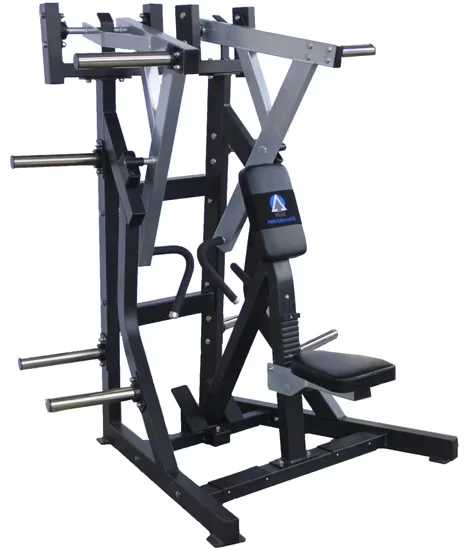
Heavy-Duty Frame Rigidity — 139kg steel construction ensures zero flex during peak-load pulling, verified across high-traffic commercial deployments.
Technical Specifications
| Parameter | Value |
|---|---|
| Product Type | Integrated Gym Trainer |
| Designation | OS-H5005 |
| Exercise Part | Back |
| Frame Material | Steel |
| Product Dimensions | 1231 × 1360 × 1503 mm |
| Net Weight | 139 kg |
| Movement System | ISO-Lateral Independent Arms |
| Seat & Cushion Color | Available per customer requirements |
| Main Frame Color | Available per customer requirements |
| Fit Area | Professional Gym and Club |
| Appliance | Community, Gymnasium |
| Age Group | Adult |
| Gender | Unisex |
| OEM/ODM | Acceptable |
| Transport Package | Plywood Box |
| HS Code | 9506911900 |
| Certification | ISO 9001, CE |
Application Suitability
| Deployment Scenario | Typical Use |
|---|---|
| Chain gym strength zone | High-frequency back training across peak member hours with low maintenance intervals |
| Corporate wellness room | Diverse employee demographic performing controlled rowing movements during lunch and post-work windows |
| Community fitness center | Supervised and unsupervised back sessions by users of varying strength levels |
| Sports performance training center | Targeted latissimus and rhomboid loading for athlete conditioning programs |
| Professional club free-weight adjunct | Complementary cable-based back work between barbell and dumbbell stations |
Why Frame Resonance Shows Up Before the Warranty Does
A rigid steel frame eliminates the harmonic vibration that loosens pivot bolts on lighter competitors.
When a 150kg athlete loads a mid-row pull on a machine built with thinner-gauge tubing, the frame flexes. That flex travels into the pivot bearings, accelerates wear on the bushings, and eventually produces a metallic rattle that members notice before the maintenance team does [NEED_CITE: structural vibration fatigue in commercial resistance equipment]. The ISO-Lateral Low Row commercial strength equipment addresses this with a 139kg steel frame that absorbs load without deflection, keeping pivot points aligned through years of heavy cycles. I have seen lighter units pulled from gym floors within eighteen months because the wobble made members avoid the station entirely.
Back Training Coverage in a Mixed Cardio and Strength Layout
This unit targets the mid and lower back through a converging pull path, filling the gap between lat pulldown stations and free-weight barbell rows. The ISO-Lateral Low Row commercial strength equipment pairs well with a chest press and shoulder press from the same lineup, forming a complete upper-body circuit that keeps member traffic flowing. It suits medium-to-high density placement where floor space allows roughly one meter of clearance on each side for loading and unloading weight plates. The seat and pad geometry accommodates users from lighter recreational lifters through heavy-set athletes without adjustment beyond the standard seat height pin.
Continuous Pull Cycles and Facility Environment Factors
Commercial strength machines face a different duty cycle than cardio units — fewer hours of non-stop motion, but far higher peak loads per rep [NEED_CITE: duty cycle classification for commercial strength training equipment]. The steel frame handles these repeated peak pulls without cumulative deformation, but the facility still needs level flooring to prevent uneven load distribution across the base feet. In spaces where humidity from adjacent pools or locker rooms drifts into the strength area, the powder-coated surfaces resist surface corrosion when routine wipe-downs are maintained. Adequate overhead clearance is required for the 1503mm frame height plus any top-mounted accessory hooks.
Reading the Spec Sheet Beyond the Weld Seams
The 139kg net weight of this Integrated Gym Trainer signals substantial tubing wall thickness and reinforced gusset plates at the main junctions. ISO-Lateral independent arms mean each side of the pull path operates on its own pivot, preventing the stronger arm from compensating for the weaker side — a common issue on fixed-bar machines that masks muscle imbalances during assessments. The steel frame construction pairs with sealed pivot bearings that require only periodic lubrication rather than full replacement under normal commercial use. Seat and pad adjustments use pop-pin mechanisms rated for thousands of insertion cycles, which matters when multiple users swap settings between every set [NEED_CITE: EN 957 requirements for selectorized strength equipment].
What Light-Gauge Frames Cost After the First Year
Facilities that selected lighter back machines to save on initial outlay frequently report callback visits within the first year. Pivot bushings ovalize under repeated heavy loads, creating slop in the arm travel that members interpret as poor build quality. Welds at the base-to-upright junction develop hairline cracks when the frame flexes on every repetition. Entire stations get cordoned off for repair while members migrate to competitors with better-maintained floors [NEED_CITE: commercial gym equipment downtime and member retention correlation]. The mass of this unit is not excess — it is the structural reserve that keeps pivot geometry tight through daily abuse.
Why This Lineup Fits the Procurement Shortlist
The OS-H5005 sits within a full strength series that allows a facility to source every upper and lower body station from one manufacturing partner, simplifying spare parts inventory and color consistency. OEM and ODM customization extends to frame color, cushion color, and brand markings so the equipment matches the facility interior palette. Each unit ships with documentation covering weld inspection records, load test certificates, and assembly sequences. The manufacturer provides 3D layout planning that accounts for the 1231 × 1360mm footprint plus operational clearance, ensuring member flow between stations does not create bottlenecks during peak hours. Post-delivery technical support covers calibration questions and wear-part sourcing around the clock.
Documentation & Test Records
- CE declaration of conformity covering mechanical safety of the selectorized frame
- EN 957 test report for static and dynamic load verification on pivot assemblies
- ISO 9001 certificate confirming quality management across the fabrication process
- Noise and vibration assessment record for the independent arm mechanism
- Weld inspection report documenting joint integrity at primary structural nodes
- Spare parts catalog with part numbers for bearings, cables, and pop-pins
Installation, Commissioning & Maintenance
- Allocate minimum one meter lateral clearance around the 1231 × 1360mm base for safe plate loading
- Level the floor contact feet before anchoring to prevent uneven pivot loading on the ISO-Lateral arms
- Perform initial cable tension calibration and verify full range of motion on both independent arms
- Lubricate pivot bearings and inspect cable sheathing every quarter under standard commercial frequency
- Wipe down pads and frame with non-corrosive cleaner after each operational day to prevent sweat accumulation
Request a Deployment Assessment
Share your strength zone floor plan and planned station count to receive a 3D layout showing operational clearance and member traffic flow around each unit. Specify your daily member throughput so we can recommend maintenance intervals matched to your actual usage pattern. Indicate whether the installation floor sits above occupied spaces to confirm whether vibration isolation pads are necessary. Confirm your target market so that any documentation and labeling requirements are addressed before production.
Frequently Asked Questions
Q: How does an ISO-Lateral arm design differ from a fixed-bar rowing machine?
A: Independent arms allow each side to move through its own arc without being constrained by the other. This prevents the dominant side from overcompensating, which is especially valuable during rehabilitation or when training athletes with known asymmetries. The trade-off is a slightly more complex pivot assembly that requires periodic bearing inspection.
Q: What determines the structural weight of a commercial strength frame?
A: Tubing wall thickness, gusset plate reinforcement at load-bearing junctions, and the mass of the pivot hardware all contribute. A heavier frame resists deflection under peak loads, which preserves alignment of the movement path over years of use. Weight alone is not sufficient — weld quality and material grade matter equally.
Q: Can the frame and cushion colors be matched to an existing gym interior?
A: Yes. The manufacturer accepts color specifications for both the powder-coated frame and the upholstery cushion. A sample swatch approval step is typically included before full production runs to confirm visual match under the facility lighting conditions. Lead times depend on color availability and order volume.
Q: What maintenance intervals should a high-traffic gym plan for this unit?
A: Pivot bearings should be lubricated quarterly, cable sheathing inspected monthly for fraying, and pop-pin mechanisms checked for secure engagement weekly. Actual intervals depend on daily usage volume — facilities running supervised group sessions back-to-back may need to compress the schedule accordingly.
Q: What is the typical MOQ and production lead time for OEM customization?
A: Minimum order quantities vary depending on the extent of customization — logo imprint, color changes, and console or label modifications each have different thresholds. Production lead time is calculated after the customization scope is confirmed and sample approval is completed. Discuss your specific requirements during the inquiry stage.