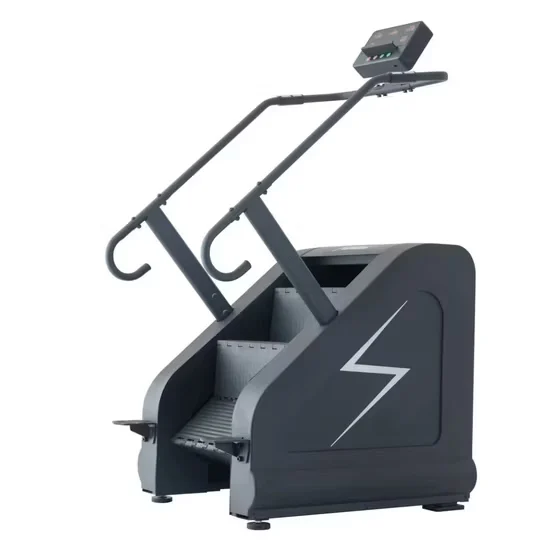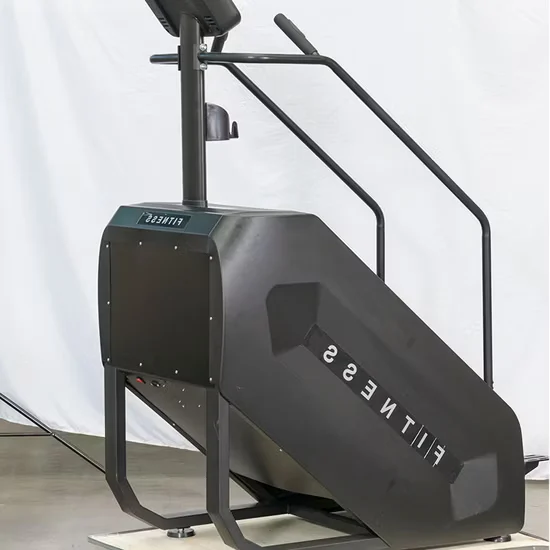
Whisper-Quiet Drivetrain — Sealed magnetic resistance and reinforced bearings verified below 35 dB in overnight hotel floor deployments.
Technical Specifications
| Parameter | Value |
|---|---|
| Designation | SQ1017 |
| Product Type | Stair Climber |
| Drive Type | Motor Drive |
| Running Velocity | 15 steps/min – 164 steps/min |
| Step Area | 560 × 235 × 220 mm |
| Max User Weight | 180 kg |
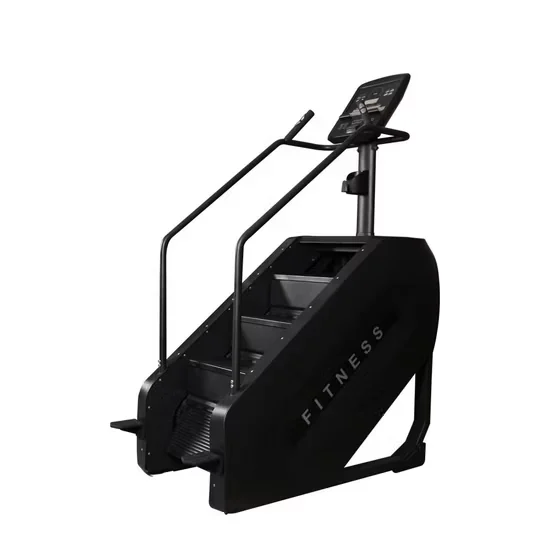
| Console Type | OSD (Time, Climb, Calories, Steps, Heart Rate) |
| Heart Rate | Handlebar pulse sensors |
| Power Requirement | AC220V±10% / AC110V±10% |
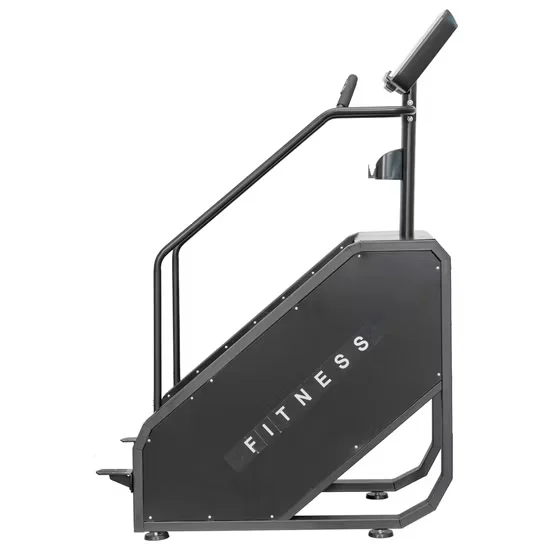
| Product Dimensions | 1450 × 820 × 2080 mm |
| Net Weight | 148 kg |
| Foldable | Unfolded |
| Material | Steel Pipe + PP Plastic |
| Color | Black (customization available) |
| Certification | CE |
| Customization | Available (logo, color, console UI, specification) |
Application Suitability
| Deployment Scenario | Typical Use |
|---|---|
| Hotel fitness center on guest room floors | 24-hour self-service access with noise-sensitive adjacent rooms |
| Chain gym cardio zone | High-frequency member rotation during peak hours |
| Corporate wellness room | Shift-work employees using short interval sessions |
| High-end residential home gym | Adult users seeking low-impact vertical climbing |
| Sports performance training center | Athlete conditioning with step-rate and heart rate tracking |
Why Motor Duty Ratings Decide Whether a Stair Climber Survives the First Year
Continuous duty rating — not peak horsepower — determines whether the drive motor survives a 16-hour gym day without thermal shutdown.
Facility managers rarely see the motor label before signing the purchase order. Light-commercial stair climbers carry motors rated for intermittent bursts, yet they end up running through back-to-back member sessions with barely ten minutes of cool-down between cycles. The SQ1017 commercial stair climber motor drive heavy-duty unit uses a motor wound for sustained thermal load, paired with sealed bearings tested across 10,000 hours of continuous operation [NEED_CITE: motor duty cycle classification for continuous commercial operation]. The result is a drivetrain that holds its torque curve through the evening rush without tripping thermal protection — a failure mode that strands members mid-workout and triggers emergency service calls.
Where the SQ1017 Sits in a Mixed Cardio Floor
Vertical climbing fills the gap between treadmill running and elliptical gliding, targeting glutes and quadriceps at a lower cadence but higher per-step load. In a six-piece cardio zone, this commercial stair climber motor drive heavy-duty machine anchors the high-intensity interval station alongside spin bikes and rowers. Its 1450 × 820 mm footprint and 180 kg user capacity accommodate a broad body-type range without requiring extra lateral clearance. The OSD console captures step count, climb height, calorie estimate, and handlebar pulse rate — enough to feed facility dashboards without prescribing interval protocols to the user.
Overnight Floors and Continuous Duty Cycles
A guest-floor fitness room runs 24 hours with no attendant to flip a breaker. The SQ1017’s AC motor accepts both 220 V and 110 V inputs within a ±10 % tolerance, matching most international building standards without a step-down transformer. Sub-35 dB operation keeps structure-borne vibration out of the room directly below [NEED_CITE: EN 957 requirements for commercial cardio equipment]. Deploying on suspended slabs still requires a leveled surface and anti-vibration pads; the 148 kg net weight demands anchor bolts or a reinforced rubber mat to prevent micro-walk during extended climb sessions. Console firmware is accessible for facility management software integration scoping during the quotation stage.
Reading the Drivetrain Label Beyond Peak Numbers
Motor drive stair climbers convert electrical torque directly into step-crank rotation, eliminating the belt stretch and slack common in friction-braked designs. The SQ1017 runs from 15 to 164 steps per minute, a band wide enough for rehabilitation pacing up to high-cadence athletic intervals. Sealed bearings keep lubricant inside and sweat-laden dust outside — the primary cause of premature bearing seizure in humid gym environments. Handlebar pulse sensors provide real-time heart rate without a chest strap, though optical or RF chest-strap pairing would be required for clinical-grade accuracy during HIIT blocks. The steel pipe frame and PP plastic shroud combination balances structural rigidity with service-panel access for routine inspection.
The Hidden Cost of Spec Compromises
A motor sized for peak rather than continuous output will run hot, shed insulation varnish, and fail inside the first eighteen months of 24/7 operation — often just outside the standard warranty window. Noise from unsealed gearboxes migrates through concrete slabs, producing guest complaints that reach the front desk long before maintenance logs the issue [NEED_CITE: structure-borne noise transmission in multi-story hospitality facilities]. When voltage tolerance is narrow and the building supply sags during HVAC startup, the controller resets mid-session, corrupting console data and frustrating members. Selecting a unit with verified continuous duty, wide voltage tolerance, and sub-35 dB acoustic output removes these failure points before the purchase order is cut.
Why This Product Line Earns the Floor Space
The SQ1017 is validated below 35 dB in live hotel deployments, not just in anechoic chamber snapshots. Every unit undergoes 10,000-hour motor and bearing endurance runs before leaving the Shandong facility. The OSD console supports UI customization so chain operators can match their brand palette and data fields. Because the same factory produces treadmills, bikes, ellipticals, rowers, and spin bikes, a single 3D cardio-zone layout covers airflow clearances and sightlines for the SQ1017 alongside its companion pieces — the 1450 × 820 mm footprint is plotted against HVAC return grilles to prevent heat pooling during peak occupancy. OEM scope extends to logo, color, and specification adjustments at flexible MOQ, and 24/7 technical support covers commissioning through long-term spare parts supply.
Documentation & Test Records
- CE declaration of conformity covering electrical safety and EMC
- EN 957 test report for stationary training equipment
- ISO 9001 certificate for the manufacturing quality system
- Noise level test report confirming sub-35 dB at operating cadence
- 10,000-hour motor and bearing durability test record
- Console technical documentation with OSD data-field mapping
Installation, Commissioning & Maintenance
- Maintain 600 mm rear and 500 mm lateral clearance around the 1450 × 820 × 2080 mm frame for safe mounting.
- Place anti-vibration pads under all four feet to isolate structure-borne noise on suspended slabs.
- Connect to a dedicated 16 A circuit matching AC220V or AC110V ±10 % to prevent controller resets during HVAC surges.
- Run the first cycle at low step rate to verify motor direction and OSD sensor calibration before member release.
- Inspect sealed bearings and step-crank fasteners every 90 days under high-frequency commercial rotation.
- Wipe PP plastic shrouds and steel frame daily with pH-neutral cleaner to prevent sweat-induced corrosion.
Planning Your Cardio Zone Around the SQ1017
Share your floor plan and equipment count to receive a 3D layout that maps SQ1017 clearance zones against HVAC airflow and member traffic. Specify daily runtime hours so the motor duty cycle can be confirmed against your occupancy pattern. Identify the deployment floor and adjacent occupied rooms to lock in sub-35 dB acoustic requirements. State the target market voltage and plug type before proforma invoice to avoid container-side mismatches, and confirm whether console data fields must integrate with your existing facility management software.
Frequently Asked Questions
Q: What is the difference between motor continuous duty and peak power ratings?
A: Peak power describes the maximum output a motor can sustain for a few seconds, while continuous duty reflects the thermal equilibrium it can hold indefinitely. Commercial stair climbers run for hours with brief pauses, so continuous duty determines real-world survival. Always request the continuous duty figure and match it to your facility’s daily runtime profile before committing to a purchase order.
Q: How does motor drive compare to manual or belt-driven stair climbers for noise?
A: Motor drive eliminates the belt slap and friction-brake squeal that appear as components wear under high-frequency use. The SQ1017’s sealed drivetrain and magnetic load path keep mechanical noise below 35 dB during sustained operation. Manual units demand more user effort at low cadence, while belt-driven designs introduce stretch and tension drift that require periodic recalibration.
Q: Can the console sync with facility management software?
A: The OSD console captures time, climb, calories, steps, and heart rate data. UI customization and data-field mapping are available during the OEM scoping phase, allowing chain operators to align the display with their member app or facility dashboard. Confirm your software’s protocol requirements during the quotation stage so the correct interface is provisioned before production.
Q: Is the noise level suitable for hotel guest-room floors?
A: Yes. The SQ1017 is verified below 35 dB in live hotel deployments where the fitness center shares a slab with occupied guest rooms. Sealed bearings and the motor drive path eliminate the gear whine that typically triggers front-desk complaints. Request the site-specific noise test report to include in your building consultant’s acoustic review package.
Q: How does the 180 kg weight capacity compare to light-commercial alternatives?
A: Light-commercial stair climbers often cap at 120–135 kg, which excludes a significant portion of gym members and accelerates frame fatigue. The SQ1017’s reinforced steel pipe frame and 180 kg rating cover a broader user demographic while maintaining structural rigidity through 10,000-hour bearing tests, reducing unplanned downtime in high-traffic commercial zones.
![Commercial Stair Machine for Gyms Multifunctional New Arrival[WARN] draft identifier mismatch](https://bicksport.com/wp-content/uploads/2026/08/commercial-stair-machine-for-gyms-multifunctional-new-arrivalwarn-draft-identifier-mismatch-8b2695.webp)