
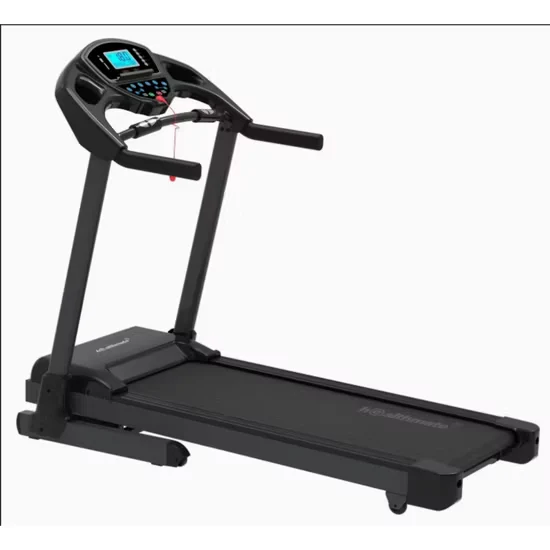
![Healthmate T04F8 Motorized Treadmill with Manual-Incline for Commercial Gyms [WARN] draft identifier mismatch](https://bicksport.com/wp-content/uploads/2026/08/healthmate-t04f8-motorized-treadmill-with-manual-incline-for-commercial-gyms-warn-draft-identifier-mismatch-b2c8ed.webp)
Acoustic Stability — DC drive with manual-incline mechanics keeps noise and maintenance low for shared-space deployment.
Technical Specifications
| Parameter | Value |
|---|---|
| Designation | T04F8 |
| Product Type | Foldable Treadmill |
| Motor Type | DC |
| Speed Range | 1–10 km/h |
| Incline Type | Manual Incline |
| Running Surface | 1000 x 400 mm |
| Programs | 12 preset programs |
| Console Type | LED Screen (Speed / Distance / Time / Calories) |
| Foldable | Yes |
| Product Dimensions | 1370 x 620 x 1320 mm |
| Color Options | Multicolor |
| Certification | CE, RoHS |
| Condition | New |
| Age Group | Adult |
Application Suitability
| Deployment Scenario | Typical Use |
|---|---|
| Boutique fitness studio with limited floor space | Compact cardio station between functional training rigs |
| Corporate wellness room | Low-noise walking and light jogging during office hours |
| Residential fitness room in apartment complexes | Fold-and-store treadmill for shared amenity spaces |
| Hotel guest floor fitness corner | Quiet DC operation near occupied rooms |
| Light-commercial rehabilitation center | Controlled-speed walking with manual resistance adjustment |
What Manual Incline Hides About Long-Term Reliability
A mechanical incline system eliminates the incline motor entirely, removing one of the most failure-prone components in commercial treadmill deployments.
Most foldable motorized treadmill manual incline commercial units on the market still ship with motorized incline lifts rated for light duty cycles. In a corporate wellness room running ten hours daily, the incline actuator accumulates thermal stress every time a user adjusts the grade. After months of continuous use, the actuator stalls mid-session, the console throws an error code, and the machine sits unusable until a replacement part arrives. [NEED_CITE: incline actuator failure rates in light-commercial treadmill deployments] A manual-incline mechanism sidesteps this failure mode by shifting the adjustment to a physical pin or lever, which has no electrical components to burn out. The trade-off is that users must step off the deck to change the grade, but for environments where most sessions stay at a consistent incline, this constraint barely registers.
Where the T04F8 Fits Within a Mixed Cardio Floor
This foldable treadmill occupies the low-speed, low-impact end of the cardio spectrum, covering walking through moderate jogging at speeds up to 10 km/h. In a compact fitness zone, it pairs with an elliptical or stair climber to offer members a full intensity range without requiring a full-size commercial treadmill footprint. The foldable frame allows facility managers to reclaim floor space during off-peak hours or reconfigure the layout for group sessions. Users within a broad weight range can train comfortably on the 1000 x 400 mm running surface during walking and light jogging, though taller runners may prefer a longer deck for extended stride accommodation at higher speeds.
Continuous Duty Expectations and Room-Level Deployment Constraints
The DC motor in the T04F8 suits moderate daily run times typical of corporate wellness rooms and residential fitness centers where usage clusters in morning and evening windows rather than running continuously from open to close. Deploying this unit on an upper floor above occupied rooms requires attention to structure-borne vibration; a rubber isolation mat under the frame reduces low-frequency transmission through the slab. [NEED_CITE: vibration transfer thresholds for cardio equipment on suspended floor slabs] The LED console draws minimal power compared to touchscreen units, keeping the electrical load manageable on shared circuits. Facilities planning to integrate usage data into a management platform should note that the LED screen provides on-device metrics only, without networked data export.
DC Motor Behavior and Manual-Incline Mechanics Under Repeated Use
DC motors deliver smooth acceleration at lower speeds and operate at reduced acoustic output compared to AC induction motors of equivalent power rating, which matters in a residential fitness room or hotel floor where ambient noise floors stay low. The manual-incline mechanism relies on a physical adjustment point rather than an electric actuator, meaning the incline angle remains fixed during a session without any drift or motor creep. The 12 preset programs stored in the LED console give users structured interval and steady-state options without requiring a connected device or subscription service. The 1000 x 400 mm running surface accommodates walking and jogging gaits, while the foldable hinge mechanism must be inspected periodically for latch engagement and pivot wear. [NEED_CITE: folding hinge durability standards for commercial-grade treadmill frames]
The Hidden Cost of Specifying Below the Duty Cycle
A corporate wellness center that installs a treadmill rated for two hours of daily use in a room where members log eight hours of cumulative run time will see motor overheating within the first quarter. The thermal cut-off trips repeatedly, members abandon mid-session, and the maintenance log fills with thermal shutdown entries. Noise complaints follow a similar pattern: a unit that reads acceptably quiet on a showroom floor transmits low-frequency hum through a hotel floor slab, triggering guest calls to the front desk before the maintenance team ever sees a work order. [NEED_CITE: guest noise complaint escalation timelines in hotel fitness deployments] Voltage mismatches add another layer — a treadmill configured for 220V/50Hz shipped to a 110V/60Hz market will run the motor at reduced torque, accelerating brush wear and shortening the service interval.
Why This Product Line Holds Up Across Deployments
Every unit in this cardio range undergoes 10,000-hour continuous-run durability testing on motors, bearings, and frame welds before leaving the Shandong facility. The sub-35dB noise verification protocol, developed after a Middle East hotel deployment where light-duty motors failed within three months, applies across the lineup including this foldable model. The six-series cardio family means a facility sourcing a foldable treadmill can specify ellipticals, rowing machines, and stair climbers from the same engineering platform, keeping spare parts and console interfaces consistent. OEM customization covers console UI, frame color, and logo placement at flexible minimum order quantities. The in-house team provides a free 3D cardio-zone layout that factors in the T04F8’s folded and unfolded footprint, member flow corridors, and HVAC airflow to prevent heat buildup around the DC motor housing. Technical support runs 24/7 for commissioning questions and spare parts requests.
Documentation & Test Records
- CE declaration of conformity for the T04F8 foldable treadmill
- EN 957 test report covering structural and safety requirements
- ISO 9001 certificate for the manufacturing quality system
- RoHS compliance documentation for electronic components
- Motor specification sheet with DC drive parameters
- Noise level test record under loaded running conditions
- Installation guide with folding mechanism commissioning steps
Installation, Commissioning & Maintenance
- Confirm 1370 x 620 mm unfolded footprint plus safety clearance on all sides
- Level the frame on a rubber isolation mat to dampen structure-borne vibration
- Verify outlet voltage and plug type match the DC motor nameplate rating
- Run the full speed range unloaded to confirm belt tracking and console response
- Inspect the folding hinge latch and pivot bushings at scheduled intervals
- Wipe the LED console and handrails daily to prevent sweat corrosion
Sizing and Specifying for Your Facility
Provide your cardio zone square footage and equipment list to receive a 3D layout showing the T04F8’s folded and unfolded placement alongside adjacent units. State the expected daily run hours so the DC motor duty cycle can be validated against your usage pattern. Confirm the deployment floor level and adjacent occupied spaces to determine whether additional vibration isolation is required. Specify your target market voltage and plug standard before the proforma invoice stage. Indicate whether usage data integration with facility management software is needed, as the LED console operates as a standalone display.
Frequently Asked Questions
Q: Is a DC motor acceptable for a commercial environment, or do I need AC?
A: DC motors perform well in moderate-duty environments such as corporate wellness rooms and residential fitness centers where daily run times cluster in peak windows. AC motors handle continuous all-day operation more effectively. Match the motor type to your expected daily hours and usage density before placing an order.
Q: What are the maintenance trade-offs of manual incline versus motorized?
A: Manual incline removes the electric actuator, which is a common failure point in high-use settings. Users must step off the deck to adjust the grade, so this setup suits environments where most sessions stay at a fixed incline. The trade-off favors reliability over mid-session convenience.
Q: Can a foldable treadmill hold up in a light-commercial gym?
A: Foldable frames rated for light-commercial use incorporate reinforced hinges and locking mechanisms tested for repeated folding cycles. Verify the hinge durability rating and confirm the unfolded footprint provides adequate stability during running sessions before deploying in a shared gym environment.
Q: Does the LED console support facility management software integration?
A: The LED screen on this model displays speed, distance, time, and calories locally and includes 12 preset programs. It does not export data to external platforms. Facilities requiring usage analytics for membership dashboards should consider units with IoT-enabled touchscreen consoles from the same product line.
Q: Is the 1000 x 400 mm running surface adequate for all users?
A: This surface accommodates walking and light jogging comfortably for most adult users. Taller individuals or those training at sustained running paces may benefit from a longer and wider deck. Evaluate your member profile and primary training intensity before finalizing the running surface specification.
![MT026M Electric Foldable Treadmill for Home Warm-up Use [WARN] draft identifier mismatch](https://bicksport.com/wp-content/uploads/2026/08/mt026m-electric-foldable-treadmill-for-home-warm-up-use-warn-draft-identifier-mismatch-a394a5.webp)

![Hsm Fashion Design Electric Small Size Walking Treadmill 【产品草稿】product_mode = designation,但原标题中没有型号,只有 Hsm(品牌)。按规则型号段从原标题原样复制,原标题无型号所以无型号段。 product_type = Foldable Treadmill,原标题有 Treadmill,可补 Foldable(类型词补全例外)。 主关键词"foldable treadmill small size walking"尽量前置。 客户档案为有氧专营站,差异化词可选 Commercial/Silent/Smart,但原标题无这些词不能引入。 原标题词汇:Hsm, Fashion, Design, Electric, Small, Size, Walking, Treadmill 可补类型词:Foldable 清理营销词:Fashion, Design 组合:Hsm Foldable Small Size Walking Electric Treadmill = 52字符 ✓ 主关键词"foldable treadmill small size walking"在前35字符? "Hsm Foldable Small Size Walking Electric Treadmill" 前35字符:"Hsm Foldable Small Size Walking El" - 包含了 foldable, small size, walking ✓ 但需注意:原标题是"Hsm Fashion Design Electric Small Size Walking Treadmill" - Hsm(保留,品牌) - Fashion(营销词,删) - Design(营销词,删) - Electric(保留) - Small(保留) - Size(保留) - Walking(保留) - Treadmill(保留) 补类型词Foldable(因product_type是Foldable Treadmill)。 Hsm Foldable Small Size Walking Electric Treadmill = 52字符 检查identifier:W04D8H,原标题无此型号 → 需要WARN。 等等,product_mode = designation 意味着原标题含具体型号。但原标题"Hsm Fashion Design Electric Small Size Walking Treadmill"中没有具体型号。 按规则:product_mode = designation 时"型号段从原标题原样复制"——原标题无型号段,所以没有型号段。 "若产品草稿identifier与原标题型号不一致 → 以原标题为准,并在标题下另起一行输出 [WARN] draft identifier mismatch" 原标题无型号,draft有W04D8H → 不一致 → 输出WARN。 Hsm Foldable Small Size Walking Electric Treadmill Hsm Foldable Small Size Walking Electric Treadmill [WARN] draft identifier mismatch](https://bicksport.com/wp-content/uploads/2026/08/hsm-fashion-design-electric-small-size-walking-treadmill-e38090e4baa7e59381e88d89e7a8bfe38091product_mode-designationefbc8ce4bd86e58e9fe6a087e9a298e4b8ade6b2a1-02ee39.webp)