
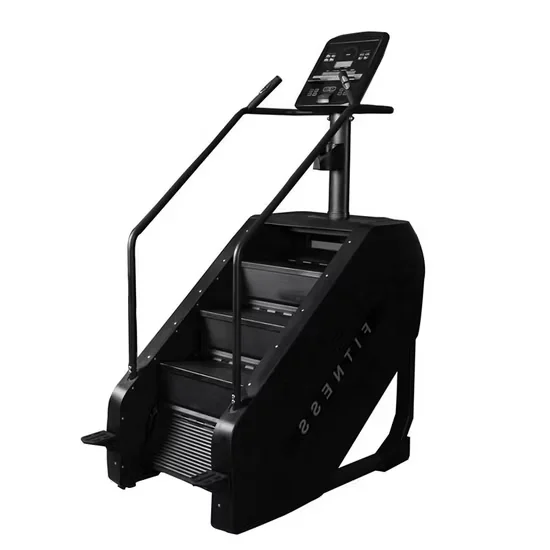
Continuous Duty Motor Architecture — Verified through 10,000-hour operational stress testing across motor, frame, and sealed bearing assemblies under high-frequency commercial deployment conditions.
Technical Specifications
| Parameter | Value |
|---|---|
| Designation | SQ1017 |
| Product Type | Stair Climber |
| Drive Type | Motor Drive |
| Function | Electric |
| Step Area | 560 x 235 x 220 mm |
| Running Velocity | 15 steps/min – 164 steps/min |
| Console Display (OSD) | Time, Climb, Calories, Steps, Heart Rate |
| Power Requirement | AC220V±10% / AC110V±10% |
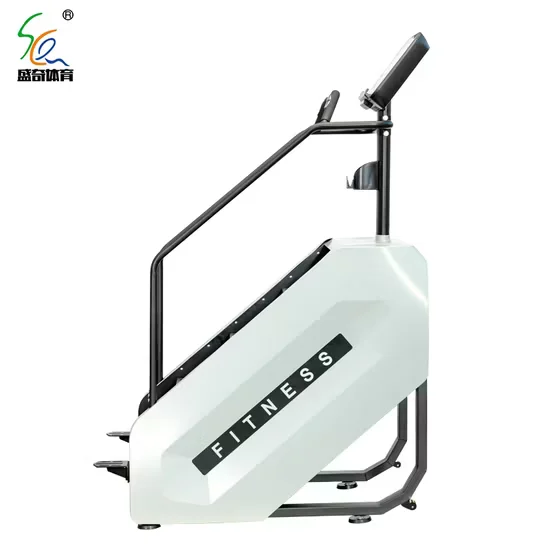
| Product Dimensions | 1450 x 820 x 2080 mm |
| Net Weight | 148 kg |
| Foldable | Unfolded |
| Material | Steel Pipe + PP Plastic |
| Color | Black |
| Certification | CE |
| Customization | Available with customized logo, color, and console UI |
| Target Users | Adult |
| Application | Home, Gymnasium |
| Max User Weight | 180 kg |
Application Suitability
| Deployment Scenario | Typical Use |
|---|---|
| hotel fitness center on guest room floors | 24-hour unsupervised access requiring sub-35dB operation and continuous motor duty |
| chain gym cardio zone | High-frequency member traffic demanding 10,000-hour component durability and IoT console sync |
| corporate wellness room | Moderate daily usage with heart rate monitoring for employee fitness tracking programs |
| high-end residential home gym | Multi-user household environment requiring stable step velocity and quiet motor operation |
| sports performance training center | Athlete conditioning with precise step rate control and real-time workout analytics |
What Continuous Motor Duty Means for Your Commercial Stair Machine for Gym Equipment Purchase
A motor rated for continuous duty sustains rated output indefinitely without thermal shutdown — peak ratings only describe momentary bursts.
Facility operators rarely ask the right question before wiring payment: they see horsepower numbers without knowing whether those numbers represent sustained output or momentary peaks. Light-commercial stair climbers deployed in public gyms typically fail within the first year because their motors were never engineered for the thermal load of back-to-back users running 164 steps per minute for sixteen hours straight. The SQ1017 commercial stair climber motor drive gym equipment addresses this by building the drive system around continuous thermal capacity rather than peak marketing numbers [NEED_CITE: motor duty cycle classification for continuous commercial operation]. When a hotel places a stair climber on a floor above occupied guest rooms, the motor must also remain thermally stable while operating at whisper-quiet acoustic levels — two demands that eliminate most light-duty drives from consideration.
Positioning the Stair Climber Within a Mixed Cardio Floor
The SQ1017 covers high-intensity vertical loading that complements the low-impact horizontal work provided by treadmills and ellipticals. In a balanced cardio zone, this commercial stair climber motor drive gym equipment occupies the anaerobic conditioning slot — members target glute and quad activation at step rates between 80 and 140 steps per minute, while the 15 steps/min floor allows rehabilitation users to begin at manageable intensity. The 560 x 235 mm step area accommodates users up to 180 kg, and the 1450 x 820 mm footprint fits standard cardio bay spacing. Console OSD outputs — Time, Climb, Calories, Steps, Heart Rate — give members real-time feedback without requiring external device pairing, which simplifies deployment in facilities that have not yet invested in app-based ecosystem infrastructure.
Continuous Operation Demands and Environmental Requirements
A 24-hour hotel fitness center will cycle this unit through an estimated 40 to 60 individual sessions daily, making thermal management and acoustic output the two non-negotiable deployment criteria. The motor drive system must sustain operation without generating noise that transmits through floor slabs into occupied rooms below — sub-35dB verified operation addresses this directly [NEED_CITE: EN 957 requirements for commercial cardio equipment noise levels]. Dual-voltage input (AC220V±10% / AC110V±10%) removes the post-shipment discovery of incompatible local power standards. Installation requires a level surface with vibration-dampening pads beneath the 148 kg steel pipe frame to prevent structure-borne noise transfer. Console data integration depends on confirming IoT protocol compatibility with the facility management software before production.
Motor Drive and Step Rate Engineering Explained
Motor-driven stair climbers use a continuous variable-speed drive rather than the user-powered alternator systems found in some competitor designs. The SQ1017 motor maintains consistent step velocity across the full 15 to 164 steps/min range regardless of user weight — a critical distinction because user-powered systems slow under heavier loads, producing an inconsistent training stimulus. The steel pipe frame construction with sealed bearings eliminates the belt stretch and pulley wear that plague chain-driven climbers after several thousand operating hours. Console heart rate monitoring relies on handlebar sensors, which provide stable readings during steady-state climbing but may lag during rapid interval transitions — facilities offering heart rate zone training should provision chest strap compatibility through the console data interface. The 560 mm step width provides lateral stability that narrow-step designs compromise, particularly for users at the upper end of the 180 kg capacity rating.
The Hidden Cost of Underspecified Commercial Equipment
Light-commercial stair climbers installed in high-traffic gym environments routinely enter thermal protection shutdown during peak hours, leaving members waiting and front desk staff fielding complaints. Motors not engineered for continuous duty accumulate winding insulation damage from repeated thermal cycling, leading to catastrophic failure well before the expected depreciation timeline. Console systems lacking standardized data output protocols strand usage information on the device itself — facility managers lose visibility into equipment utilization patterns that inform replacement and expansion decisions [NEED_CITE: commercial cardio console data integration standards]. Voltage mismatches discovered after container arrival force either expensive transformer installations or complete equipment return, both of which delay facility opening timelines.
Why This Product Line Addresses Deployment Risk
Sub-35dB acoustic operation has been validated in hotel deployments where equipment operates directly above occupied guest rooms. The 10,000-hour durability testing protocol covers motor thermal cycling, frame fatigue, and sealed bearing integrity under simulated continuous high-frequency use. The IoT-enabled console delivers workout analytics and app sync capability, eliminating the data isolation problem that blinds facility operators to actual equipment utilization. Full OEM and ODM customization extends to console UI configuration, allowing chain operators to maintain brand consistency across locations. The 3D cardio-zone layout service covers square footage, sightlines, and member flow — for the SQ1017, this means calculating the 1450 x 820 mm footprint against required front and rear clearance for safe mounting and dismounting. Technical support operates on a 24/7 response cycle to address commissioning issues across time zones.
Documentation & Test Records
- CE declaration of conformity specific to the SQ1017 stair climber
- EN 957 test report covering structural integrity and safety requirements
- ISO 9001 certificate covering manufacturing quality management systems
- Noise level test report confirming sub-35dB operation under load
- Motor specification sheet with continuous duty thermal ratings
- Console technical documentation including data interface protocols
Installation, Commissioning & Maintenance
- Maintain minimum 600 mm rear clearance for safe dismount from the 1450 mm length frame
- Install vibration-dampening pads beneath all four feet to isolate the 148 kg frame from floor structure
- Confirm local voltage matches AC220V or AC110V configuration before energizing the motor drive system
- Calibrate step rate sensor during initial commissioning to verify 15–164 steps/min accuracy
- Inspect sealed bearings at 3,000-hour intervals and replace per maintenance schedule
- Configure console IoT data output protocols to match facility management software during setup
Requesting a Deployment-Matched Quotation
Provide your cardio zone floor area and planned unit count to receive a 3D layout plan that accounts for the SQ1017 footprint, required clearance zones, and airflow patterns. Specify expected daily operating hours so the motor duty cycle can be matched to your facility’s traffic pattern. Identify the deployment floor and adjacent occupied spaces to confirm acoustic requirements. State your target market voltage and plug standard to eliminate post-shipment compatibility issues. Indicate whether console data must integrate with existing facility management software or member-facing apps.
Frequently Asked Questions
Q: What is the difference between motor continuous duty and peak power in stair climbers?
A: Continuous duty represents the output level a motor sustains indefinitely without thermal shutdown, while peak power describes momentary burst capacity lasting seconds. Commercial facilities need continuous duty ratings matched to their daily operating hours. A motor specified only by peak power will overheat and fail prematurely under back-to-back user traffic typical of public gym environments.
Q: How does the console sync with facility management software and member apps?
A: The console provides data output through configurable IoT protocols that connect to third-party facility management systems. Integration requires confirming protocol compatibility during the specification phase — we provide console technical documentation listing supported interfaces. Facilities should identify their target software platform before production so the correct communication module is installed.
Q: Can this stair climber be deployed on hotel floors without noise complaints?
A: The motor drive system and frame assembly have been verified for sub-35dB operation under load, which meets the acoustic threshold for installation above or adjacent to occupied guest rooms. Proper deployment requires vibration-dampening pads beneath the frame to prevent structure-borne noise transmission through the floor slab to spaces below.
Q: What voltage and plug standards are supported for international shipping?
A: The unit accepts AC220V±10% or AC110V±10% input, covering the primary voltage standards across global markets. Plug configuration is set during production to match the destination country standard. Facilities must specify their local voltage and plug type during the quotation phase to prevent incompatibility upon arrival.
![Commercial Stair Climber Machine for Home Gym Fitness [WARN] draft identifier mismatch](https://bicksport.com/wp-content/uploads/2026/08/commercial-stair-climber-machine-for-home-gym-fitness-warn-draft-identifier-mismatch-7b0cb3.webp)
![Commercial Stair Machine for Fitness Clubs SQ1017 [WARN] draft identifier mismatch](https://bicksport.com/wp-content/uploads/2026/08/commercial-stair-machine-for-fitness-clubs-sq1017-warn-draft-identifier-mismatch-351157.webp)
