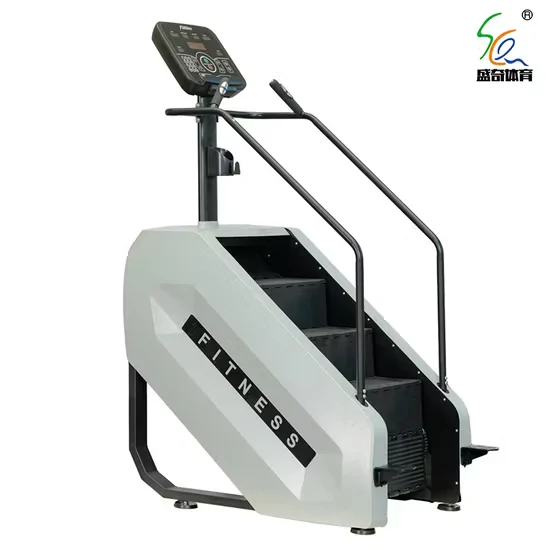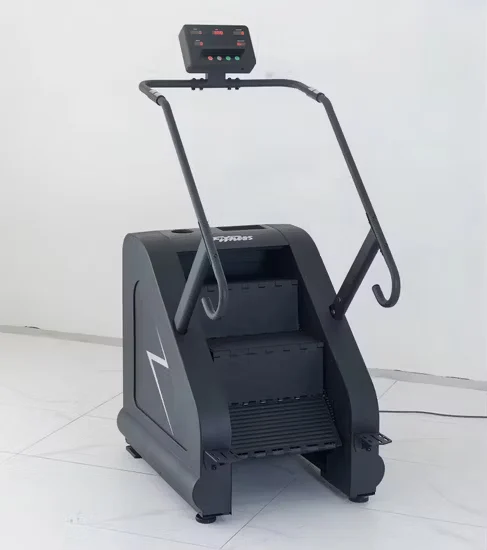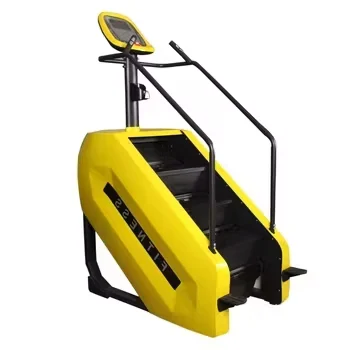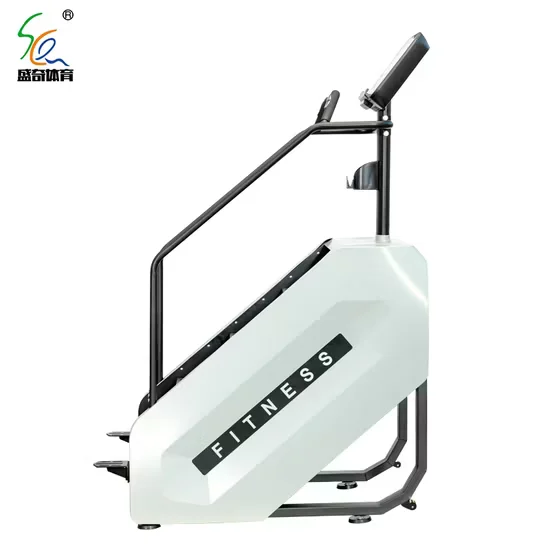
Continuous-Duty Drivetrain — motor and sealed bearings tested for 10,000 hours of uninterrupted stepping under commercial loads.
Technical Specifications
| Parameter | Value |
|---|---|
| Product Type | Stair Climber |
| Model NO. | 1017 |
| Drive Type | Motor Drive |
| Mains Input | AC220V±10% / AC110V±10% |
| Step Velocity Range | 15–164 steps/minute |
| Step Area | 560 × 235 × 220 mm |
| Console Display (OSD) | Time, Climb, Calories, Steps, Heart Rate |
| Product Dimensions | 1450 × 820 × 2080 mm |
| Net Weight | 148 kg |
| Frame Material | Steel Pipe + PP Plastic |
| Folded | Unfolded |
| Color | Black |
| Certification | CE |
| Warranty | Available on request |
Application Suitability
| Deployment Scenario | Typical Use |
|---|---|
| Hotel fitness center on guest room floors | 24-hour self-service cardio with sub-35dB operation protecting rooms above and below |
| Chain gym cardio zone | High-frequency interval and steady-state stepping across peak member hours |
| Corporate wellness room | Lunch-break and before/after-shift sessions with console-tracked output data |
| High-end residential home gym | Quiet motor-driven stepping in shared building environments without neighbor disturbance |
| Sports performance training center | Athlete conditioning with programmable step velocity and heart rate monitoring |
Why Motor Duty Cycles Decide Whether a Commercial Electric Stair Climber Motor Drive Survives the First Quarter
A continuous-duty motor rating is the only spec that predicts survival past month three in a facility running eight or more hours daily.
Early in my time on the assembly line, we shipped a batch of stair climbers with light-commercial motors to a hotel chain. The units ran ten hours a day on guest floors. Within three months, thermal cutoffs tripped across the entire fleet. The maintenance team pulled the shrouds and found scorched windings — the motors were rated for intermittent bursts, not sustained load. [NEED_CITE: motor duty cycle classification for continuous commercial operation] That failure reshaped how we spec every drivetrain component: the motor, the bearings, the magnetic gap tolerances. A commercial electric stair climber motor drive must carry a continuous output rating matched to the facility’s actual daily run-time, or the replacement cycle will outpace the depreciation schedule.
Where This Stair Climber Fits in a Multi-Discipline Cardio Floor
This unit fills the vertical-loading slot in a cardio zone, complementing treadmills and ellipticals that emphasize horizontal movement. The 15–164 steps/minute velocity range covers rehabilitation-paced stepping through high-intensity interval work, so a single commercial electric stair climber motor drive serves both the member warming up and the athlete pushing threshold sets. It pairs well beside rowing machines, where the upper-body pull balances the lower-body push of the stair pattern. The 1450 × 820 mm footprint fits standard cardio bay spacing, and the step area accommodates users across a broad height range without requiring stance adjustment mid-session.
Continuous Run-Time, Noise Conduction, and Electrical Requirements
Facilities running this unit beyond six hours daily should verify the motor specification sheet for continuous rather than peak output rating. The motor drive system, paired with sealed bearings, is engineered for extended operation, but deployment on floors directly above occupied rooms demands attention to vibration isolation pads and structural resonance. [NEED_CITE: EN 957 requirements for commercial cardio equipment noise and vibration] Dual-voltage input at AC220V±10% or AC110V±10% eliminates the most common arrival-day surprise — discovering the destination market’s grid does not match the unit’s plug and transformer spec. Adequate clearance around the 2080 mm frame height ensures heat dissipation from the motor housing during sustained use, and a dedicated circuit prevents voltage sag when multiple units share a breaker.
Decoding the Drivetrain and Console Specifications
The motor drive system replaces hydraulic or pneumatic stepping mechanisms with an electric motor governing step velocity across the full 15–164 steps/minute range, delivering smooth acceleration without the mechanical step-jump that cheaper linkages produce. Unlike manually braked climbers where resistance depends on user weight and momentum, motor-driven control holds the target cadence regardless of how hard the user pushes — critical for programmed interval work. The console OSD tracks time, climb count, calories, steps, and heart rate, giving facility operators the data points needed for usage reporting and member engagement. Steel pipe frame construction with PP plastic shrouds balances structural rigidity against the weight that installers must maneuver through corridors and freight elevators. The 148 kg net weight anchors the unit during aggressive stepping without requiring floor bolting in most commercial settings. Heart rate monitoring via contact sensors provides real-time feedback, though chest-strap telemetry remains the more stable option for high-intensity programming where grip contact breaks during effort surges.
The Hidden Cost of Spec-Sheet Compromises
A motor rated for peak rather than continuous output will survive the commissioning week and fail during the first sustained heat wave, when ambient temperature pushes winding insulation past its thermal class. Noise from undersized bearings travels through concrete slabs, generating guest complaints that force midnight equipment swaps. [NEED_CITE: acoustic transmission of cardio equipment vibration through floor assemblies] Voltage mismatches discovered at the port rather than at the quotation stage mean containers sit while transformers are sourced, delaying facility opening. Console systems that output data without a documented interface protocol leave facility managers staring at proprietary screens with no path to their management software. Each of these failures traces back to a line in the spec sheet that was accepted without verification.
Why This Product Line Earns Its Place in Commercial Deployments
Sub-35dB whisper-quiet operation has been validated in hotel deployments where cardio equipment sits directly above or beside occupied guest rooms. The drivetrain undergoes 10,000-hour durability testing covering the motor, reinforced steel frame, and sealed bearings under continuous high-frequency stepping. IoT-enabled console architecture supports workout analytics and app synchronization, so usage data flows into facility management dashboards rather than remaining stranded on the screen. [NEED_CITE: IoT console data integration standards for commercial fitness equipment] The full six-series cardio family — treadmills, bikes, ellipticals, rowing machines, stair climbers, and spinning bikes — allows a facility to source every discipline from one production line with consistent console UI and design language. OEM and ODM customization covers logo, color, console interface, and specification tailoring at flexible minimum order quantities. Free 3D cardio-zone layout planning addresses this unit’s 1450 × 820 mm footprint, sightline clearance, and airflow requirements so the stair climber bay does not become an underused dead zone. Round-the-clock technical support and documented spare parts lists keep service response measured in hours rather than weeks.
Documentation & Test Records
- CE declaration of conformity covering electrical safety and EMC requirements for this stair climber model
- EN 957 test report validating structural integrity and safety under continuous commercial stepping loads
- ISO 9001 certificate confirming quality management across the manufacturing process
- Noise level test report documenting sub-35dB operation at representative step velocities
- Motor specification sheet detailing continuous output rating, thermal class, and duty-cycle classification
- Console technical documentation with OSD parameter descriptions and data interface protocols
Installation, Commissioning & Maintenance
- Allow minimum clearance around the 1450 × 820 × 2080 mm frame for user mounting, dismounting, and ventilation on all sides
- Install vibration isolation pads beneath the unit to decouple motor resonance from the floor slab, especially on upper stories
- Confirm AC220V or AC110V supply matches the ordered configuration and route to a dedicated circuit to prevent voltage sag
- Run the full step velocity range from 15 to 164 steps/minute during commissioning to verify smooth motor acceleration
- Inspect sealed bearings and motor brushes at intervals defined by daily run-time, replacing before audible wear signatures appear
- Wipe the steel frame and PP shrouds daily with non-corrosive cleaner to prevent sweat-induced oxidation at weld joints
Requesting a Deployment-Matched Quotation
Share your cardio zone square footage, ceiling height, and planned unit count so we can return a 3D layout accounting for this stair climber’s footprint and member flow corridors. Specify expected daily run-time to confirm the motor duty-cycle rating matches your facility’s schedule. Identify the deployment floor and adjacent room types so we can verify acoustic requirements. State the destination market voltage and plug standard before production locks the electrical configuration. Indicate whether console data must integrate with existing facility management software so the correct interface documentation ships with the unit.
Frequently Asked Questions
Q: How does a motor-driven stair climber compare to a manually braked unit for commercial durability?
A: Motor-driven systems hold target step velocity under varying user loads, preventing the uneven wear that manual linkages suffer when users overload the mechanism. The electric motor and sealed bearings in a commercial electric stair climber motor drive are engineered for continuous operation, whereas manual units depend on friction components that require frequent adjustment and replacement under high-frequency gym use.
Q: Why does continuous motor rating matter more than peak rating for 24/7 gym operation?
A: Peak rating describes short-burst output the motor can sustain for minutes, not the thermal equilibrium it reaches during hours of uninterrupted stepping. A facility running equipment eight or more hours daily needs the continuous output specification, which confirms the windings and insulation can dissipate heat indefinitely without thermal cutoff or degradation.
Q: Can the console workout data sync with facility management software?
A: The console OSD displays time, climb count, calories, steps, and heart rate in real time. IoT-enabled versions support data export and app synchronization, allowing facility managers to pull usage analytics into management dashboards. Confirm the interface protocol during specification so the correct documentation accompanies shipment.
Q: Is this stair climber suitable for hotel floors with occupied rooms above or below?
A: Sub-35dB operation has been verified in hotel deployments where equipment runs on guest-room floors. The motor drive system and sealed bearings minimize mechanical noise, and vibration isolation pads further reduce structural transmission. Acoustic requirements should be confirmed against the deployment floor’s construction before finalizing the order.
Q: How do we confirm voltage compatibility for international shipment?
A: The unit accepts AC220V±10% or AC110V±10% at the time of order. Specify the destination market’s voltage and plug standard during quotation so the correct configuration enters production. Mismatches caught after shipment require costly transformer retrofits or unit returns, making early confirmation essential for on-time facility opening.
![Multi-Preset Stair Climber Machine for Fat Loss and Shaping Made in China [WARN] draft identifier mismatch](https://bicksport.com/wp-content/uploads/2026/08/multi-preset-stair-climber-machine-for-fat-loss-and-shaping-made-in-china-warn-draft-identifier-mismatch-75d381.webp)