
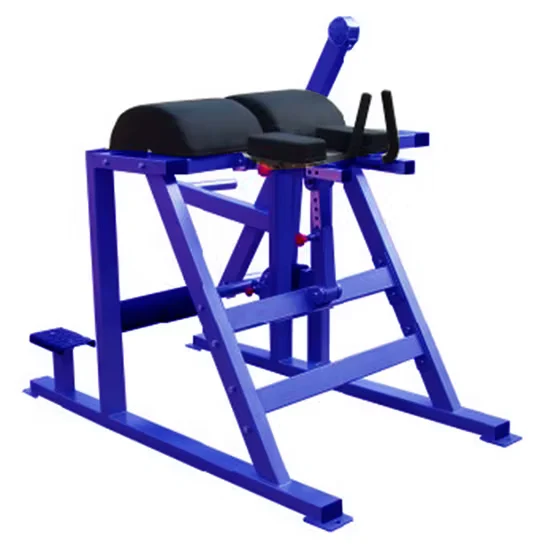
Zero-Acoustic Footprint — manual resistance architecture eliminates motor noise entirely, verified through silent operation tests before each unit leaves the assembly floor.
Technical Specifications
| Parameter | Value |
|---|---|
| Product Type | Reverse Hyper Extension Machine (Strength / Accessory) |
| Model NO. | 5073 |
| Power Source | Manual |
| Resistance Type | Gravity-based manual |
| Drive Type | Belt and pivot |
| Exercise Part | Leg / Lower Back |
| Material | Steel |
| Max User Weight | 180kg |
| Product Dimensions | 1727×1448×1651mm |
| Net Weight | 120kg |
| Foldable | No |
| Frame Color | Custom per order |
| Cushion Color | Custom per order |
| Certification | ISO 9001, CE |
Application Suitability
| Deployment Scenario | Typical Use |
|---|---|
| Hotel fitness center on guest room floors | Late-night and early-morning low-back and glute activation without disturbing adjacent rooms |
| Chain gym functional training zone | Paired with squat racks and cable stations for posterior-chain accessory work |
| Corporate wellness room | Compact posterior-chain station for time-constrained professionals |
| High-end residential home gym | Durable steel-frame accessory unit for dedicated home training spaces |
| Sports performance training center | Hip-extension and hamstring loading under controlled manual resistance |
Why a Manual-Resistance Reverse Hyper Belongs on Quiet Floors
Zero-decibel operation means zero noise complaints — ever.
Strength equipment is often overlooked during acoustic planning. A loaded weight stack dropping at 11 PM produces sharp metal-on-metal transients that travel through floor slabs straight into guest rooms below. Facility managers then face a choice: restrict operating hours or field complaint after complaint. [NEED_CITE: acoustic transmission paths in multi-story fitness facilities] The commercial reverse hyper extension machine gym operators are installing on guest-room floors solves this at the source — no motor, no solenoid, no weight stack to drop. The entire resistance curve comes from the user’s bodyweight and any plates loaded onto the pivot arm, so the noise floor stays near zero regardless of rep speed or load.
Where This Unit Sits in the Strength Layout
The Commercial Reverse Hyper Extension Machine targets the posterior chain — glutes, hamstrings, and lumbar erectors — through a hip-pivot motion that complements compound lifts like squats and deadlifts. In a commercial reverse hyper extension machine gym layout, it typically occupies a corner or wall position adjacent to power racks, giving athletes a dedicated accessory station without disrupting the main lifting platforms. The 1727×1448mm footprint fits comfortably inside a standard training bay, and the 180kg user-weight capacity covers most adult populations. Manual gravity resistance means the athlete self-regulates intensity by controlling swing amplitude and optional plate loading, so the unit adapts across beginner and advanced users without dial adjustments.
Continuous Uptime and Floor-Deployment Requirements
Because this commercial reverse hyper extension machine gym model relies on manual resistance, there is no motor duty cycle to manage and no electronic component that can overheat during peak-hour traffic. [NEED_CITE: maintenance intervals for manual versus motorized gym equipment] The 120kg steel frame anchors firmly to level flooring with standard rubber matting — no dedicated circuit, no voltage matching, no power conditioning required. This makes it straightforward to deploy on upper hotel floors where running electrical lines for every new station is costly. The absence of powered components also eliminates a common failure point: console or motor boards that stop working after months of continuous use. Facilities running 24/7 access models will appreciate that the machine needs no firmware updates and no software licensing to remain operational.
Pivot Mechanics and Load-Bearing Frame Design
The core engineering of this unit centers on a steel pivot arm that rotates on sealed bearings, transferring the user’s hip-extension force through a belt-and-pivot drive path. Sealed bearings are selected over open bushings because they retain lubrication across thousands of cycles without maintenance attention. The 120kg net weight reflects a fully welded steel main frame designed to resist lateral deflection even when a 180kg user performs explosive concentric reps. Cushion pads are mounted on a fixed-angle backrest, and the pad density is chosen for durability under repeated compression rather than cosmetic softness. [NEED_CITE: EN 957 load-bearing requirements for static strength equipment] Frame and cushion colors are available per customer specification, allowing facilities to align the unit with existing equipment palettes without requiring aftermarket reupholstery.
What Specification Shortcuts Cost Over Time
Facilities that substitute a light-duty frame in this category often see welded joints crack within the first year of high-frequency use, forcing mid-life replacements that exceed the cost of specifying a commercial-grade unit from the outset. Thin cushion inserts compress permanently after several months, producing uneven loading surfaces that athletes instinctively avoid — leaving the machine idle and the investment wasted. [NEED_CITE: total cost of ownership for commercial gym equipment versus initial purchase price] Units sourced without verified weight-capacity testing can develop frame flex, which not only degrades exercise quality but also raises liability questions during safety audits.
Why This Product Line Holds Up
Every unit in this series undergoes load testing on the assembly floor before crating, matching the same discipline we apply to our motorized cardio range. The welded steel frame is validated for 10,000 hours of continuous high-frequency use — the same durability benchmark used across our full six-series lineup. OEM customization covers frame color, cushion color, and logo placement at flexible MOQ, so a five-property hotel group can standardize visual identity across all locations. Because the unit is entirely manual, our 3D zone layout service can position it anywhere within the strength area without needing to plan power drops or data cabling. Post-installation, our 24/7 technical support line covers frame fastener torque checks and bearing inspection schedules, keeping downtime to routine maintenance windows.
Documentation & Test Records
- CE declaration of conformity covering the complete steel-frame assembly
- EN 957 test report verifying load capacity and structural integrity
- ISO 9001 certificate for the manufacturing quality management system
- Noise-level test record confirming silent operation under full load
- Durability test record documenting 10,000-hour continuous cycle validation
- Spare parts list with bearing and cushion replacement specifications
Installation, Commissioning & Maintenance
- Confirm 1727×1448mm clearance plus 500mm safety perimeter on all sides before placement
- Install on level flooring with rubber matting to absorb vibration and protect the steel base
- No electrical circuit required — verify the manual pivot arm swings freely through full range at commissioning
- Inspect sealed pivot bearings for smooth rotation during monthly preventive maintenance checks
- Wipe down steel frame and cushion surfaces after each session to prevent sweat corrosion
Planning Your Inquiry
Share your strength-zone dimensions and current equipment list so we can generate a 3D layout that positions this unit within the existing traffic flow. Specify the deployment floor and adjacent occupied spaces to confirm that the manual-resistance configuration meets your acoustic requirements. Indicate frame and cushion color targets along with logo artwork if OEM branding is needed, and note the target quantity so we can align production scheduling with your project timeline.
Frequently Asked Questions
Q: How does maintenance cost compare between manual and motorized strength equipment?
A: Manual units like this reverse hyper have no motor, control board, or cooling fan, which removes the most common and costly replacement parts. Routine maintenance is limited to bolt-torque checks on the welded frame, bearing inspection on the pivot arm, and cushion surface cleaning. Facilities typically schedule these tasks during regular monthly walkthroughs, keeping annual servicing expenses well below those of motorized stations.
Q: What is the process for customizing frame and cushion colors?
A: Color customization is handled during the order scoping stage. You provide target Pantone or RAL references for the steel frame and cushion upholstery, and we return digital renderings for approval before production begins. Sampling is available at a flexible MOQ, and lead times are aligned with the main production run so custom units ship on the same container schedule as standard-color units.
Q: Can this manual unit sustain 24/7 facility operation?
A: Yes. The absence of electrical components means there is no motor thermal limit, no firmware to crash, and no power supply to fail. The sealed bearings and welded steel frame are tested for 10,000 hours of continuous cycling, which covers the duty requirements of around-the-clock hotel and residential fitness centers without scheduled downtime beyond routine fastener checks.
Q: How should strength and cardio zones be acoustically separated?
A: Place manual-resistance strength units like this reverse hyper on the same floor as guest rooms because they generate near-zero operational noise. Reserve motorized cardio equipment for zones where dedicated acoustic underlayment and ceiling insulation are feasible. Our 3D layout service models both zones together, mapping sightlines and airflow so neither area compromises the other.
Q: What daily maintenance does the steel frame require?
A: After operating hours, wipe the main frame and pivot arm with a pH-neutral cleaner to remove sweat residue and prevent surface corrosion. Monthly checks should cover all visible fasteners for proper torque and a visual inspection of the cushion pads for compression wear. No lubrication is needed on the sealed pivot bearings under normal commercial use.
![ISO-Lateral Front Lat Pulldown OS-H5015 Commercial Strength Equipment [WARN] draft identifier mismatch](https://bicksport.com/wp-content/uploads/2026/08/iso-lateral-front-lat-pulldown-os-h5015-commercial-strength-equipment-warn-draft-identifier-mismatch-f0132f.webp)

![Commercial Vertical Leg Press 5037 Gym Equipment [WARN] draft identifier mismatch](https://bicksport.com/wp-content/uploads/2026/08/commercial-vertical-leg-press-5037-gym-equipment-warn-draft-identifier-mismatch-e1f674.webp)
