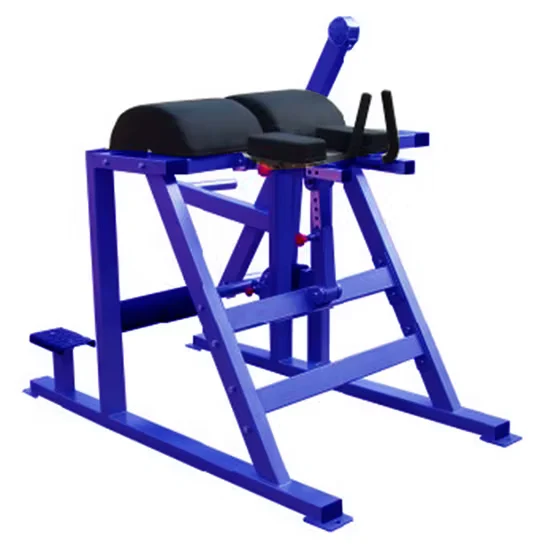
10,000-Hour Endurance — Verified through continuous high-frequency mechanical load testing on reinforced steel frames and sealed bearing assemblies.
Technical Specifications
| Parameter | Value |
|---|---|
| Product Type | Plate Loaded Rear Deltoid Machine |
| Model NO. | 5011 |
| Exercise Part | Arm (Rear Deltoid) |
| Material | Steel |
| Plate Loading System | Standard Olympic Plates |
| Max User Weight | 180kg |
| Product Dimensions | 1982 1003 925mm |
| Net Weight | 83kg |
| Certification | ISO 9001, CE |
Application Suitability
| Deployment Scenario | Typical Use |
|---|---|
| Commercial Gymnasium | Heavy-frequency resistance training in free weight and selectorized zones. |
| Hotel Fitness Center | 24/7 access to targeted shoulder conditioning for transient guests. |
| Corporate Wellness Facility | Ergonomic rear deltoid isolation for employee fitness programs. |
| Sports Performance Center | Biomechanically accurate upper body posterior chain development. |
Why Structural Resonance Destroys Member Retention in Strength Zones
Precision-welded steel and ISO-lateral convergence eliminate the mechanical vibration that plagues inferior plate loaded ISO-lateral rear deltoid machine commercial units.
When a facility installs under-engineered strength equipment, the structural resonance generated during heavy concentric and eccentric phases transfers directly through the floor deck. In multi-story hotel fitness centers or commercial gymnasiums situated above occupied spaces, this low-frequency vibration becomes an immediate operational liability. Maintenance logs fill with complaints regarding "rattling" and "loose" frames long before the bearings actually fail [NEED_CITE: structural vibration transmission in multi-story fitness facilities]. The resulting member attrition and guest complaints force facility directors into costly, premature equipment replacements. This plate loaded ISO-lateral rear deltoid machine commercial solution utilizes a 19821003925mm reinforced steel footprint to anchor the load path, ensuring that the kinetic energy of the lift is contained within the machine’s structural geometry rather than dissipated into the building architecture.
Biomechanical Convergence in the Free Weight Zone
This equipment targets the posterior shoulder complex through a converging ISO-lateral movement pattern that mimics natural scapular retraction. Within a comprehensive strength layout, it complements overhead pressing and latissimus dorsi machines by isolating the often-neglected rear deltoid and rhomboid musculature. The plate-loaded mechanism accommodates standard Olympic bumper or iron plates, allowing for granular progression suitable for both rehabilitation protocols and elite athletic hypertrophy. It is positioned optimally against perimeter walls or within dedicated hypertrophy aisles where floor loading is reinforced. The 180kg maximum user capacity and 83kg net weight of the machine itself provide the necessary counter-balance for high-intensity, low-repetition sets without frame lift-off.
Continuous Load Cycles and Spatial Integration
A plate loaded ISO-lateral rear deltoid machine commercial deployment must account for the acoustic footprint of iron plates colliding and the spatial requirements for safe ingress and egress. Unlike selectorized pin-loaded units, plate-loaded variants require adequate lateral clearance for the user to load and unload Olympic plates safely. The 1003mm width dictates a minimum operational envelope that prevents congestion during peak traffic hours. From an environmental perspective, the sealed bearing architecture demands minimal lubrication, making it ideal for 24/7 hotel fitness environments where maintenance access is restricted to specific service windows [NEED_CITE: bearing maintenance intervals for 24-hour commercial fitness equipment]. The static nature of the frame, combined with the absence of electronic motors, eliminates electromagnetic interference and reduces the thermal load on the facility’s HVAC system compared to automated resistance counterparts.
Interpreting the 1982mm Load Path and Steel Geometry
The 1982mm depth of the frame is not arbitrary; it represents the calculated moment arm required to stabilize the machine during maximal eccentric loading. In ISO-lateral mechanics, each arm pivots independently on a sealed axle, requiring the base to resist torsional forces that would otherwise cause the unit to "walk" across the floor deck. The use of commercial-grade steel ensures that the yield strength far exceeds the maximum potential load of a 180kg user plus additional plate mass. The pivot points utilize industrial sealed bearings to maintain a friction-free arc, ensuring that the resistance felt by the user is purely the gravitational force of the plates rather than mechanical stiction. This mechanical purity is critical for advanced trainees who rely on consistent tension curves throughout the range of motion.
The Operational Cost of Frame Deflection
Selecting strength equipment based solely on initial acquisition cost ignores the long-term degradation of the user experience. When a frame lacks sufficient cross-sectional thickness or triangulated welding, repetitive loading induces micro-deflections that eventually lead to fatigue cracking at the stress concentrators. This manifests as a "wobbly" or "insecure" feel that high-level trainees immediately reject. Furthermore, inferior bushings and unsealed pivot points oxidize and grind, creating an audible metallic friction that contributes to the overall noise pollution of the gym floor [NEED_CITE: fatigue failure points in commercial strength equipment frames]. In a high-turnover chain gym environment, this mechanical degradation leads to out-of-order tagging, member frustration, and the eventual capital expenditure of replacement units long before the anticipated depreciation schedule concludes.
Engineering the HuiYang Strength Series
The decision to integrate this plate loaded ISO-lateral rear deltoid machine commercial unit into a facility is supported by a manufacturing ethos rooted in vertical integration. The 10,000-hour durability testing protocol extends beyond simple cyclical loading to include impact testing on the plate horns and weld integrity verification. The ISO 9001 certified production line ensures that the 83kg net weight represents a consistent density of steel, preventing the "light" feel associated with hollow-tube economy models. The 180kg user weight capacity is verified through static and dynamic load testing that simulates years of aggressive use. Furthermore, the availability of OEM customization allows facility operators to align the equipment aesthetics with their brand identity without compromising the underlying biomechanical geometry. The 3D layout planning service ensures that this specific footprint integrates seamlessly into the facility’s traffic flow and sightlines.
Documentation & Test Records
- CE declaration of conformity verifying European safety and health requirements for stationary training equipment.
- EN 957 test report detailing structural integrity and safety of plate-loaded strength training machines.
- ISO 9001 certificate confirming quality management systems across the manufacturing lifecycle.
- Noise level test record establishing the acoustic baseline of the sealed bearing pivot assembly.
- Durability test record validating the 10,000-hour operational lifespan under continuous commercial load.
- Installation and commissioning guide covering floor anchoring, leveling, and preventative maintenance schedules.
Installation, Commissioning & Maintenance
- Allocate a minimum 1500mm operational clearance around the 19821003925mm frame to facilitate safe Olympic plate loading and unloading.
- Verify floor leveling and utilize high-density rubber matting to dampen acoustic impact from dropped plates and stabilize the 83kg base.
- Conduct initial pivot axle inspection to ensure sealed bearings are free from shipping debris and rotate without torsional resistance.
- Implement a monthly visual inspection protocol for weld integrity on the ISO-lateral convergence arms and plate storage horns.
- Apply manufacturer-approved lithium-based grease to pivot points only if specified in the maintenance manual to prevent dust attraction.
- Clean steel surfaces and plate horns with non-corrosive, pH-neutral cleaners to preserve the powder-coat finish against sweat and humidity.
Procurement Alignment and Facility Planning
Facility directors should provide the total square footage of the designated free weight zone to receive a comprehensive 3D layout that optimizes the placement of this plate loaded ISO-lateral rear deltoid machine commercial asset relative to traffic flow and adjacent equipment. It is essential to specify the anticipated daily user volume to ensure the deployment aligns with the 10,000-hour durability expectations. Confirmation of the flooring substrate is required to determine if additional acoustic dampening or anchoring solutions are necessary for the 83kg frame. Finally, operators should indicate any specific OEM color or branding requirements to ensure the equipment integrates visually with the existing fleet upon delivery.
Frequently Asked Questions
Q: How does ISO-lateral movement differ from fixed-path rear deltoid machines?
A: ISO-lateral mechanisms allow each arm to move independently along a converging arc. This prevents the stronger side of the user’s back from compensating for the weaker side, a common occurrence in fixed-bar machines. The independent convergence mimics the natural retraction of the scapula, providing a more biomechanically accurate stimulus to the rear deltoid and rhomboid musculature while reducing shear stress on the shoulder joint.
Q: What are the maintenance implications of plate-loaded versus selectorized systems?
A: Plate-loaded systems generally require significantly less maintenance as they eliminate the complex cable-and-pulley networks and weight stack guide rods found in selectorized machines. The primary maintenance focus is on the integrity of the pivot bearings and the structural welds. This simplicity translates to lower long-term service costs and reduced downtime, making it ideal for facilities with limited technical staff.
Q: Why is the net weight of the frame critical for plate-loaded equipment?
A: The 83kg net weight of the steel frame provides the necessary counter-mass to stabilize the machine during heavy lifting. If a frame is too light, the leverage generated by loading multiple Olympic plates can cause the unit to lift or tip, creating a severe safety hazard. A substantial steel footprint ensures that the machine remains planted and rigid, even when subjected to maximal eccentric loads and explosive concentric movements.
Q: What flooring requirements are necessary for this 1982mm deep machine?
A: Given the dynamic nature of plate loading and the potential for plates to be dropped, a high-density rubber flooring substrate is mandatory. The floor must be structurally capable of supporting the combined static weight of the 83kg machine, the user (up to 180kg), and the loaded plates. Proper leveling is also essential to prevent torsional stress on the frame welds and to ensure the pivot bearings operate on a true plane.
Q: How does the 180kg user weight capacity impact facility liability?
A: A 180kg capacity ensures that the equipment can safely accommodate a wide demographic of users, including heavy-weight athletes and bodybuilders. Utilizing machines with lower weight limits in a commercial setting exposes the facility to significant liability and equipment failure risks. This commercial-grade rating, backed by EN 957 testing, provides facility operators with the necessary documentation to satisfy insurance and safety auditing requirements.
![Commercial ISO Lateral Leg Press Machine Hammer Strength [WARN] draft identifier mismatch](https://bicksport.com/wp-content/uploads/2026/08/commercial-iso-lateral-leg-press-machine-hammer-strength-warn-draft-identifier-mismatch-a50c6d.webp)
![Professional Hammer Strength Full Rack Commercial Gym Equipment H5084 [WARN] draft identifier mismatch](https://bicksport.com/wp-content/uploads/2026/08/professional-hammer-strength-full-rack-commercial-gym-equipment-h5084-warn-draft-identifier-mismatch-5b9980.webp)
![Hammer Strength Shoulder Press Bench OS-H5053 Commercial Gym Equipment [WARN] draft identifier mismatch](https://bicksport.com/wp-content/uploads/2026/08/hammer-strength-shoulder-press-bench-os-h5053-commercial-gym-equipment-warn-draft-identifier-mismatch-01b503.webp)