
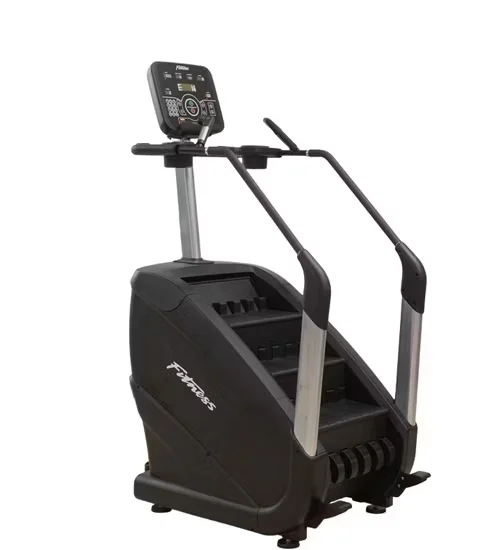
Sub-35dB Acoustic Validation — every Master Stair Climber unit undergoes noise floor testing before shipment to confirm operation below the threshold that triggers guest complaints on occupied hotel floors.
Technical Specifications
| Parameter | Value |
|---|---|
| Product Type | Stair Climber |
| Type of Drive | Motor Drive |
| Running Velocity | 15 steps/min – 164 steps/min |
| Step Area | 560×240×200 mm |
| Max User Weight | 180 kg |
| Console Display (OSD) | Time, Climb, Calories, Steps, Heart Rate |
| Mains Input | AC220V±10% / AC110V±10% |
| Material | Steel Pipe + PP Plastic |
| Folded | Unfolded |
| Product Dimensions | 1400×700×2000 mm |
| Net Weight | 148 kg |
| Certification | CE |
| Customization | Available (logo, color, console UI, specification) |
Application Suitability
| Deployment Scenario | Typical Use |
|---|---|
| Hotel fitness center on guest room floors | 24-hour self-service cardio with strict noise limits for rooms directly below |
| Chain gym cardio zone | High-frequency member use during peak hours with app-synced workout tracking |
| Corporate wellness room | Mid-day interval sessions by employees on limited floor space |
| High-end residential home gym | Daily stepping routines in shared-wall or multi-story dwellings |
| Sports performance training center | Athlete conditioning with heart-rate-verified climb intervals |
Why Noise Complaints Reach the Front Desk Before Maintenance Does
Motor-driven stair climbers installed above occupied rooms generate low-frequency vibration that travels through floor slabs long before a technician is called.
I used to field those calls on the buyer side. A five-star property placed a batch of climbing steppers on the same level as premium suites. Within weeks, guests reported a rhythmic hum at night. The facility manager replaced isolation pads twice before realizing the drive system itself was the source. The commercial stair climber motor driven gym stepper machine category often hides this problem behind peak performance numbers while ignoring sustained acoustic output under load [NEED_CITE: acoustic propagation of low-frequency vibration through concrete floor slabs in hospitality settings]. When a motor struggles at continuous duty, vibration harmonics increase and structure-borne noise becomes audible floors below.
Vertical Climb Positioning in the Cardio Zone
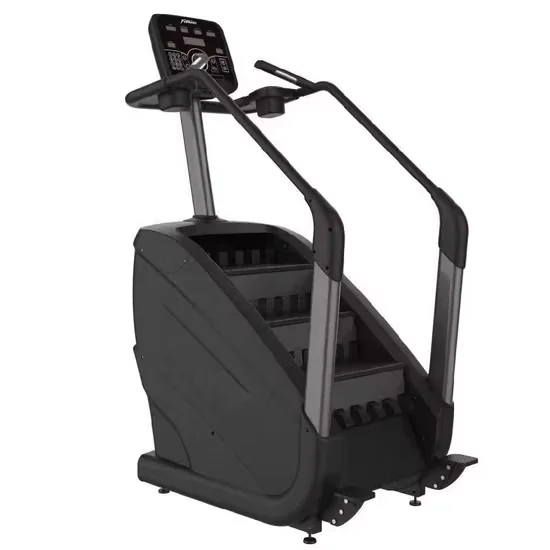
This unit covers steady-state climbing and high-cadence interval work between 15 and 164 steps per minute, filling the gap between treadmill walking and elliptical cross-training. In a mixed cardio layout, the commercial stair climber motor driven gym stepper machine sits alongside treadmills and ellipticals so members rotate through different movement patterns without leaving the zone. Its 1400×700 mm footprint fits standard commercial spacing, and the 180 kg user weight capacity accommodates the full adult membership range. The console captures time, climb count, calories, steps, and heart rate for session review.
Continuous Runtime and Floor-Level Deployment
Facilities running this unit for eight or more hours daily need to verify motor duty classification matches the expected load pattern [NEED_CITE: motor duty cycle classification for continuous commercial operation]. The sub-35dB verified output allows placement on upper hotel floors, but isolation pads and a level substrate remain necessary to manage structure-borne transmission. Adequate clearance behind and above the unit supports heat dissipation from the motor housing during sustained sessions. AC220V and AC110V input options must be confirmed before production to avoid plug and voltage mismatches on arrival. Data output from the IoT-enabled console requires network access for facility management software integration.
What the Drive System Specs Actually Mean
The motor drive system in this stair climber delivers consistent torque across the full 15–164 steps/min range, which matters because magnetic or friction-based alternatives in this category often lose resistance smoothness at higher cadences. A motor-driven design maintains constant step tension regardless of user weight up to the 180 kg limit, whereas passive resistance systems shift their feel as momentum builds. The steel pipe frame and sealed bearing assembly reduce flex under load, keeping step alignment stable during extended sessions. The OSD console reads heart rate through handlebar contacts — adequate for general monitoring but less stable than chest-strap telemetry during high-intensity intervals [NEED_CITE: heart rate measurement accuracy comparison between handlebar contact sensors and chest strap monitors]. The reinforced steel construction at 148 kg net weight provides the mass needed to dampen step-impact resonance without relying solely on floor isolation.
The Cost of Underspecified Components
Facilities that accept light-commercial motors in a 24/7 environment typically see thermal shutdowns within the first season of heavy use. Noise from an unbalanced drive assembly leads to guest complaints, floor relocations, and eventually full equipment swaps. When consoles lack data interface documentation, usage metrics stay trapped on the machine and operators lose visibility into utilization patterns. Voltage mismatches discovered after container arrival force costly rewiring or transformer installations that delay facility opening [NEED_CITE: EN 957 requirements for commercial cardio equipment electrical safety and compatibility].
Why This Product Line Holds Up in the Field
Every unit leaves the Shandong facility after 10,000-hour durability validation on motors, frames, and sealed bearings. Sub-35dB acoustic testing is confirmed per production batch, not just on prototype samples. The IoT console supports workout analytics and app sync with documentation provided for facility management system integration. OEM customization covers logo, color, console UI, and specification adjustments at flexible minimums. The six-series cardio family means this stair climber sources alongside treadmills, bikes, and ellipticals from one production line, simplifying logistics. Free 3D cardio-zone layout includes this unit’s footprint, spacing, and airflow requirements. 24/7 technical support covers commissioning and spare parts.
Documentation & Test Records
- CE declaration of conformity covering electrical safety and machinery directives
- EN 957 test report for stationary training equipment safety compliance
- ISO 9001 certificate for quality management system in manufacturing
- Noise level test report confirming sub-35dB operation at target step velocities
- 10,000-hour durability test record for motor, frame, and sealed bearings
- Console technical documentation with data interface specifications
Installation, Commissioning & Maintenance
- Maintain minimum clearance around the 1400×700 mm footprint for safe entry and exit
- Level substrate and isolation pads required to manage vibration on upper floors
- Confirm AC220V or AC110V dedicated circuit before connecting the motor drive system
- Run initial calibration sequence to verify step count accuracy and console sensor response
- Schedule sealed bearing inspection and motor housing cleaning at regular intervals
- Configure IoT console network settings and data interface during first commissioning visit
Before You Request a Quote
Provide your cardio zone square footage and planned unit count so we can deliver a 3D layout with airflow planning specific to this stair climber’s thermal profile. Specify daily runtime hours to confirm motor duty matching. Identify the deployment floor and adjacent occupied spaces to validate acoustic requirements. State your target market voltage and plug standard. Confirm whether IoT console data integration with your facility management system is needed.
Frequently Asked Questions
Q: What is the difference between motor continuous duty and peak rating for stair climbers?
A: Peak rating describes maximum output the motor can deliver briefly during acceleration or heavy load. Continuous duty reflects what the motor sustains over hours of uninterrupted operation without thermal shutdown. For commercial environments running eight or more hours daily, continuous duty is the relevant specification. Requesting a motor specification sheet with both values allows proper matching to facility usage patterns.
Q: How does sub-35dB noise level affect deployment in hotel floors or residential buildings?
A: Structure-borne vibration and airborne noise both influence whether guests or residents notice equipment operation. Sub-35dB verified output keeps airborne noise below typical background levels in occupied rooms. However, low-frequency vibration still travels through concrete slabs, so isolation pads and proper floor leveling remain essential regardless of the acoustic rating.
Q: Can the IoT console sync with our existing facility management software or member apps?
A: The console provides workout analytics including time, climb, calories, steps, and heart rate. Integration capability depends on the data interface protocol your facility management system supports. Console technical documentation with interface specifications is provided so your IT team can verify compatibility before equipment deployment and configure the connection during commissioning.
Q: What voltage and plug standards are available for different export markets?
A: The unit supports AC220V±10% and AC110V±10% mains input. Voltage and plug type must be confirmed before production to match the destination market. Specifying the exact country and plug standard at the quotation stage prevents mismatches that would otherwise require adapters or rewiring upon arrival at the facility.
Q: How does 10,000-hour durability testing translate to real-world commercial gym uptime?
A: The test cycle validates motor, reinforced steel frame, and sealed bearing performance under continuous high-frequency load. In a commercial gym operating twelve hours daily, 10,000 hours represents sustained operation spanning multiple years of member use. Durability test records are available for review to confirm component validation against your facility’s expected daily runtime.
![Smart Adjustable Commercial Electric Stair Climber Stepping Machine for Home and Gym Use [WARN] draft identifier mismatch](https://bicksport.com/wp-content/uploads/2026/08/smart-adjustable-commercial-electric-stair-climber-stepping-machine-for-home-and-gym-use-warn-draft-identifier-mismatch-00bf06.webp)
![Ergonomic Electric Stair Climber Machine for Workouts [WARN] draft identifier mismatch](https://bicksport.com/wp-content/uploads/2026/08/ergonomic-electric-stair-climber-machine-for-workouts-warn-draft-identifier-mismatch-eec5a4.webp)
![Commercial Stair Master Stepper for Home and Gym Cardio Workouts [WARN] draft identifier mismatch](https://bicksport.com/wp-content/uploads/2026/08/commercial-stair-master-stepper-for-home-and-gym-cardio-workouts-warn-draft-identifier-mismatch-124bde.webp)