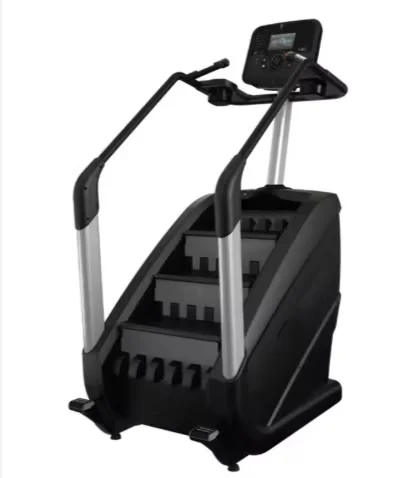
![Commercial Stair Master Stepper for Home and Gym Cardio Workouts [WARN] draft identifier mismatch](https://bicksport.com/wp-content/uploads/2026/08/commercial-stair-master-stepper-for-home-and-gym-cardio-workouts-warn-draft-identifier-mismatch-124bde.webp)
Continuous-Duty Endurance — Motor drive and steel-frame construction tested for 10,000 hours of continuous commercial cardio operation.
Technical Specifications
| Parameter | Value |
|---|---|
| Product Type | Stair Climber |
| Drive Type | Motor Drive |
| Power Requirement | AC220V±10% / AC110V±10% |
| Running Velocity | 15 steps/min – 164 steps/min |
| Step Area | 560 × 240 × 200 mm |
| Console Type | OSD (Time, Climb, Calories, Steps, Heart Rate) |
| Max User Weight | 180 kg |
| Product Dimensions | 1400 × 700 × 2000 mm |
| Net Weight | 148 kg |
| Foldable | Unfolded |
| Material | Steel Pipe + PP Plastic |
| Certification | CE |
Application Suitability
| Deployment Scenario | Typical Use |
|---|---|
| Chain gym cardio zone | High-frequency stepping sessions across varied fitness levels during peak and off-peak hours |
| Hotel fitness center on guest room floors | Round-the-clock access with motor-drive quietness preventing noise transfer to adjacent rooms |
| Corporate wellness room | Moderate daily traffic with employees completing 15–30 minute climb intervals between meetings |
| High-end residential home gym | Dedicated workout rooms where non-folding steel-frame stability is preferred over portability |
| Sports performance training center | Athletes using 15–164 steps/min range for sport-specific conditioning and interval protocols |
What Peak Horsepower Hides About Continuous Duty in a Stair Climber
A motor rated only at peak output will thermal-shutdown under sustained commercial stepping loads.
Facility operators routinely specify stair climbers by peak horsepower, only to discover that the motor cannot sustain output during back-to-back user sessions. Light-commercial motors in a commercial stair climber motor drive gym environment accumulate heat faster than their cooling systems dissipate it, leading to thermal cutoffs that interrupt workouts and frustrate members [NEED_CITE: motor duty cycle classification for continuous commercial operation]. The thermal mass of the motor housing, winding gauge, and duty-cycle rating together determine whether a unit survives 14-hour operational days — not the peak number on a brochure.
Where This Stair Climber Sits in a Mixed Cardio Zone
The Commercial Stair Master Stepper for Home and Gym Cardio Workouts targets vertical-loading cardio, complementing the horizontal effort of treadmills and the seated cadence of recumbent bikes. Step cadence spanning 15 to 164 steps/min covers warm-up pacing through high-intensity interval climbs, accommodating users from beginners to conditioned athletes. The 1400 × 700 mm footprint positions well along perimeter walls or as an anchor unit in a dedicated stepping cluster, with the 2000 mm height requiring overhead clearance verification. The OSD console captures time, climb count, calories, steps, and heart rate, giving users immediate feedback without facility management software integration.
Thermal Load and Facility Infrastructure Requirements
A stair climber operating across 12 to 16 hours daily demands continuous-duty motor thermal management, and the AC motor drive in this unit is sized to reduce thermal shutdown risk during sustained use. Deployment on floors above occupied spaces requires attention to vibration transfer through the steel frame into the building structure — anti-vibration pads beneath the 148 kg chassis help isolate step-impact frequencies [NEED_CITE: structural vibration transfer standards for commercial fitness floors]. The dual-voltage configuration (AC220V±10% / AC110V±10%) must match the facility’s electrical supply before the unit is powered on, preventing motor winding damage from incorrect input. Adequate airflow around the motor housing is necessary; installations recessed into alcoves or tight corners restrict convective cooling and shorten motor service intervals.
Motor Drive, Step Cadence, and Console Readout — What the Specs Mean
Motor-drive stair climbers use an electric motor to set step speed rather than relying on user-generated momentum, which provides consistent cadence control from 15 to 164 steps/min regardless of user weight or stride force. This differs from self-powered climbers where step rate fluctuates with user effort and fatigue, making motor-driven units preferable for interval programming where precise cadence targets matter. The 560 × 240 mm step area accommodates a range of foot sizes while the 200 mm step depth provides clearance for full-foot placement. The OSD console displays five metrics simultaneously without touchscreen interaction — a deliberate trade-off favoring readout visibility and button reliability over media streaming capability. Heart rate monitoring via the console provides session-level tracking, though users requiring continuous beat-to-beat accuracy for heart-rate-zone programming should pair chest-strap monitors independently [NEED_CITE: heart rate measurement accuracy standards across grip-based and chest-strap methods].
The Hidden Cost of Underspecified Drive Components
When a stair climber specified for home use is deployed in a commercial gym, the motor windings overheat within weeks under continuous member traffic, triggering thermal protection cutouts that leave equipment idle. Operators then face emergency replacement costs and member complaints about equipment availability, often discovering that the original spec sheet never defined continuous-duty rating [NEED_CITE: EN 957 requirements for commercial cardio equipment]. Voltage mismatches between the unit’s motor winding configuration and the facility’s electrical supply can damage the drive board on first power-up — a problem typically found only after the container has been unpacked. Units with insufficient frame rigidity develop step-mechanism vibration over time, generating noise that migrates through floor structures and triggers complaints from adjacent hotel rooms or office spaces below.
Why This Product Line Covers the Deployment Gap
Sub-35 dB whisper-quiet operation has been verified across hotel fitness center deployments, meaning this stair climber can occupy floors above guest rooms without triggering noise complaints. The 10,000-hour durability testing protocol covers the motor, step mechanism bearings, and frame welds under continuous high-frequency loading conditions. The six-series cardio family allows a facility to source treadmills, bikes, ellipticals, rowers, climbers, and spinning bikes from a single product line with consistent console interfaces. Full OEM/ODM capability extends to console UI customization, logo placement, and color specification at flexible minimum order quantities. A free 3D cardio-zone layout service addresses square footage, equipment spacing, sightlines, and airflow planning specific to this climber’s 1400 × 700 × 2000 mm envelope. Technical support operates on a 24/7 response basis for commissioning and field troubleshooting.
Documentation & Test Records
- CE declaration of conformity covering stair climber electrical safety and EMC compliance
- EN 957 test report validating mechanical safety under repeated loading cycles
- ISO 9001 certificate covering manufacturing process control and traceability
- Noise level test report documenting sub-35 dB operation under continuous motor drive
- Durability test record confirming 10,000-hour motor and bearing service validation
- Motor specification sheet detailing continuous duty rating, winding configuration, and thermal protection parameters
Installation, Commissioning & Maintenance
- Verify 1400 × 700 × 2000 mm clearance including 600 mm rear service access and 1000 mm overhead space for the 2000 mm frame height
- Install anti-vibration pads beneath the 148 kg chassis to isolate step-impact frequencies from floor structures, especially on elevated hotel floors
- Confirm AC220V or AC110V supply matches the unit’s dual-voltage motor winding configuration before first power-up to prevent drive board damage
- Calibrate step cadence range across 15–164 steps/min during commissioning and verify OSD readout accuracy against a tachometer reference
- Inspect step mechanism bearings and motor drive belt tension at 90-day intervals under high-frequency commercial use schedules
- Clean step surfaces and handrails with non-corrosive solutions to prevent sweat-induced degradation of PP plastic and steel pipe finishes
Equipment Selection and Deployment Inquiry
Provide your cardio zone floor area and equipment count to receive a 3D layout plan addressing stair climber placement, member flow corridors, and HVAC airflow coverage. Specify daily operating hours so the motor duty-cycle match can be confirmed against your facility’s peak and off-peak usage patterns. Identify the deployment floor and adjacent occupied spaces to validate noise isolation requirements. Confirm the target market voltage standard (AC220V or AC110V) and plug type for pre-shipment configuration. State whether console data output integration with your facility management platform is required.
Frequently Asked Questions
Q: Motor-drive versus self-powered stair climbers — which suits high-traffic facilities better?
A: Motor-drive units maintain consistent step cadence regardless of user fatigue, which supports interval programming and predictable equipment loading across diverse member fitness levels. Self-powered climbers require the user to generate all momentum, creating variable mechanical load that can accelerate component wear under high-traffic conditions. For facilities with 12-plus hour daily operation and users spanning beginners to advanced athletes, motor-drive systems deliver more predictable maintenance intervals and session consistency.
Q: Why does continuous duty motor rating matter more than peak horsepower?
A: Peak horsepower measures the motor’s maximum instantaneous output, typically achieved only for seconds during acceleration. Continuous duty rating reflects sustained thermal equilibrium — the output level the motor can maintain indefinitely without thermal shutdown. A stair climber in a commercial gym experiences near-continuous loading across operational hours, making continuous duty rating the relevant specification for predicting motor service life and avoiding thermal protection cutouts during peak usage periods.
Q: How does the 15–164 steps/min cadence range support different training goals?
A: The lower cadence range around 15 steps/min accommodates warm-up pacing and rehabilitation stepping, while the upper range near 164 steps/min supports high-intensity interval climbing for conditioned users. This breadth allows a single unit to serve the full membership spectrum without requiring separate machines for low and high intensity zones. The motor drive maintains target cadence consistently, which is important for structured interval programs where cadence precision matters.
Q: Can the OSD console metrics integrate with facility management software?
A: The OSD console displays time, climb count, calories, steps, and heart rate directly on the unit for user feedback. Facilities requiring data export to management platforms should specify console data interface requirements during the inquiry stage so that integration capability can be confirmed or custom console configuration scoped. Integration needs vary by facility software ecosystem and should be addressed before production begins rather than after deployment.

![SQ1017 High Performance Motor Drive Commercial Stair Machine [WARN] draft identifier mismatch](https://bicksport.com/wp-content/uploads/2026/08/sq1017-high-performance-motor-drive-commercial-stair-machine-warn-draft-identifier-mismatch-c50b40.webp)
![Ergonomic Electric Stair Climber Machine for Workouts [WARN] draft identifier mismatch](https://bicksport.com/wp-content/uploads/2026/08/ergonomic-electric-stair-climber-machine-for-workouts-warn-draft-identifier-mismatch-eec5a4.webp)