
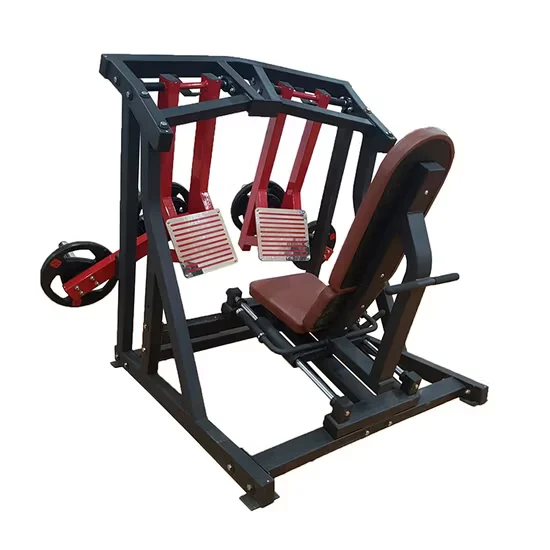
Zero Motor Noise, Zero Downtime — Manual ISO-Lateral drive eliminates electrical failure points while sub-ambient acoustic output keeps adjacent guest rooms undisturbed.
Technical Specifications
| Parameter | Value |
|---|---|
| Product Type | Strength Machine — Leg Press |
| Product Name | ISO-Lateral Leg Press |
| Model NO. | 5031 |
| Resistance Type | Manual (ISO-Lateral independent arms) |
| Drive System | Mechanical linkage, no motor |
| Noise Level | Near-zero (no motor or fan) |
| Frame Material | Reinforced commercial-grade steel |
| Max User Weight | 180 kg |
| Product Dimensions | 1989 × 1771 × 1545 mm |
| Net Weight | 148 kg |
| Foldable | No (unfolded fixed configuration) |
| Power Requirement | None — fully manual |
| Connectivity | N/A |
| Console | N/A |
| Certification | ISO 9001, CE |
| OEM / ODM | Available (color, logo, upholstery, frame finish) |
Application Suitability
| Deployment Scenario | Typical Use |
|---|---|
| Hotel fitness center on guest room floors | Silent leg training beside occupied rooms with zero noise transfer |
| Chain gym strength zone | High-frequency bilateral and unilateral leg work across diverse member profiles |
| Corporate wellness room | Compact heavy-duty leg press for limited-floor-plate employee facilities |
| High-end residential home gym | Manual resistance unit requiring no dedicated electrical circuit |
| Sports performance training center | Independent-arm pressing for athlete-specific load balancing |
Why Silence Still Matters in the Strength Zone
Noise complaints in mixed-use fitness floors rarely originate from treadmills alone — plate-loaded leg presses transmit impact through structural slabs into rooms below.
The ISO-Lateral Leg Press removes the motor entirely, reducing floor-transmitted vibration to bearing friction and pad contact only.
I once watched a five-star property replace an entire batch of hydraulic resistance machines after guests on the floor below reported rhythmic thudding through the ceiling at 6 a.m. The root cause was not the machine’s mechanism but the frame resonance amplifying each repetition into the concrete slab. A manual, mechanically linked commercial ISO-lateral leg press strength machine avoids this failure mode because there is no oscillating hydraulic pump and no unbalanced rotating mass to generate harmonic vibration [NEED_CITE: structural vibration transmission from plate-loaded vs. manual resistance equipment]. The reinforced steel frame and sealed bearing pivots keep operational sound below the ambient noise floor of any climate-controlled fitness space.
Positioning Within a Commercial Strength Floor
This commercial ISO-lateral leg press strength machine fills the compound lower-body pressing role in a mixed strength zone, complementing squat racks, hack squats, and isolation leg equipment. The independent dual-arm design allows unilateral loading, which serves members recovering from asymmetries or athletes requiring single-leg force profiling. Its fixed footprint of roughly 3.5 square meters places it mid-floor or wall-anchored without the clearance demands of plate-loaded sled systems. The 180 kg user weight threshold accommodates the full commercial member spectrum, and the absence of a weight stack means no cable or pulley maintenance interval.
Floor Loading, Acoustic Isolation, and Deployment Environment
A 148 kg steel frame concentrates load on four contact points, so the deployment surface must sustain static and dynamic point loads without deflection. On upper floors — particularly above guest rooms or conference spaces — a high-density rubber isolation mat between the frame feet and the slab decouples the low-frequency energy of each press cycle [NEED_CITE: recommended floor isolation standards for upper-floor commercial gym deployments]. No electrical circuit is required, eliminating voltage mismatch concerns across export markets. Ventilation is irrelevant to the machine itself, but the surrounding zone still needs airflow planning to manage occupant heat load during high-volume set sequences.
Manual Linkage Versus Motorized and Hydraulic Resistance
A fully manual ISO-Lateral system transmits user force through a lever arm and pivot bearing rather than a hydraulic cylinder or electric brake. This means the resistance curve is governed by gravity and lever geometry, producing a predictable load profile that does not drift as seals age or fluid heats. Hydraulic cylinders, by contrast, lose consistency over extended duty cycles and require periodic seal replacement [NEED_CITE: hydraulic cylinder maintenance intervals in commercial resistance equipment]. The sealed bearings at each pivot point are rated for continuous high-frequency articulation, matching the 10,000-hour durability benchmark that Biketon applies across its commercial range.
The Hidden Cost of Specifying Below Commercial Grade
Strength machines specified for light-commercial duty cycles accumulate pivot wear at a rate that outpaces the maintenance schedule, introducing play into the linkage that members perceive as instability under load. I have seen procurement teams substitute thinner-gauge steel frames to reduce unit cost, only to face weld fatigue cracking within the first year of heavy member use. Hydraulic leg presses deployed in hotel gyms often develop seal leaks that leave oily residue on the floor pad — a slip hazard that triggers liability concerns [NEED_CITE: slip hazard incident rates from hydraulic fluid leakage in fitness facilities]. The upfront savings on a sub-grade frame or hydraulic cylinder disappear the moment the first unit is pulled from the floor for warranty replacement.
Why This Product Line
Biketon’s strength range shares the same acoustic discipline that defines its cardio family: near-zero operational noise verified in hotel deployments above occupied guest floors. The 10,000-hour durability testing protocol extends to pivot bearings and frame welds, not just motors. Full OEM and ODM customization covers frame color, upholstery material, logo placement, and pad density to match a facility’s visual identity. The 3D layout service addresses the ISO-Lateral Leg Press’s specific footprint and sightline requirements within a mixed strength and cardio zone. Documentation packages include structural load calculations relevant to upper-floor installations. Technical support operates around the clock across time zones for commissioning and spare parts coordination.
Documentation & Test Records
- CE declaration of conformity for commercial strength equipment
- EN 957 test report covering structural integrity and safety
- ISO 9001 quality management system certificate
- Frame weld inspection and steel gauge verification report
- Sealed bearing cycle-life durability test record
- OEM customization specification sheet with material options
Installation, Commissioning & Maintenance
- Position on a level surface with minimum 600 mm clearance on all sides for safe entry and exit
- Place high-density isolation pads under each frame foot to decouple vibration from the subfloor
- No electrical connection required — commission by verifying full range of motion on both independent arms
- Inspect sealed bearing pivots for lateral play at quarterly intervals under high-frequency deployment
- Wipe frame and upholstery with pH-neutral cleaner after each operating day to prevent sweat corrosion
- Confirm floor load rating with structural engineer for upper-floor installations exceeding 148 kg point load
Requesting a Deployment Assessment
Provide your strength zone square footage and planned equipment list to receive a 3D layout incorporating the ISO-Lateral Leg Press’s footprint, member flow corridors, and sightline integration with adjacent cardio zones. Specify the deployment floor level and adjacent occupied spaces so acoustic isolation requirements can be confirmed. Indicate whether OEM color and upholstery customization is needed to align with your facility’s interior specification.
Frequently Asked Questions
Q: How does ISO-Lateral independent-arm design differ from a fixed-path leg press?
A: Independent arms allow each leg to press through its own natural movement path rather than forcing both limbs into a single rigid track. This reduces joint shear stress during the pressing cycle and lets members address left-right strength imbalances. The manual linkage means resistance is governed entirely by loaded weight and lever geometry, producing a consistent feel that does not degrade with seal wear or temperature change.
Q: What maintenance advantage does a fully manual leg press offer over hydraulic or electric resistance?
A: Manual linkage eliminates hydraulic fluid, seals, pumps, and electric motors — the components most likely to require scheduled servicing or unexpected repair. Maintenance reduces to periodic bearing inspection and frame cleaning. There is no fluid to leak onto the floor pad, no motor brush to replace, and no electronic board to troubleshoot, which keeps the machine on the floor and generating member value instead of sitting in a service queue.
Q: How should a facility evaluate frame durability for commercial leg press equipment?
A: Request the manufacturer’s cycle-test record showing the frame and pivot bearings tested under continuous load for a defined hour count — Biketon benchmarks at 10,000 hours. Verify the steel gauge and weld inspection documentation. Confirm the maximum user weight rating covers your heaviest members with margin. Ask for field deployment references in comparable high-frequency commercial environments.
Q: How do you plan a strength zone layout when mixing manual and motorized equipment?
A: Manual machines like the ISO-Lateral Leg Press require no power outlet, which gives layout flexibility but still demands attention to member flow, spotting clearance, and ventilation zoning. Group heavy compound manual presses together to concentrate floor loading. Place motorized cardio units with higher acoustic output further from acoustically sensitive boundaries. A 3D layout plan accounts for all of these variables before equipment ships.
Q: What customization options are available for OEM orders?
A: OEM and ODM orders can specify frame color, logo application, upholstery material, pad density, and finish texture. Minimum order quantities are flexible to accommodate single-venue rollouts and multi-site chain deployments alike. Custom color and branding specifications are confirmed during the quotation phase so production tooling aligns with the facility’s interior design requirements.


![Hammer Strength Equipment Adjustable Bench OS-H5069 for Commercial Gyms [WARN] draft identifier mismatch](https://bicksport.com/wp-content/uploads/2026/08/hammer-strength-equipment-adjustable-bench-os-h5069-for-commercial-gyms-warn-draft-identifier-mismatch-ee3dff.webp)