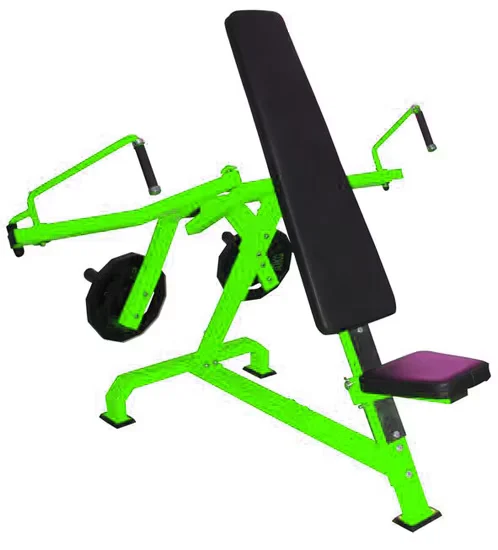
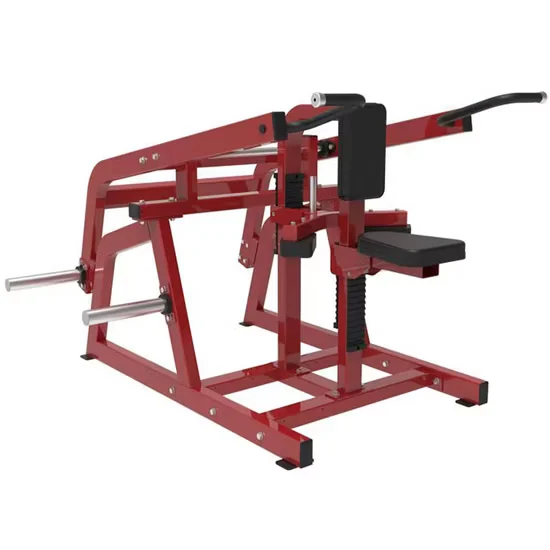
![Commercial Squat Lunge Machine Gym Equipment for Professional Gyms [WARN] draft identifier mismatch](https://bicksport.com/wp-content/uploads/2026/08/commercial-squat-lunge-machine-gym-equipment-for-professional-gyms-warn-draft-identifier-mismatch-879872.webp)
Structural Rigidity — Heavy-gauge steel frame engineered to eliminate flex and weld-point fatigue during continuous high-frequency strength training sessions.
Technical Specifications
| Parameter | Value |
|---|---|
| Product Type | Strength Machine (Squat Lunge) |
| Power Source | Manual |
| Resistance Type | Manual (Plate-Loaded or Selectorized options) |
| Exercise Target | Waist, Leg |
| Material | Steel |
| Product Dimensions | 1623 × 1691 × 872 mm |
| Net Weight | 122 kg |
| Foldable | Unfolded |
| Certification | ISO 9001, CE |
| OEM/ODM | Available |
| Warranty | Commercial frame and parts coverage available |
Application Suitability
| Deployment Scenario | Typical Use |
|---|---|
| Chain gym free-weight zone | High-volume squat and lunge programming during peak hours |
| Corporate wellness room | Compact lower-body station for executive fitness routines |
| Hotel fitness center | Durable leg training option accessible to guests around the clock |
| Professional sports training center | Athlete-specific unilateral and bilateral leg strength work |
| Community recreation facility | Shared-use strength station accommodating diverse user sizes |
Why Frame Flex Undermines Member Confidence in the Weight Room
A rigid steel frame is the foundation of safe, repeatable resistance training in public facilities.
When light-duty strength equipment enters a commercial gym floor, the first failure point is rarely the cable or pulley — it is the frame itself. Weld joints develop micro-cracks under repetitive loading from multiple users throughout the day, and the lateral sway during heavy squats or lunges makes members feel unstable [NEED_CITE: structural load testing standards for commercial strength equipment]. Facility operators then face costly mid-cycle replacements and member complaints about equipment that feels loose or unsafe. This commercial squat lunge machine gym equipment addresses those failure points with a reinforced steel structure built for continuous public use.
Positioning Within a Professional Strength Zone
This machine occupies the intersection of guided movement and free-range loading, targeting the quadriceps, glutes, and stabilizer muscles through controlled squat and lunge patterns. In a well-planned gym layout, it pairs with hip-thrust machines and leg-press stations to create a comprehensive lower-body cluster, reducing member crossover traffic between distant zones. The 1623 × 1691 mm footprint fits standard commercial spacing grids while leaving clearance for loading plates and user approach from multiple angles. It accommodates a broad range of user heights and body weights, making it suitable for general-population gym floors as well as dedicated athletic performance areas. The manual resistance system means users or trainers set the load directly, offering commercial squat lunge machine gym equipment that adapts to beginners and advanced lifters without electronic calibration.
Continuous Use Demands and Environmental Requirements
A squat lunge station in a busy gym sees repeated loading cycles from early morning through late evening, placing cumulative stress on every structural connection. The steel frame must maintain dimensional stability across thousands of repetitions daily without developing play in the guide rods or pivot points [NEED_CITE: duty cycle classification for commercial strength machines]. Deployment on upper floors requires attention to impact transmission — dropped plates and foot-driven lunges generate low-frequency vibration that travels through concrete slabs, so isolation pads beneath the 122 kg base frame are recommended. Adequate overhead clearance must account for the 1691 mm machine height plus full user arm extension during overhead lunge variations. The manual resistance system eliminates electrical requirements entirely, simplifying placement away from dedicated power circuits.
Decoding the Manual Resistance and Frame Engineering
The manual resistance approach removes the most common maintenance headache in commercial strength equipment: motorized weight-stack selectors and electronic brake systems that fail under sweat exposure and dust accumulation. By relying on direct plate loading or mechanical pin selection, this machine eliminates circuit boards, solenoids, and wiring harnesses from the failure equation. The 122 kg net weight reflects substantial steel mass in the base and uprights, lowering the center of gravity so the unit remains planted during aggressive unilateral lunge movements where lateral forces peak. Frame tubing gauge and gusset placement at high-stress junctions determine whether a machine survives three years of commercial use or develops wobble within six months [NEED_CITE: EN 957 requirements for static strength equipment stability]. The unfolded configuration prioritizes rigidity over portability, a deliberate trade-off that favors permanent installation in dedicated strength zones.
The Hidden Cost of Underspecified Strength Frames
Procurement teams that prioritize unit cost over frame mass often discover the true expense months after installation. Light-duty squat machines develop visible frame deflection under loads well within their rated capacity, prompting members to abandon the station for free racks they perceive as safer. Weld failures in the guide-rail uprights can create sudden dropout events that carry liability implications for facility operators [NEED_CITE: commercial gym equipment liability and structural failure documentation]. Replacing an entire bank of underspecified machines mid-contract disrupts member routines and signals poor procurement judgment to ownership. Voltage and electrical concerns do not apply here, but the mechanical equivalent — undersized pivot bearings and thin-wall tubing — produces the same operational downtime through purely structural failures.
Why This Product Line Earns Its Place on the Floor
Every unit leaving the Shandong facility undergoes frame load testing that verifies weld integrity and tubing deflection limits under sustained commercial-duty cycles. The steel construction is validated for 10,000 hours of continuous high-frequency operation, matching the durability standard applied across the full cardio and strength catalog. OEM and ODM customization extends to frame color, logo placement, and upholstery specification, allowing gym chains to maintain brand consistency across locations. Facility planners receive complimentary 3D strength-zone layouts that account for this machine’s 1623 × 1691 mm footprint alongside safety clearances for plate loading and member circulation. Technical support responds around the clock to commissioning questions, and a complete spare-parts list ships with every unit to streamline long-term maintenance planning.
Documentation & Test Records
- CE declaration of conformity confirming European market compliance for this strength machine
- EN 957 test report covering structural stability and safety requirements for static training equipment
- ISO 9001 certificate verifying quality management across the manufacturing process
- Durability test record documenting frame and pivot performance under extended loading cycles
- Steel material specification sheet detailing tubing gauge and welding inspection results
- Installation guide with anchor-point recommendations and spare parts catalog
Installation, Commissioning & Maintenance
- Allocate minimum 500 mm clearance on all sides of the 1623 × 1691 mm footprint for safe plate loading and user approach
- Install vibration-isolation pads beneath the 122 kg base frame to reduce low-frequency transmission to adjacent floors
- Verify floor levelness within tolerance before anchoring to prevent frame twist under asymmetric lunge loading
- Inspect all pivot bearings and guide-rod surfaces quarterly for wear and apply manufacturer-specified lubricant
- Check weld points and fastener torque at six-month intervals per the maintenance schedule in the installation guide
- Wipe down steel contact surfaces daily with pH-neutral cleaner to prevent sweat-induced corrosion
Equipment Selection and Project Planning
Provide your strength-zone square footage and target equipment count to receive a detailed 3D layout that positions this machine within optimal member flow patterns. Specify expected daily usage volume so the engineering team can confirm frame duty-cycle suitability for your facility type. Identify deployment floor level and adjacent occupied spaces to determine whether additional vibration isolation is required beneath the base frame. Confirm target market and any facility branding requirements early to scope OEM customization for frame color and logo application.
Frequently Asked Questions
Q: What separates commercial-grade frame construction from light-duty alternatives?
A: Commercial frames use thicker-gauge steel tubing, reinforced gussets at high-stress junctions, and larger-diameter pivot bearings designed for thousands of daily repetitions. Light-duty frames cut cost with thinner walls and smaller welds that develop flex and fatigue cracks under sustained public use, leading to premature replacement and member safety concerns.
Q: How does a manual resistance system affect long-term maintenance?
A: Manual resistance eliminates motors, solenoids, circuit boards, and wiring that fail under sweat exposure and dust in gym environments. Maintenance focuses on mechanical components — pivot bearings, guide rods, and fastener torque — which are straightforward to inspect and service without specialized electronic diagnostic tools or proprietary replacement parts.
Q: What weight capacity testing applies to public facility strength equipment?
A: Commercial units undergo static and dynamic load testing per EN 957 standards, verifying frame integrity under loads significantly exceeding rated user weight plus added resistance. Testing includes cyclic loading to simulate years of repetitive use and lateral force application to confirm stability during unilateral movements like lunges.
Q: What OEM customization options are available for this machine?
A: Customization covers frame powder-coat color, logo placement, upholstery material and color, and specification adjustments such as grip diameter or foot-platform angle. Minimum order quantities apply and vary by modification scope, so confirming branding requirements early in the procurement process ensures accurate lead-time estimation.
Q: How should a gym plan strength-zone layout around this machine?
A: Plan for the 1623 × 1691 mm footprint plus minimum 500 mm clearance on all sides for plate loading and user circulation. Position lower-body machines in clusters to reduce member crossover traffic, and consider floor-level vibration transmission when placing heavy squat and lunge stations above occupied spaces.