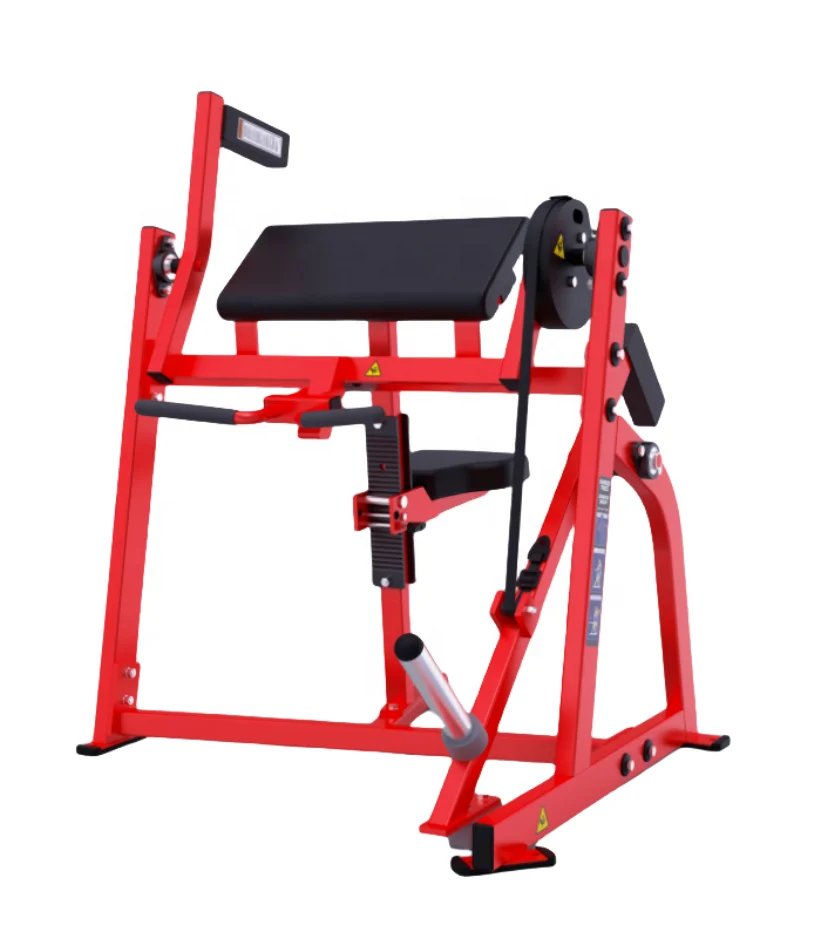
Sealed Bearing Architecture — Manual resistance with sealed pivot points ensures smooth, low-noise articulation under continuous commercial use.
Technical Specifications
| Parameter | Value |
|---|---|
| Designation | 5028 |
| Product Type | ISO-Lateral Kneeling Leg Curl Machine |
| Exercise Part | Leg |
| Resistance Type | Manual |
| Frame Material | Steel |
| Product Dimensions | 1270 × 1000 × 1290 mm |
| Net Weight | 145 kg |
| Foldable | Unfolded |
| Appliance | Community, Gymnasium |
| Fit Area | Professional Gym and Club |
| Age Group | Adult |
| Gender | Unisex |
| Certification | ISO 9001, CE |
| Production Capacity | 500 PCS/Month |
Application Suitability
| Deployment Scenario | Typical Use |
|---|---|
| Chain gym strength training zone | High-frequency hamstring isolation work during peak hours |
| Professional sports performance center | Unilateral leg conditioning and muscle imbalance correction |
| Corporate wellness fitness room | Moderate-volume resistance training for employee wellness programs |
| Community recreation gymnasium | Supervised group and individual lower-body strength sessions |
| High-end residential fitness facility | Shared-access hamstring training with minimal noise transfer |
What Sealed Bearings Change About Long-Term Resistance Consistency
Consistent tension through the full range of motion depends entirely on bearing quality.
When a kneeling leg curl machine sees two hundred sets a day, the pivot points take repetitive lateral loading that exposes any gap in bearing seals. I have watched gym operators replace entire selectorized leg stations because unsealed bearings let chalk dust and sweat residue penetrate the raceway, turning smooth arcs into grinding, uneven resistance curves. Members do not file complaints about bearings — they stop booking the machine and tell the front desk it "feels broken." [NEED_CITE: sealed bearing lifecycle expectations in commercial gym environments]
A commercial ISO-lateral kneeling leg curl machine with properly sealed pivot points sidesteps this attrition loop entirely. The sealed bearings in this model maintain smooth articulation without scheduled relubrication intervals, which matters when the machine sits in a high-traffic strength zone between plate-loaded racks and functional trainers.
Where This Station Fits in a Strength Floor Layout
This ISO-lateral kneeling leg curl occupies a focused niche in the posterior chain training sequence. It pairs naturally with hip thrust stations and Romanian deadlift platforms upstream, and calf raise units downstream, forming a complete lower-body training corridor. The 1270 × 1000 mm footprint allows placement against walls or between rack bays without blocking traffic lanes. The kneeling configuration accommodates users across a broad height range, and the ISO-lateral independent arm design lets athletes isolate each hamstring group without the dominant leg compensating — something fixed-path machines cannot replicate.
Continuous Operation and Floor Loading Considerations
A machine rated at 145 kg net weight sits firmly in place without walking across the floor during heavy eccentric phases, but floor leveling still matters. Deploying on uneven concrete causes frame twist that translates into uneven pad contact and asymmetric resistance feel. I have seen operators in multi-story facilities place these units on upper floors without vibration isolation pads, and while the sealed manual system generates far less noise than motorized equipment, repetitive plate loading on adjacent machines transmits structure-borne vibration that compounds. [NEED_CITE: structural vibration transfer thresholds for upper-floor gym deployments]
Ensuring a dedicated circuit is unnecessary here since the resistance is manual, but adequate clearance on three sides — at minimum 600 mm — allows safe entry, exit, and spotter access during heavy working sets.
Reading the Frame and Resistance Engineering
The steel frame construction provides the rigidity needed for ISO-lateral independent arm movement, where each side tracks its own arc without cross-contamination from the opposing limb. This matters because hamstring imbalances are common, and a fixed-bar design forces the stronger side to mask the weaker side’s deficit. The manual resistance system eliminates motor maintenance entirely — no brushes to replace, no drive belts to tension, no control boards vulnerable to voltage spikes. [NEED_CITE: manual versus motorized resistance system maintenance intervals in commercial settings]
The pivot points are biomechanically engineered to align with natural knee joint articulation, reducing shear stress at the axis of rotation. When the pivot sits even a few centimeters off the anatomical knee center, the pad migrates up or down the shin during the curl, forcing the user to fight the machine rather than train through it. The ISO-lateral design also means each arm must be independently balanced at the factory, which is a quality checkpoint that separates commercial-grade units from lighter-duty alternatives.
The Hidden Cost of Underspecifying Pivot Hardware
Operators who select leg curl stations based on pad comfort and paint finish while ignoring bearing specifications pay for it within the first year. Unsealed pivots in a humid gym environment corrode silently, and by the time the resistance feels rough, the raceway damage is already past the point of field repair. I recall a facility in Southeast Asia that cycled through three different leg curl brands in two years because the coastal humidity destroyed exposed bearings in months — the frames were fine, but the articulation was shot. [NEED_CITE: corrosion failure timelines for unsealed bearings in high-humidity gym environments]
That pattern repeats everywhere: the machine looks correct on the spec sheet, but the pivot hardware tells a different story about how long it will perform under continuous commercial loading.
Why This Product Line Holds Up in the Field
The sealed bearing architecture on this commercial ISO-lateral kneeling leg curl machine is validated through extended durability testing — components are run through cycles that simulate continuous high-frequency use well past the point where consumer-grade equivalents fail. The steel frame undergoes welding inspection and static load testing to confirm it handles maximum user weight without deflection. OEM and ODM customization covers pad density, frame color, and branding, so facility operators can match existing fleet aesthetics without compromising internal specifications. The 1270 × 1000 mm footprint feeds directly into 3D strength-zone layouts where equipment spacing, sightlines, and member flow are planned before a single unit ships. Documentation includes full test records, so buyers can verify claims before committing to a container load.
Documentation & Test Records
- CE declaration of conformity for commercial fitness equipment
- EN 957 test report covering static and dynamic load performance
- ISO 9001 quality management system certificate
- Noise level test record for manual resistance articulation
- Durability test log for sealed bearing lifecycle validation
- Frame welding inspection and static load certification
Installation, Commissioning & Maintenance
- Verify 1270 × 1000 mm footprint clearance with 600 mm minimum access on three sides
- Level frame on floor using adjustable feet before loading weight plates or pins
- Inspect sealed bearing pivot points for smooth articulation before releasing to members
- Check pad mounting bolts and ISO-lateral arm balance during first-week commissioning
- Schedule quarterly visual inspection of frame welds and pivot hardware integrity
- Clean upholstery and frame contact points weekly to prevent sweat-induced corrosion
Planning Your Strength Zone Equipment Inquiry
Provide the total strength area dimensions and existing equipment list so we can generate a 3D layout showing how this unit integrates with your posterior chain training sequence. Specify average daily member volume to confirm the manual resistance system matches your usage intensity. Confirm the deployment floor and adjacent room types so we can advise on vibration isolation requirements. State your target market and any OEM customization needs including pad material, frame finish, and branding placement.
Frequently Asked Questions
Q: How does ISO-lateral movement differ from a fixed-path leg curl machine?
A: ISO-lateral independent arms allow each leg to move through its own arc without the stronger limb compensating for the weaker one. Fixed-path designs link both legs to a single axis, which masks imbalances and can reinforce asymmetries over time. This makes ISO-lateral stations preferred for rehabilitation and athletic performance settings where unilateral assessment matters.
Q: What maintenance does the manual resistance system require compared to selectorized stacks?
A: Manual resistance systems eliminate guide rods, cables, and selector pins that require regular lubrication and alignment checks. The sealed bearings in the pivot points need no scheduled relubrication. Operators mainly inspect pad mounting hardware and frame bolts on a quarterly cycle, which reduces total maintenance time compared to weight stack systems with exposed cables and pulleys.
Q: What clearance and spacing should planners allow around this machine?
A: The 1270 × 1000 mm frame requires at least 600 mm clearance on three sides for safe entry, exit, and spotter positioning. When planning a posterior chain training corridor, allow additional transition space between this unit and adjacent hip or calf stations so members can move between exercises without congestion during peak training hours.
Q: How do sealed bearings affect the machine lifespan in humid environments?
A: Sealed bearings prevent moisture, chalk dust, and sweat residue from penetrating the raceway, which is the primary cause of pivot degradation in coastal or high-humidity facilities. Unsealed bearings in these environments can corrode within months, causing rough articulation that members interpret as equipment failure and leading to premature machine replacement.
Q: What frame testing standards apply to commercial strength equipment of this type?
A: Commercial strength frames are tested under EN 957 standards, which specify static load, dynamic fatigue, and stability requirements. The ISO 9001 certification covers the manufacturing quality system, while the CE marking confirms conformity with European safety directives. Buyers should request the specific test reports to verify that weld integrity and load ratings match the deployment demands.