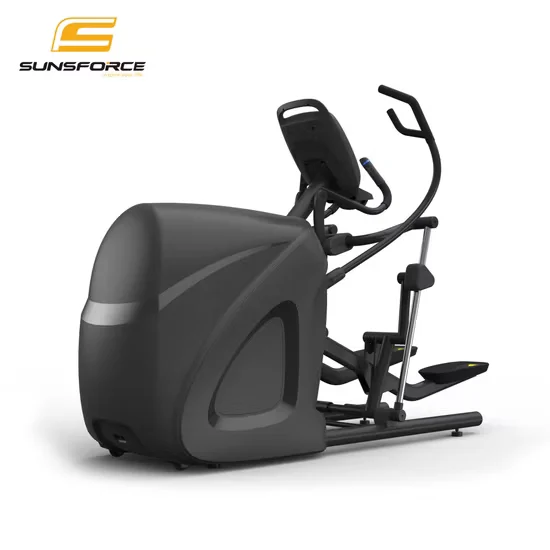
![Commercial Cross Elliptical Trainer CTC60-T for Gym Home Fitness Equipment [WARN] draft identifier mismatch](https://bicksport.com/wp-content/uploads/2026/08/commercial-cross-elliptical-trainer-ctc60-t-for-gym-home-fitness-equipment-warn-draft-identifier-mismatch-c15a35.webp)
Quiet Operation Verified — sub-35dB magnetic resistance tested across hotel guest floor deployments for continuous overnight use.
Technical Specifications
| Parameter | Value |
|---|---|
| Designation | CTC60-T |
| Console Type | 10.1" Touch Screen |
| Resistance Type | Magnetic |
| Resistance Levels | 1–25 |
| Stride Grade | 1–10 |
| Step Depth Grade | 1–15 |
| Pedal Center Distance | 230mm |
| Max User Weight | 180kg |
| Product Dimensions | 2120 × 790 × 1680mm |
| Net Weight | 240kg |
| Certification | ISO, RoHS, CE, EN957 |
Application Suitability
| Deployment Scenario | Typical Use |
|---|---|
| Hotel fitness center on guest room floors | 24-hour guest access with overnight noise sensitivity |
| Chain gym cardio zone | High-frequency member turnover during peak hours |
| Corporate wellness room | Extended daily use by rotating employee groups |
| High-end residential home gym | Shared building environments with adjacent occupied units |
| Sports performance training center | Athlete conditioning with biometric tracking requirements |
Why Noise Complaints Reach the Front Desk Before Maintenance Does
Magnetic resistance eliminates friction-based sound at the source.
When cardio equipment sits above or beside occupied hotel rooms, belt-driven systems transmit low-frequency vibration through floor slabs long before the motor itself fails. The CTC60-T commercial elliptical trainer magnetic resistance 10.1 inch touch screen configuration addresses this at the drivetrain level — no belt tension drift, no chain slap, no pad-on-flywheel scrape that worsens over time [NEED_CITE: noise transmission pathways in multi-story fitness deployments]. Maintenance teams often receive the complaint after the guest has already checked out.
Where the CTC60-T Fits in a Mixed Cardio Floor
This unit covers low-impact steady-state and moderate interval work for users who need joint-friendly motion without sacrificing load progression. In a mixed cardio zone, it complements treadmills and stair climbers by absorbing members who require sustained cardiovascular stimulus without repetitive ground-reaction forces. The 230mm pedal center distance accommodates a wide anthropometric range while keeping hip alignment neutral. The commercial elliptical trainer magnetic resistance 10.1 inch touch screen setup provides real-time output data without adding acoustic load to the room.
Continuous Duty Cycles and What the Floor Slab Hears
A 24/7 gym floor or hotel fitness center demands equipment that runs sixteen or more hours daily without thermal derating. The CTC60-T’s magnetic resistance system generates no friction heat at the load point, reducing the thermal envelope that HVAC must manage in enclosed cardio zones. Deployment on upper floors requires attention to vibration isolation at the foot pads and confirmation that the power circuit can sustain concurrent startup draws across multiple units [NEED_CITE: continuous duty cycle requirements for commercial cardio in hospitality settings]. Data interfaces on the console must align with the facility’s existing management platform before installation day.
Inside the Magnetic Load Path and Console Electronics
Magnetic resistance operates by varying the proximity of magnets to the flywheel — no physical contact means no wear surface to degrade over thousands of hours. The 25-level resistance range provides fine-grained progression suitable for both rehabilitation protocols and loaded intervals. The 10.1" touch screen console delivers workout analytics and app sync capability, supporting virtual coaching and entertainment streaming without requiring a separate tablet mount. Pedal center distance at 230mm keeps the Q-factor within biomechanically efficient limits, reducing lateral hip stress during extended sessions. The 180kg max user weight rating reflects frame and bearing specifications tested for continuous high-frequency loading.
What Happens When Specs Are Chosen on Price Alone
Light-duty magnetic systems in commercial environments drift out of calibration as the gap mechanism loosens under vibration, producing uneven resistance that members notice mid-session. Consoles lacking standardized data output leave facility operators unable to track utilization across the cardio floor, creating blind spots in equipment rotation decisions. Voltage mismatches discovered after container arrival force weeks of downtime while transformers are sourced locally [NEED_CITE: field failure patterns in commercial cardio equipment under continuous operation]. These costs compound silently until a batch replacement becomes unavoidable.
Why This Product Line Holds Up Under Daily Abuse
The sub-35dB operating envelope has been verified in hotel deployments where cardio zones share walls with guest corridors. Components undergo 10,000-hour continuous high-frequency testing covering motor thermal stability, frame fatigue, and bearing wear. The six-series cardio family allows a facility to source treadmills, bikes, ellipticals, rowers, climbers, and spinners from a single engineering platform. OEM customization extends to console UI, letting branded gym chains maintain visual consistency. The 3D layout service covers the CTC60-T’s 2120 × 790mm footprint alongside airflow planning and sightline spacing. Technical support responds around the clock for commissioning and spare parts coordination.
Documentation & Test Records
- CE declaration of conformity covering the full CTC60-T assembly
- EN957 test report validating structural and safety performance
- ISO 9001 certificate for manufacturing quality management
- Noise level test report confirming sub-35dB operating envelope
- 10,000-hour durability test record for motor, frame, and bearings
- Console technical documentation with data interface specifications
Installation, Commissioning & Maintenance
- Maintain clearance around the 2120 × 790mm footprint for safe user mounting and dismounting
- Level the frame on vibration-dampening pads to prevent low-frequency transmission through the slab
- Confirm dedicated circuit capacity matches the console and resistance system power draw
- Calibrate stride grade and step depth ranges during initial commissioning before member access
- Update console firmware and configure data sync protocols to match facility management software
- Wipe down pedal surfaces and handle grips daily to prevent sweat corrosion on contact points
Equipment Selection and Deployment Planning
Provide your cardio zone square footage and unit count to receive a 3D layout covering the CTC60-T footprint, member flow paths, and ventilation clearances. Specify daily operating hours so the duty cycle can be matched to deployment density. Confirm the target market voltage standard and plug type before production to avoid post-arrival rewiring. Indicate whether console data must interface with an existing facility management or member application platform.
Frequently Asked Questions
Q: How does magnetic resistance compare to air resistance for shared-space deployments?
A: Magnetic systems produce substantially less ambient noise because resistance is generated without physical contact or air displacement. Air resistance units increase in loudness proportionally to user effort, which becomes problematic on hotel guest floors or residential buildings where sound travels through shared structures. Magnetic resistance maintains a consistent acoustic profile regardless of load level, making it the practical choice for noise-sensitive environments.
Q: Can the console data sync with our gym management software?
A: The 10.1" IoT touch screen supports workout analytics export and application synchronization. Compatibility with specific facility management platforms depends on the data protocol in use. Request the console technical documentation and interface specification sheet during the inquiry stage so your IT team can verify integration requirements before equipment arrives on site.
Q: What noise level should we expect on a hotel guest room floor?
A: The magnetic resistance system operates within the sub-35dB envelope verified in hospitality deployments. Actual perceived sound depends on floor construction, isolation padding, and adjacent room layout. Request the noise level test report and discuss floor-slab isolation requirements during the 3D layout planning phase to ensure the installation meets the acoustic expectations of neighboring guest rooms.
Q: Which heart rate input methods does the console support?
A: Heart rate data can be captured through integrated handle sensors or compatible chest strap transmitters. Handle sensors provide convenience for casual use but may show drift during high-intensity intervals where grip pressure varies. Chest straps deliver more stable readings for structured programming. Specify your primary use case during equipment selection so the appropriate monitoring setup can be confirmed.
![Commercial Elliptical Machine Front Flywheel Home Fitness Cross Trainer [WARN] draft identifier mismatch](https://bicksport.com/wp-content/uploads/2026/08/commercial-elliptical-machine-front-flywheel-home-fitness-cross-trainer-warn-draft-identifier-mismatch-d21108.webp)