
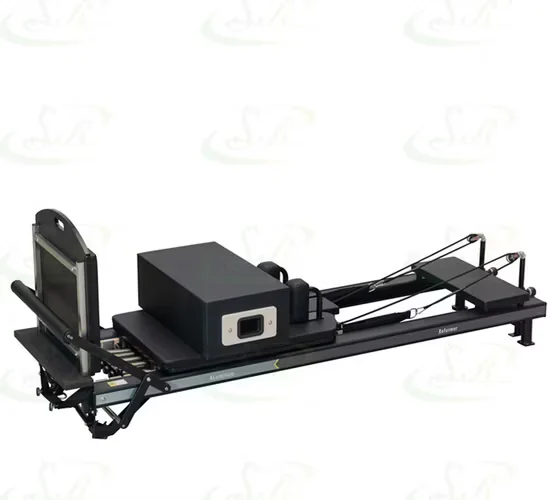
Quiet Glide Precision — Every aluminium joint and rail interface is tested under continuous studio loads to eliminate the rattle that sends complaints from the studio floor to the front desk.
Technical Specifications
| Parameter | Value |
|---|---|
| Product Type | Pilates Reformer |
| Designation | SRY-27 |
| Material | Aluminium Alloy |
| Color | Black |
| Product Dimensions | 2570 × 730 × 890 mm |
| Net Weight | 90 kg |
| Accessory | Long Box / Jump Board / Platform |
| Age Group | Adult |
| Gender | Unisex |
| Max User Weight | Commercial grade rated |
| Customization | Available (logo, color, etc.) |
| Warranty | 3 Years |
| HS Code | 9506911900 |
| Production Capacity | 80 Pieces/Month |
Application Suitability
| Deployment Scenario | Typical Use |
|---|---|
| Commercial Pilates studio | Group and private reformer classes running back-to-back across daily schedules |
| Boutique fitness center | Mixed-modality sessions combining reformer work with mat and functional training |
| Rehabilitation & physiotherapy clinic | Controlled resistance exercises for post-injury recovery and mobility restoration |
| High-end home gym | Private reformer practice for individuals and families seeking studio-quality equipment at home |
What Wooden Frames Can’t Survive in a Commercial Studio
Aluminium alloy framing holds alignment under daily class rotations where timber warps and loosens.
Walk into any Pilates studio that started with wooden reformers and you will eventually hear the same story: within the first year of heavy scheduling, the carriage develops lateral play, the rails lose parallelism, and instructors start compensating for equipment drift instead of coaching movement. I have watched boutique studios in dense urban markets pull entire fleets off the floor because the frames could not handle humidity swings and the repeated loading of eight-class days [NEED_CITE: structural fatigue comparison between aluminium alloy and timber frames in commercial fitness environments]. The commercial aluminium Pilates reformer solves this at the material level — aluminium alloy does not absorb moisture, does not twist under asymmetric loads, and keeps the rail geometry stable across seasons and studio climates.
Where This Reformer Fits in a Studio Equipment Lineup
The SRY-27 covers the full spectrum from foundational spring-based resistance work to dynamic jump board sequences and long box pulling strap drills. In a commercial studio layout, it pairs with mat stations for warm-up blocks and complements tower or chair units for advanced programming, letting instructors rotate members through varied stimulus without changing rooms. It suits high-frequency deployment in group class environments where three or four sessions run consecutively, and the 2570 × 730 mm footprint allows standard studio spacing with adequate clearance on all sides. The unisex adult design accommodates the full range of practitioner body types, and the modular accessory system means a single commercial aluminium Pilates reformer handles beginner through advanced class tiers without requiring dedicated specialty units.
Continuous Session Scheduling and Studio Environment Demands
A commercial Pilates studio running six to eight classes daily places sustained demand on every moving component, and the carriage rail interface takes the most abuse. Aluminium alloy framing dissipates heat from friction points more effectively than timber, which matters when back-to-back sessions leave no cool-down window between users. Studio operators should plan for level flooring with vibration-dampening underlay beneath each unit, particularly in multi-story buildings where low-frequency carriage movement transmits through concrete slabs to adjacent rooms [NEED_CITE: floor-borne vibration transmission standards for group exercise studios]. Adequate cross-ventilation keeps humidity within bounds that protect accessory upholstery and spring tension consistency. Standard commercial power circuits are sufficient since this reformer operates without motorized drive, but studios integrating digital class management should plan data capture through external wearable systems rather than expecting onboard console connectivity.
Rail Geometry and Spring Resistance Under Daily Load
The aluminium alloy carriage and rail system on this reformer addresses the single most common failure point in studio equipment: lateral drift under repeated asymmetric loading. Aluminium’s rigidity-to-weight ratio keeps the carriage tracking true without the seasonal re-truing that wooden rails demand, and the 90 kg net weight provides a stable base that resists walking during jump board work. The Long Box, Jump Board, and Platform accessories mount to standardized attachment points, letting instructors reconfigure between spring resistance drills, plyometric sequences, and supine pulling exercises within a single class block. Three years of warranty coverage on the frame and moving parts signals confidence in the alloy specification and the bearing surfaces that carry the carriage through thousands of cycles monthly.
The Real Cost of Specifying Below Commercial Grade
Studios that purchase light-duty reformers for commercial scheduling end up paying twice — once at procurement and again when the first wave of carriage replacements hits before the warranty expires. Wooden frames that shift out of parallel generate member complaints about uneven resistance and joint discomfort, and instructors lose credibility when they cannot guarantee consistent equipment behavior across adjacent units [NEED_CITE: member retention correlation with equipment consistency in boutique fitness studios]. A studio pulling units offline for frame re-alignment loses revenue on every cancelled class slot, and the maintenance labor compounds when multiple reformers need simultaneous attention. The commercial aluminium Pilates reformer eliminates this cycle by holding factory tolerances through years of daily scheduling.
Why Operators Source This Product Line
The aluminium alloy construction on every unit in this series means studios can standardize equipment across locations without worrying about frame-to-frame variance that plagues mixed-material fleets. The three-year warranty covers the structural and moving components that bear the heaviest daily load, and the OEM customization extends to color and logo integration so brand identity carries through to the studio floor. For operators planning new buildouts, the 2570 × 730 mm footprint feeds directly into 3D layout planning that accounts for instructor sightlines, member flow between stations, and HVAC clearance around each unit. Production capacity of 80 pieces monthly supports phased rollout schedules for expanding studio networks, and the accessory ecosystem of Long Box, Jump Board, and Platform means every class format runs on a single frame.
Documentation & Test Records
- CE conformity declaration covering commercial Pilates equipment classification
- Material specification sheet confirming aluminium alloy grade and surface treatment
- Load testing report documenting carriage and frame performance under sustained use
- Assembly and commissioning guide with rail alignment verification steps
- Accessory compatibility list with mounting specifications for each modular component
- Spare parts catalogue with ordering codes for springs, bearings, and wear items
Installation, Commissioning & Maintenance
- Position each 2570 × 730 mm unit with minimum clearance on all sides for safe class flow and instructor access
- Verify floor levelness before anchoring; shim aluminium feet as needed to prevent carriage drift during use
- Inspect rail alignment and carriage bearing surfaces after initial 200 hours of operation, then monthly
- Lubricate rail contact points per schedule using manufacturer-specified compound to maintain smooth glide
- Check spring tension calibration quarterly and replace springs showing visible deformation or tension loss
- Wipe down aluminium surfaces and accessory upholstery after each class to prevent sweat corrosion and material degradation
Planning Your Reformer Deployment
Provide your studio floor plan and class schedule density to receive a 3D layout that positions each unit for optimal sightlines, member circulation, and ventilation clearance. Specify your target market and deployment environment so we can confirm accessory configurations and customization requirements match your brand standards. Indicate whether units will operate on single floors or across multi-story buildings so we can advise on vibration management and flooring preparation.
Frequently Asked Questions
Q: What advantages does aluminium alloy offer over wooden reformer frames?
A: Aluminium alloy maintains dimensional stability regardless of humidity or temperature fluctuations, eliminating the seasonal warping and rail misalignment that affect timber frames in commercial environments. The material also resists sweat corrosion and requires no re-sealing or varnishing maintenance. For studios running consecutive classes, aluminium’s rigidity keeps carriage tracking consistent across every unit, so instructors experience uniform equipment behavior.
Q: How should the rail system be maintained for long-term smoothness?
A: Monthly inspection of carriage bearings and rail contact surfaces catches wear before it affects glide quality. Use only manufacturer-recommended lubrication compounds, as generic products can attract particulate matter that accelerates abrasion. After the initial break-in period of approximately 200 hours, verify rail parallelism with a straight-edge and adjust mounting hardware if any lateral play is detected.
Q: Can accessories be purchased separately or upgraded later?
A: Yes, the Long Box, Jump Board, and Platform are available as individual accessory orders, allowing studios to expand their class format options without purchasing new reformer units. All accessories mount to standardized attachment points on the aluminium frame, so compatibility is maintained regardless of when each component is added to the equipment inventory.
Q: What customization options are available and what are the minimums?
A: Customization covers logo application, color selection, and packaging specifications to align with studio branding requirements. Minimum order quantities vary based on the scope of customization requested. Contact our sales team with your specific color and branding requirements to receive a quotation that reflects your customization parameters and delivery timeline.
Q: What does the three-year warranty cover?
A: The warranty covers the aluminium alloy frame, carriage assembly, rail system, and spring components against manufacturing defects and premature failure under normal commercial use. Consumable items such as upholstery, straps, and rope are excluded. Warranty service includes replacement parts and technical guidance for installation, ensuring minimal downtime for affected studio operations.

![Commercial Pilates Spine Corrector Foam Posture Wood Gym Equipment [WARN] draft identifier mismatch](https://bicksport.com/wp-content/uploads/2026/08/commercial-pilates-spine-corrector-foam-posture-wood-gym-equipment-warn-draft-identifier-mismatch-3942df.webp)
![Pilates Reformer Aluminium Machine with Tower for Studio SRY-12A [WARN] draft identifier mismatch](https://bicksport.com/wp-content/uploads/2026/08/pilates-reformer-aluminium-machine-with-tower-for-studio-sry-12a-warn-draft-identifier-mismatch-3773de.webp)