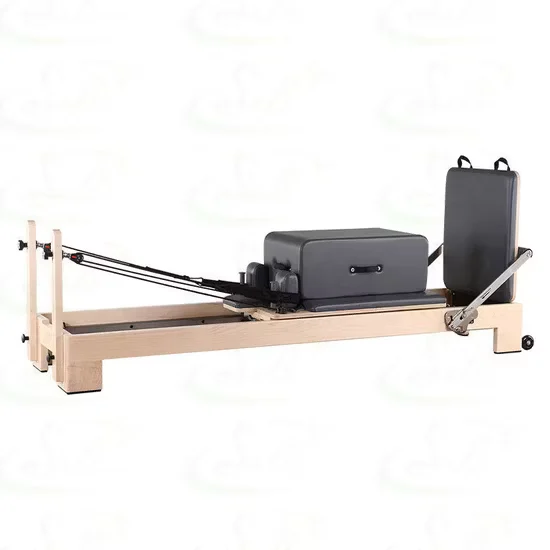
Precision-Machined Glide — Aluminum alloy frame and sealed carriage wheels deliver consistent, quiet motion across thousands of studio sessions.
Technical Specifications
| Parameter | Value |
|---|---|
| Designation | SRY-12A |
| Product Type | Pilates Reformer |
| Frame Material | Aluminum Alloy |
| Color | White |
| Accessory | Long Box / Jump Board / Platform |
| Tower Attachment | Half / Full Tower |
| Product Dimensions | 25707301850mm |
| Net Weight | 130kgs |
| Target User | Adult, Unisex |
| Logo | Customized Is Allowed |
| Warranty | 3 Years |
| Certification | CE, ISO 9001 |
Application Suitability
| Deployment Scenario | Typical Use |
|---|---|
| boutique Pilates studio group | uniform equipment rollout across multiple locations for consistent class experience |
| rehabilitation and physical therapy clinic | controlled resistance progression for post-injury and mobility recovery programs |
| high-end residential fitness room | multi-discipline space integration where floor space is shared with other apparatus |
| corporate wellness center | low-impact programming for employee fitness initiatives with minimal supervision |
| sports performance training center | athlete conditioning focusing on core stability and eccentric loading |
What Warped Frames and Noisy Carriages Cost a Studio Over Time
Rigidity and glide smoothness dictate whether a reformer survives its first year in a fully booked studio.
Studio operators routinely replace units that develop lateral play in the carriage system after several months of continuous class scheduling. Aluminum alloy construction resists the torsional stress that causes steel frames to gradually deform under cyclic loading, particularly when clients perform standing and kneeling exercises on the tower attachment [NEED_CITE: material fatigue characteristics in commercial Pilates equipment]. A carriage that rattles or binds mid-session disrupts instructor cues and forces class sizes down, eroding revenue per square meter long before the frame itself fails.
Positioning Within the Studio Equipment Mix
This commercial aluminum alloy Pilates reformer with tower covers the full spectrum from foundational mat-based movements to advanced standing work using the integrated pulley system. It complements Cadillac and Wunda Chair stations by handling the highest-volume exercise repertoire in a single footprint, reducing the need for participants to transition between apparatus mid-class. The 2570mm length accommodates taller users without compromising carriage travel, making it suitable for facilities serving diverse clientele. Deployment density should allow sufficient clearance on all sides for instructor circulation and safe mounting.
Continuous Scheduling and Floor Loading Considerations
A fully booked studio running back-to-back classes places the carriage system under near-continuous use for eight or more hours daily. The aluminum alloy frame dissipates vibration more effectively than welded steel assemblies, reducing structure-borne noise transmission to rooms below [NEED_CITE: vibration damping properties of aluminum alloy in fitness equipment]. Facilities on upper floors or above occupied spaces benefit from this characteristic, particularly when jump board work is part of the programming. Adequate ventilation around the equipment zone prevents humidity buildup that accelerates spring corrosion and degrades cable integrity over time.
Dissecting the Frame, Carriage, and Spring Architecture
The aluminum alloy extrusion provides torsional rigidity while keeping the unit at 130kgs — heavy enough to remain stable during dynamic exercises yet manageable for repositioning during studio reconfiguration. Precision-machined rail surfaces maintain consistent contact with carriage wheels, preventing the uneven glide that develops when tolerances drift under repeated loading. The spring resistance configuration offers progressive tension suitable for rehabilitation through to advanced athletic conditioning, with replacement intervals determined by usage intensity rather than calendar dates. Tower pulleys are aligned to minimize cable wear during overhead and lateral pull patterns, a common failure point in retrofitted tower attachments where geometry is compromised.
The Hidden Toll of Spec-Down Equipment in Commercial Spaces
Procuring reformers with lighter frames and generic carriage bearings often surfaces as maintenance overhead within the first operational quarter. Springs lose tension consistency, requiring instructors to manually compensate during classes and introducing liability concerns. Carriage wheels that lack sealed bearings accumulate dust and debris, accelerating rail wear and generating audible friction that clients notice immediately [NEED_CITE: bearing specification impact on maintenance frequency in studio equipment]. The cumulative cost of replacement springs, carriage rebuilds, and member complaints regularly exceeds the initial savings on a lower-specification unit.
Why This Product Line Addresses Studio Procurement Risks
The aluminum alloy frame is load-tested and documented, providing verifiable material certification rather than marketing claims. Carriage glide tolerance is specified, allowing buyers to confirm smoothness against measurable standards before committing volume orders. The integrated tower attachment eliminates the compatibility issues that arise when bolting third-party towers onto reformers not engineered for the additional lateral forces. OEM customization covers logo application and finish options, enabling brand consistency across multi-location studio networks. The 3D layout service accounts for reformer clearance requirements, traffic flow, and sightlines so the cardio and movement zones function as an integrated whole rather than competing for floor space.
Documentation & Test Records
- CE declaration of conformity for European market compliance
- EN 957 test report covering structural and safety requirements
- ISO 9001 certificate verifying manufacturing process control
- Frame material certification and load testing documentation
- Spring tension range specification with replacement interval guidance
- Installation and commissioning guide with spare parts list
Installation, Commissioning & Maintenance
- Maintain minimum clearance around the 2570*730mm footprint for safe mounting and instructor access
- Level the aluminum alloy frame on solid flooring to prevent carriage drift and uneven rail loading
- Inspect carriage wheels and rail surfaces monthly, removing accumulated dust and verifying smooth travel
- Check spring tension consistency quarterly and replace any spring showing visible deformation or fatigue
- Verify tower pulley alignment and cable condition to prevent uneven wear during overhead exercises
- Apply manufacturer-specified lubrication to moving contact points according to the maintenance schedule
Equipment Selection and Studio Planning Inquiry
Provide your studio floor area and planned class capacity to receive a 3D layout incorporating reformer spacing, instructor circulation paths, and ventilation requirements. Specify whether the deployment is on an upper floor with occupied rooms below to confirm noise and vibration transmission suitability. Indicate target market and voltage requirements for any electrically assisted accessories. State whether console data integration with facility management software is required for usage tracking and class analytics.
Frequently Asked Questions
Q: What are the trade-offs between aluminum alloy and steel frames for studio reformers?
A: Aluminum alloy reduces overall weight for easier repositioning during studio reconfiguration while maintaining torsional rigidity under dynamic loading. Steel frames are typically heavier and can dampen vibration through mass, but they are susceptible to gradual deformation if the alloy grade or wall thickness is insufficient. Aluminum resists corrosion in humid environments without requiring surface treatment, whereas steel depends on coating integrity. Cost varies by alloy specification and manufacturing process.
Q: Can a tower attachment be retrofitted to an existing reformer, or is integrated design preferable?
A: Retrofit towers introduce alignment variables that compromise pulley geometry and cable routing, often resulting in uneven resistance during lateral movements. An integrated design engineers the tower attachment into the frame from the outset, ensuring pulley alignment matches the carriage travel path and that the frame can absorb the additional lateral forces without flexing. Retrofitting also typically voids the original warranty and may not meet EN 957 requirements for the combined apparatus.
Q: What maintenance does the carriage and rail system require in a high-volume studio?
A: Carriage wheels and rail contact surfaces should be inspected monthly for dust accumulation and signs of uneven wear. Sealed bearings require no lubrication but should be checked for play or roughness during travel. Rail surfaces need periodic cleaning with manufacturer-recommended solvents to prevent abrasive particle buildup. Any lateral play or binding sensation during movement indicates immediate inspection is required to prevent accelerated component degradation.
Q: How do you determine when springs need replacement on a commercial reformer?
A: Springs gradually lose tension consistency through metal fatigue, particularly in studios running multiple classes daily with advanced programming. Visible deformation, inconsistent resistance between springs of the same rating, or a noticeably different feel during exercises are indicators that replacement is due. Manufacturers typically provide tension range specifications and recommend inspection intervals based on usage cycles rather than calendar time, as degradation correlates directly with exercise volume and load.

![White Aluminium Pilates Reformer Bed Machine for Commercial Studio Use [WARN] draft identifier mismatch](https://bicksport.com/wp-content/uploads/2026/08/white-aluminium-pilates-reformer-bed-machine-for-commercial-studio-use-warn-draft-identifier-mismatch-25d21f.webp)