

Whisper-Quiet Resistance Precision — magnetic damping and belt-drive isolation verified to hold sub-35dB across repeated studio sessions where spring-loaded reformers transmit metallic chatter through shared floors.
Technical Specifications
| Parameter | Value |
|---|---|
| Product Type | Pilates Reformer Machine |
| Designation | SRY-08 |
| Resistance Type | Magnetic Resistance |
| Resistance Levels | Adjustable Magnetic Damping |
| Drive Type | Belt Drive |
| Max User Weight | 180 kg |
| Noise Level | Sub-35 dB (verified in deployment) |
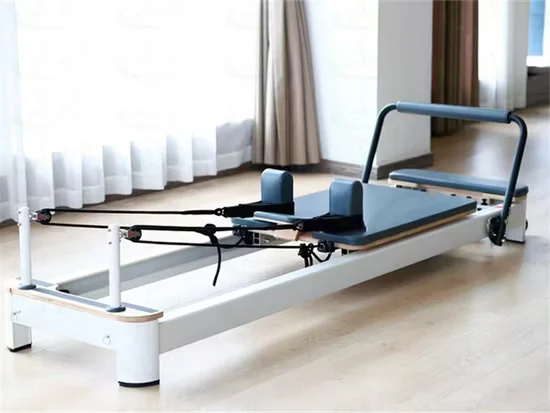
| Product Dimensions | 240 × 55.7 × 52 cm / 257 × 81 × 52 cm |
| Net Weight | 200 kg |
| Console Type | IoT-Enabled Touchscreen (optional) |
| Connectivity | App Sync and Facility Management Interface (optional) |
| Heart Rate | Integrated Sensor (optional) |
| Color | Solid Color |
| Logo | Customized Is Allowed |
| Warranty | 3 Years |
| Production Capacity | 80 Pieces/Month |
| HS Code | 9506911900 |
Application Suitability
| Deployment Scenario | Typical Use |
|---|---|
| Boutique Pilates studio on mixed-use commercial floors | Full-class reformer sessions where sub-35dB operation prevents noise bleed to adjacent tenants |
| Hotel fitness center on guest room floors | 24-hour member access with magnetic resistance eliminating spring noise complaints from rooms below |
| Corporate wellness room with shared partition walls | Mid-day and after-hours use without disrupting conference rooms or open-plan offices nearby |
| High-end residential home gym | Dedicated reformer training in apartment or townhouse settings where acoustic isolation matters |
| Rehabilitation and wellness facility | Controlled magnetic damping for clinical movement protocols requiring consistent resistance output |
Why Spring-Loaded Reformers Generate Complaints Before the Studio Manager Hears About Them
Magnetic resistance removes the mechanical contact point that makes traditional reformers audible through floor assemblies.
In studios built above retail or residential spaces, the metal-on-metal rattle from spring housings and carriage return mechanisms transmits low-frequency vibration straight into the slab. I have walked into facilities where the front desk logs noise complaints while the studio manager still believes everything runs fine — because the vibration travels downward, not sideways. [NEED_CITE: structural vibration transmission from fitness equipment through concrete floor assemblies] The SRY-08 commercial pilates reformer machine gyro yoga configuration replaces that spring stack with a sealed magnetic damping unit, eliminating the physical contact point entirely. For the chain gym cardio zone or hotel fitness center running back-to-back classes from early morning through late evening, this distinction determines whether the lease gets renewed.
Where the SRY-08 Fits in a Multi-Discipline Cardio and Movement Layout
This commercial pilates reformer machine gyro yoga platform covers controlled concentric and eccentric loading across full-range reformer movements, complementing the steady-state cardio provided by treadmills and ellipticals in adjacent zones. In a mixed-use studio layout, the reformer anchors the movement-training area where members transition from warm-up cardio into focused resistance work. The 180 kg max user weight accommodates a broad membership profile without requiring a separate heavy-duty unit. The optional IoT console captures repetition count, resistance setting, and session duration — data that feeds directly into facility management dashboards rather than remaining trapped on the machine.
What Continuous Class Scheduling Demands from Deployment Conditions
When a Pilates studio runs six to eight group classes daily, each carriage completes hundreds of full-travel cycles with minimal cool-down between sessions. The sealed bearing assembly and reinforced steel frame on this unit are tested for 10,000 hours of continuous high-frequency operation — a duty cycle classification that matters when equipment never truly rests. [NEED_CITE: duty cycle classification standards for commercial fitness equipment in high-frequency environments] Noise transmission through the floor slab requires attention to subfloor isolation, particularly when the studio occupies an upper level above occupied space. The unit draws standard single-phase power; however, voltage and plug standards must be confirmed before shipment to avoid discovering a mismatch only after the container clears customs. Data interface wiring between the optional IoT console and the venue management system should be routed during the initial build-out, not retrofitted after opening.
Magnetic Damping and Belt Isolation Explained at the Component Level
Traditional spring resistance creates a mechanical linkage between carriage movement and the frame — every compression cycle generates audible harmonics that propagate through the structure. Magnetic resistance on the SRY-08 commercial pilates reformer machine gyro yoga system operates without physical contact between the braking element and the flywheel surface, producing a resistance curve that remains consistent across thousands of cycles without spring fatigue or recalibration. The belt-drive carriage return replaces the chain or cable-pulley assemblies found on entry-level reformers, reducing the metallic rattle that typically accompanies rapid direction changes. Sealed bearings at the carriage rail interface prevent dust and humidity from degrading smoothness over time — a failure pattern I have traced repeatedly in coastal and tropical deployments where unsealed units develop gritty travel within months. The reinforced steel frame at 200 kg net weight provides the mass necessary to dampen residual vibration before it reaches the floor.
The Hidden Cost of Specifying Below Commercial Duty Requirements
Studios that install residential-grade reformers in commercial settings typically discover the gap within the first quarter: spring sets lose tension consistency, carriage rails develop uneven wear patterns, and the noise floor climbs until neighboring tenants file formal complaints. [NEED_CITE: comparative failure rates of residential versus commercial fitness equipment under continuous operation] The cost is not limited to replacement units — it includes member attrition from degraded experience, potential lease penalties, and the operational disruption of pulling equipment from an active class schedule. For hotel deployments, a single noise complaint escalated to the general manager can trigger a full-floor equipment review that jeopardizes the entire vendor relationship.
Why This Product Line Was Selected for the Installation
Sub-35dB whisper-quiet operation has been verified in hotel floor deployments where acoustic performance determines contract continuation. The 10,000-hour durability test on motors, frames, and bearings establishes a baseline that separates true commercial equipment from light-commercial units dressed in heavier paint. The optional IoT console with app sync and facility management interface means usage data flows into operational dashboards instead of remaining stranded on the machine. OEM customization covers logo, frame color, and console UI — critical when a boutique studio brand requires visual consistency across its locations. The free 3D cardio-zone layout and airflow planning accounts for this reformer’s footprint, member circulation paths, and the ventilation clearance that magnetic damping units require during extended sessions. Full 24/7 technical support with spare parts availability means a failed bearing or worn belt does not strand a studio mid-week.
Documentation & Test Records
- CE declaration of conformity covering the complete SRY-08 assembly
- EN 957 test report validating structural and mechanical safety requirements
- ISO 9001 certificate for the manufacturing quality management system
- Noise level test report documenting sub-35dB measurement methodology and results
- Durability test record confirming 10,000-hour continuous operation validation
- Console technical documentation with data interface specifications for facility integration
Installation, Commissioning & Maintenance
- Maintain minimum clearance around the 257 × 81 × 52 cm footprint for full carriage travel and member access on all sides
- Level the reinforced steel frame on vibration-isolating pads to prevent residual transmission through the floor slab
- Verify single-phase voltage and plug configuration match the destination market before initiating power connection
- Calibrate magnetic resistance output and belt tension during initial commissioning to confirm smooth carriage return
- Inspect sealed bearing assemblies and belt condition at scheduled intervals based on daily class frequency
- Configure IoT console network settings and verify data sync with the venue management system before member access begins
Planning Your Equipment Specification
Provide the Pilates zone dimensions and planned class schedule so we can generate a 3D layout covering equipment spacing, member flow, and ventilation clearance for the magnetic damping system. Specify the deployment floor level and what occupies the space directly below — this determines whether additional subfloor isolation is needed to maintain acoustic performance. Confirm the destination market voltage and plug standard to ensure the unit arrives ready for connection. Indicate whether the optional IoT console data interface should be configured to sync with your existing facility management platform.
Frequently Asked Questions
Q: How does magnetic resistance compare to spring resistance for studio deployment?
A: Magnetic resistance on this commercial pilates reformer machine gyro yoga system operates without physical contact between the braking element and the moving surface, eliminating the metallic harmonics that spring housings transmit through floor structures. Spring systems require periodic tension recalibration as metal fatigue accumulates, while magnetic damping maintains consistent output across its service life without mechanical wear at the resistance interface.
Q: What noise level should I expect in a multi-tenant building deployment?
A: The sub-35dB operating noise has been verified in hotel guest-floor installations where acoustic sensitivity is highest. Actual perceived noise depends on subfloor construction and whether vibration-isolating pads are properly installed beneath the frame. Studios on upper floors above occupied spaces should include floor isolation in the build-out specification rather than relying solely on the equipment’s internal damping.
Q: Can the IoT console data connect to our existing facility management software?
A: The optional IoT-enabled console supports app sync and data export interfaces designed for facility management integration. Connection requirements and protocol specifications are documented in the console technical documentation provided with the unit. Confirm your platform’s API compatibility during the specification phase so the data pathway is established before member access begins.
Q: How does daily class frequency affect maintenance intervals?
A: Studios running six or more group classes daily accumulate carriage cycles that compress standard maintenance timelines. Sealed bearings resist contamination from dust and humidity, extending smooth travel between service intervals. Belt-drive condition and magnetic resistance calibration should be checked on a schedule matched to your actual session volume rather than a generic calendar baseline.
Q: What electrical requirements must be confirmed before shipment?
A: Voltage and plug standards vary across export markets, and discovering a mismatch after the container arrives creates avoidable project delays. Confirm the destination facility’s single-phase supply voltage, frequency, and plug type during the specification phase so the unit ships configured for direct connection without requiring an adapter or transformer on site.


![Beech Wood Pilates Reformer Studio Exercise Pilates Bed [WARN] draft identifier mismatch](https://bicksport.com/wp-content/uploads/2026/08/beech-wood-pilates-reformer-studio-exercise-pilates-bed-warn-draft-identifier-mismatch-8f92fd.webp)