
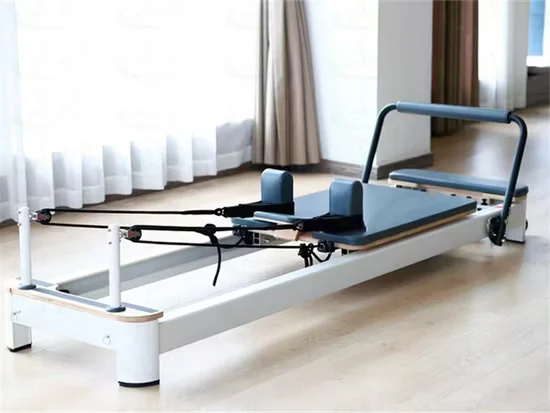
Silent Carriage Travel — Precision-machined aluminum rails and sealed bearings keep the SRY-12 reformer gliding below audible thresholds even during peak studio scheduling.
Technical Specifications
| Parameter | Value |
|---|---|
| Designation | SRY-12 |
| Product Type | Pilates Reformer |
| Frame Material | Aluminum Alloy |
| Color | White (custom colors available) |
| Accessory Suite | Long Box / Jump Board / Platform |
| Product Dimensions | 2570 × 730 × 270 mm |
| Net Weight | 90 kg |
| User Suitability | Adult / Unisex |
| Logo | Customized Is Allowed |
| Certification | ISO 9001 |
| Warranty | 3 Years |
Application Suitability
| Deployment Scenario | Typical Use |
|---|---|
| Pilates studio | Daily group classes across classical and contemporary repertoire |
| Boutique fitness center | Semi-private sessions combining reformer with mat work |
| High-end residential home gym | Personal practice with full accessory range |
| Rehabilitation and wellness center | Controlled movement therapy under practitioner supervision |
| Hotel fitness facility | Guest-accessible Pilates programming with quiet operation |
Why Studio Operators Replace Inferior Carriage Systems Within Months
The SRY-12 eliminates friction-related complaints through sealed bearing assemblies and aluminum rail geometry that sustain consistent glide under continuous daily use.
Studio reformers with unsealed wheel carriages accumulate dust and wear debris quickly, converting smooth travel into grinding noise that disrupts class focus. Operators routinely face member complaints about carriage stutter during footwork sequences — the kind of issue that spreads through reviews before maintenance ever receives a ticket [NEED_CITE: carriage bearing wear patterns in high-frequency Pilates studios]. The aluminum frame of this commercial aluminum Pilates reformer for studio environments resists the resonance that welded steel amplifies on shared floors, keeping vibration transmission well below thresholds that trigger noise complaints in adjacent rooms.
Positioning Within a Studio’s Equipment Ecosystem
The SRY-12 supports the full classical Pilates repertoire along with contemporary variations, covering supine, seated, kneeling, and standing movement patterns across beginner to advanced intensity zones. In a mixed-equipment studio layout, it complements Cadillac and chair units by handling the highest-volume exercise catalog, reducing bottlenecks during peak class scheduling. The 2570 mm rail length accommodates taller users without end-stop interference, while the 90 kg net weight provides enough mass for stability during jump board plyometrics. Studios deploying this commercial aluminum Pilates reformer for studio group classes can configure units in parallel rows with clear instructor sightlines across the room.
Continuous Scheduling and Deployment Environment Considerations
Boutique studios running four to six sessions daily demand carriage systems that maintain glide consistency without mid-week lubrication downtime. The sealed bearing design on this reformer reduces maintenance intervals compared to open-wheel alternatives, supporting continuous scheduling without unscheduled carriage removal. Floor-mounted units transfer vibration directly through the base — on upper floors of mixed-use buildings, anti-vibration pads beneath the frame feet prevent resonance transmission to occupied spaces below [NEED_CITE: structural vibration transfer thresholds for fitness equipment on suspended floors]. Adequate lateral clearance between units ensures instructors can circulate during group classes, while overhead ventilation maintains air quality during high-exertion jump board sequences.
Reading the Rail and Bearing Specifications That Define Carriage Performance
Aluminum extrusion rails offer inherent damping characteristics that steel rails lack, absorbing micro-vibrations generated during rapid carriage direction changes. Sealed bearings eliminate the need for periodic lubrication while preventing dust infiltration — the primary cause of carriage friction buildup in studio environments. The accessory mounting points for the long box, jump board, and platform maintain alignment precision through machined tolerances rather than adjustable brackets, meaning instructors do not spend class time correcting lateral drift. Frame rigidity under asymmetric loading — such as single-leg footwork at full spring tension — depends on alloy wall thickness and cross-brace geometry, both of which determine whether the carriage tracks true or develops wobble over extended use cycles.
The Hidden Cost of Specifying Below Studio-Grade
Operators who install residential-grade reformers in commercial studios typically encounter carriage wheel deformation within the first heavy-use quarter, generating noise that members associate with equipment neglect. Spring anchors on light-duty frames fatigue under repeated high-tension loading, producing inconsistent resistance that compromises exercise precision and instructor credibility [NEED_CITE: spring fatigue failure modes in commercial versus residential Pilates equipment]. Misaligned accessory interfaces on budget units force instructors to manually correct jump board positioning between classes, eroding scheduling efficiency. When a studio chain standardizes on under-specified reformers, the cumulative replacement cost across locations often exceeds what a studio-grade specification would have required initially.
Why This Product Line Holds Up in Daily Studio Rotation
The SRY-12 benefits from engineering decisions validated across the broader cardio family — sealed bearing technology and vibration isolation principles transfer directly from treadmill and elliptical development into reformer carriage design. Every unit undergoes continuous-cycle durability testing consistent with the 10,000-hour protocols applied to the motorized equipment range. Full OEM customization covers logo placement, frame color, and accessory finish, allowing studio chains to maintain brand coherence across locations. The 3D layout planning service addresses reformer spacing, instructor circulation paths, and airflow requirements specific to Pilates studio environments. Technical support extends across the complete equipment deployment, ensuring maintenance guidance covers the reformer alongside any cardio units in the same facility.
Documentation & Test Records
- CE declaration of conformity covering the SRY-12 Pilates reformer
- EN 957 test report validating structural and mechanical safety
- ISO 9001 certificate for manufacturing quality management
- Noise level test report documenting carriage travel acoustics
- Durability test record for sealed bearing and spring assemblies
- Installation and commissioning guide with spare parts list
Installation, Commissioning & Maintenance
- Maintain minimum 600 mm lateral clearance between SRY-12 units for instructor access during group sessions
- Level all four frame feet on the 2570 mm base to prevent carriage drift across the aluminum rail
- Inspect sealed bearing carriages quarterly; replace only if lateral play exceeds specification
- Verify spring anchor tension markers against calibration chart during initial commissioning
- Clean aluminum rail surfaces weekly with non-abrasive solution to maintain carriage glide
- Apply UV-protectant treatment to upholstery on the long box and platform in sunlit studio spaces
Request a Studio-Specific Equipment Proposal
Share your studio floor dimensions and planned unit count to receive a 3D layout covering reformer spacing, instructor sightlines, and ventilation planning. Specify your daily class schedule so we can confirm the sealed bearing carriage aligns with your operational tempo. Confirm your deployment floor and adjacent room usage so acoustic requirements are matched precisely. Indicate whether OEM branding — logo placement, frame color, accessory finish — is required for your facility identity.
Frequently Asked Questions
Q: How does an aluminum frame compare to steel for studio reformer noise?
A: Aluminum extrusion naturally dampens vibration rather than transmitting it through the structure like welded steel. In multi-story buildings, this difference means carriage movement generates less floor-borne resonance reaching rooms below. The SRY-12 leverages this property to maintain quiet operation during rapid direction changes and jump board sequences.
Q: What maintenance do sealed bearing carriages require in high-usage studios?
A: Sealed bearings eliminate routine lubrication by preventing dust and debris infiltration — the primary cause of carriage friction in studio environments. Maintenance reduces to periodic visual inspection for lateral play and rail surface cleaning. This contrasts with open-wheel carriages that require weekly attention under heavy class scheduling to prevent noise buildup.
Q: Are the jump board and platform accessories interchangeable across multiple SRY-12 units?
A: Yes. Accessory mounting interfaces on the SRY-12 are machined to consistent tolerances, meaning a jump board from one unit seats precisely on any other unit in the same deployment. This interchangeability lets instructors swap accessories between sessions without time-consuming alignment adjustments during class transitions.
Q: What OEM customization is available for studio chain branding?
A: Logo placement, frame color, and accessory finish can all be customized to match studio brand guidelines. Custom color matching requires approval samples before production. Lead times and minimum order quantities depend on the scope of customization — contact the project team for a branding scoping session tailored to your rollout schedule.
Q: How should studio layouts account for reformer spacing and airflow?
A: Parallel reformer rows require sufficient lateral clearance for instructor circulation and visual correction access. Overhead HVAC supply registers should distribute air across the reformer zone rather than concentrating flow in corridor areas. The 3D layout service models equipment placement against room dimensions to verify sightlines, member flow, and ventilation coverage before procurement.
![Home Yoga Solid Maple Wood Pilates Reformer with Tower for Studio [WARN] draft identifier mismatch](https://bicksport.com/wp-content/uploads/2026/08/home-yoga-solid-maple-wood-pilates-reformer-with-tower-for-studio-warn-draft-identifier-mismatch-192e82.webp)


