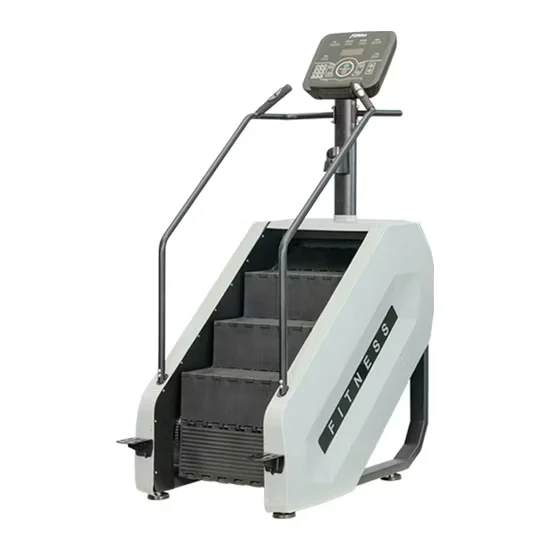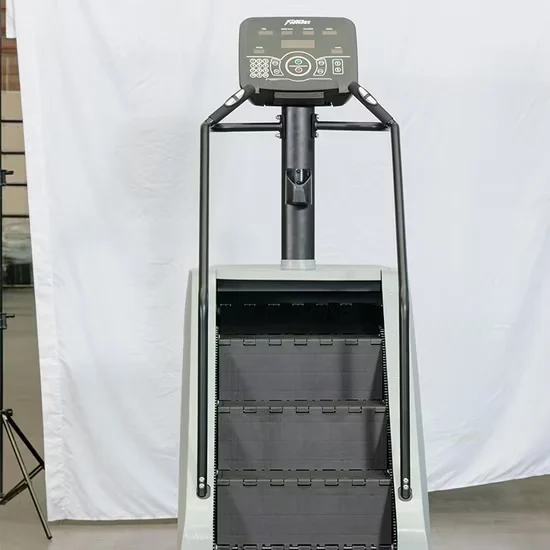
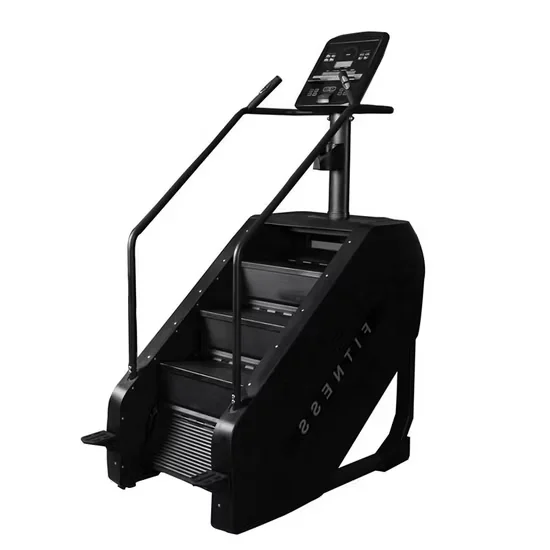
Whisper-Quiet Vertical Climbing — Motor-driven stair climber engineered with vibration-damped frame joints and balanced step mechanics to keep noise complaints off the front desk.
Technical Specifications
| Parameter | Value |
|---|---|
| Designation | SQ1017 |
| Product Type | Stair Climber |
| Type of Drive | Motor Drive |
| Function | Electric |
| Running Velocity | 15 steps/Minute – 164 steps/Minute |
| Step Area | 560 × 235 × 220 mm |
| Console Display (OSD) | Time, Climb, Calories, Steps, Heart Rate |
| Heart Rate | Handgrip sensors |
| Power Requirement | AC220V±10% / AC110V±10% |
| Product Dimensions | 1450 × 820 × 2080 mm |
| Net Weight | 148 kg |
| Material | Steel Pipe + PP Plastic |
| Folded | Unfolded |
| Color | Black |
| Customized | Yes |
| Certification | CE |
Application Suitability
| Deployment Scenario | Typical Use |
|---|---|
| Hotel fitness center on guest room floors | 24-hour cardio access with minimal noise transfer to adjacent rooms |
| Chain gym cardio zone | High-frequency climbing stations for general membership and group circuits |
| Corporate wellness room | Low-impact vertical climbing for employees during breaks and before/after shifts |
| High-end residential home gym | Compact footprint vertical cardio in dedicated fitness rooms |
| Sports performance training center | Sustained step-rate intervals for athlete conditioning programs |
Why Vibration Noise Travels Through Floors Before Maintenance Notices
Motor-drive isolation and balanced step mechanics prevent structural vibration from reaching occupied rooms below.
Commercial stair climbers with undersized motors or poorly balanced drive trains generate low-frequency vibration that migrates through floor slabs, triggering guest complaints long before the maintenance team flags an issue. In multi-story hotel deployments, the problem compounds: a cardio room on the third floor can produce audible resonance in second-floor suites during early-morning sessions. We have seen facilities replace entire fleets within a year because the original spec prioritized unit cost over drive-train balance and acoustic isolation [NEED_CITE: structural vibration transmission standards for commercial fitness equipment on upper floors]. The SQ1017 commercial stair climber motor drive gym addresses this through its motor-drive architecture and reinforced steel-pipe frame that dampens harmonic transfer before it reaches the floor plate.
Where This Stair Climber Fits in a Mixed Cardio Layout
The SQ1017 occupies the sustained vertical-climbing lane in a cardio zone, covering steady-state aerobic work and moderate-intensity interval sessions across the 15–164 steps/minute range. It complements treadmills and ellipticals by engaging the glute and quad chain through a different movement plane, and pairs naturally with rowing machines for full-body circuit configurations. Its 1450 × 820 mm footprint fits standard commercial cardio spacing grids, and the 2080 mm height requires overhead clearance verification in low-ceiling basement fitness rooms. The unit accommodates the full adult user range and the handgrip heart-rate sensors feed real-time biometric data that supports interval programming without external strap pairing. Deploying a commercial stair climber motor drive gym unit in the high-traffic lane of a chain gym cardio zone ensures the motor-drive system sees consistent utilization across membership demographics.
Continuous Operation Demands and Environmental Clearances
Facilities running 24-hour access need to confirm the motor-drive system can sustain multi-hour daily run-times without thermal degradation, and the SQ1017’s motor-drive architecture is designed to maintain consistent torque output across extended sessions [NEED_CITE: motor duty cycle classification for continuous commercial stair climber operation]. Noise传导 in hotel environments depends on floor construction as much as equipment isolation, so deployment teams should verify slab composition and consider vibration-damping underlayment beneath the unit’s leveling feet. The dual-voltage input — AC220V±10% and AC110V±10% — eliminates the post-arrival discovery that the destination market uses a different standard, a failure mode that has halted entire container deployments. Adequate airflow around the motor housing is critical; the 820 mm width requires lateral clearance on both sides for heat dissipation during continuous operation. Floor leveling must be confirmed before commissioning, as an unbalanced frame amplifies step-cycle vibration and accelerates bearing wear.
Motor-Drive Architecture and Console Data Capture
The motor-drive system delivers consistent step cadence across the full 15–164 steps/minute range, eliminating the cadence drop-off that friction-based or manual-resistance stair climbers exhibit under sustained heavy-user loads. Motor-driven systems maintain torque output regardless of user weight within the rated capacity, whereas manual systems require the user to overcome mechanical resistance that increases nonlinearly at higher step rates. The console captures Time, Climb, Calories, Steps, and Heart Rate through the OSD display, providing session-level data that facility managers can use for utilization tracking and maintenance scheduling. Handgrip heart-rate sensors deliver continuous biometric feedback during sessions, though users should maintain consistent palm contact for stable readings — a known trade-off compared to chest-strap telemetry where arm movement is unrestricted. The steel-pipe frame with PP plastic shrouding balances structural rigidity against unit weight, keeping the 148 kg net weight within the range manageable for installation crews without sacrificing frame stiffness under cyclic loading [NEED_CITE: EN 957 structural requirements for commercial stair climbing equipment].
The Hidden Cost of Specifying Below Commercial Duty
Choosing a stair climber rated for light-commercial or home use in a facility that operates sixteen or more hours daily creates a predictable failure cascade. The motor overheats under continuous load, bearings degrade prematurely from cyclic stress beyond their rated duty, and the step mechanism develops play that generates both noise and user complaints. We witnessed an entire cardio zone shut down for emergency replacement after a batch of under-specced climbers failed within months, costing the facility more in downtime and member refunds than the original equipment savings [NEED_CITE: commercial versus light-commercial duty cycle failure rates in stair climbers]. Beyond mechanical failure, consoles that lack data output capability leave facility managers blind to utilization patterns, making it impossible to justify equipment rotation or expansion budgets with usage evidence.
Why This Product Line Meets Commercial Deployment Standards
Every unit in this cardio family undergoes 10,000-hour continuous operation testing on motors, frames, and bearings before entering the shipping container — a protocol that catches duty-cycle mismatches before they surface in the field. The sub-35dB whisper-quiet operation benchmark, verified across hotel deployments, applies directly to the SQ1017’s motor-drive isolation and frame damping design. OEM customization extends to console UI configuration, allowing hotel chains to brand the startup screen and gym networks to lock specific training modes. The 3D cardio-zone layout service accounts for the SQ1017’s 1450 × 820 mm footprint alongside adjacent treadmill and elliptical spacing, optimizing sightlines and airflow for the entire climbing station. Full documentation packages ship with every order, and 24/7 technical support ensures that commissioning questions or field adjustments get resolved without waiting for business hours in a different time zone.
Documentation & Test Records
- CE declaration of conformity for EU market compliance
- EN 957 test report covering structural and safety requirements
- ISO 9001 certificate confirming manufacturing quality system
- Noise level test report verifying acoustic output under load
- Motor specification sheet with continuous-duty rating data
- Console technical documentation with data output interface details
Installation, Commissioning & Maintenance
- Verify 1450 × 820 mm footprint with minimum clearance on all sides for safe user entry and exit
- Level the unit on vibration-damping pads before first power-on to prevent frame-induced resonance
- Confirm AC220V or AC110V input matches site supply and connect to a dedicated circuit
- Run initial motor-drive calibration sequence to verify step-rate accuracy across the 15–164 steps/min range
- Inspect step mechanism and motor housing for debris accumulation during weekly cleaning cycles
- Wipe handgrip heart-rate sensors with mild disinfectant to maintain signal conductivity
Planning Your Stair Climber Deployment
Provide your cardio zone square footage and target unit count to receive a 3D layout that accounts for the SQ1017’s footprint, overhead clearance, and airflow requirements. Specify your daily operating hours so we can confirm the motor-drive duty cycle matches your facility’s utilization pattern. Confirm destination voltage standard — AC220V or AC110V — and plug type before production to prevent arrival-side mismatches. Indicate whether console data integration with your facility management software is required so we can supply the appropriate interface documentation.
Frequently Asked Questions
Q: What separates motor-drive from manual stair climbers in commercial settings?
A: Motor-drive systems maintain consistent step cadence and torque output regardless of user weight or session duration, which is critical in facilities where equipment runs continuously. Manual systems rely on user-generated force overcoming mechanical resistance, leading to cadence drop-off under sustained load and accelerated component wear. For commercial gymnasium and hotel deployments expecting diverse user populations and extended daily run-times, motor-drive architecture delivers the reliability and consistent experience that manual systems cannot sustain.
Q: How does dual-voltage input help international gym and hotel deployments?
A: The AC220V±10% and AC110V±10% capability eliminates a failure mode where equipment arrives at the destination only to discover the local power standard does not match the factory configuration. This mismatch has halted entire container deployments, forcing costly rewiring or return shipments. With dual-voltage input, the SQ1017 ships configured for the destination market’s electrical standard, simplifying commissioning and removing a variable that frequently delays facility opening timelines across international hotel groups and gym chain networks.
Q: Can the console data integrate with our facility management software?
A: The console captures Time, Climb, Calories, Steps, and Heart Rate through the OSD display. For facilities requiring data integration with member apps or management platforms, we provide console technical documentation detailing available data output interfaces. Integration capability depends on the specific console configuration selected during the OEM customization process, so we recommend specifying data connectivity requirements during the inquiry stage to ensure the appropriate interface is built into the production unit.
Q: Is the noise level suitable for hotel floors above guest rooms?
A: The motor-drive architecture and reinforced steel-pipe frame are engineered to minimize vibration transfer to the building structure. We recommend requesting the noise level test report for your specific deployment scenario and confirming floor construction details, as acoustic performance depends on both equipment isolation and slab composition. For upper-floor installations, vibration-damping underlayment beneath the unit provides additional attenuation that keeps the stair climber’s operation from reaching occupied rooms below.
![SQ1017 Commercial Stair Climber – Motor-Driven Stepmill for Gyms [WARN] draft identifier mismatch](https://bicksport.com/wp-content/uploads/2026/08/sq1017-commercial-stair-climber-motor-driven-stepmill-for-gyms-warn-draft-identifier-mismatch-340321.webp)
![Stair Machine Climbing Stepper for Commercial Gym Equipment [WARN] draft identifier mismatch](https://bicksport.com/wp-content/uploads/2026/08/stair-machine-climbing-stepper-for-commercial-gym-equipment-warn-draft-identifier-mismatch-548bcd.webp)