
![Professional Grade Mt026m Electric Fold Fitness Home Use Treadmill for Training [WARN] draft identifier mismatch](https://bicksport.com/wp-content/uploads/2026/08/professional-grade-mt026m-electric-fold-fitness-home-use-treadmill-for-training-warn-draft-identifier-mismatch-63d9e4.webp)
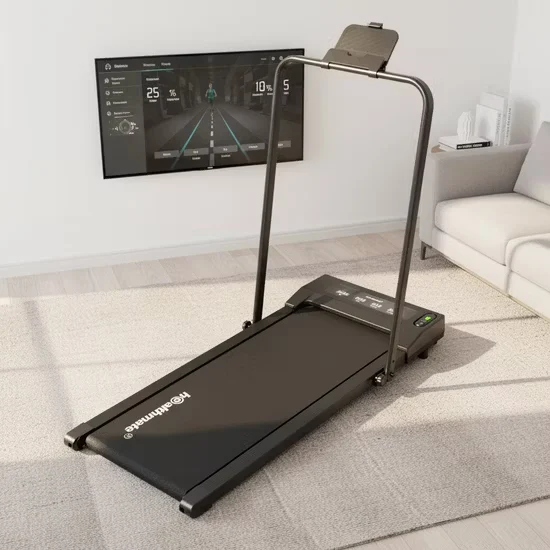
Compact Footprint Engineering — MT026M foldable frame reduces storage depth to 390 mm, enabling multi-use room deployments without permanent spatial commitment.
Technical Specifications
| Parameter | Value |
|---|---|
| Designation | MT026M |
| Motor Type | DC |
| Motor Power | 1.5 HP (peak or continuous not specified in source) |
| Speed Range | 1–12 km/h |
| Running Surface | 1200 x 460 mm |
| Console Type | LCD (Speed / Distance / Time / Calories / Pulse) |
| Programs | 12 |
| Heart Rate | Handgrip pulse sensors |
| Foldable | Yes |
| Product Unfold Size | 1465 x 750 x 1150 mm |
| Product Folded Size | 1465 x 750 x 390 mm |
| Net Weight | 46.0 kg |
| Certification | CE, RoHS |
| OEM/ODM Custom | Available |
| Material | ABS |
Application Suitability
| Deployment Scenario | Typical Use |
|---|---|
| High-end residential home gym | Daily walking and light jogging in apartment or multi-use rooms where floor space and noise transmission constrain equipment choices |
| Corporate wellness room | Compact cardio station for employee fitness breaks, stowed when room serves other functions |
| Boutique studio recovery zone | Low-intensity steady-state cardio complementing treatment rooms or cool-down areas with limited square footage |
| Hotel guest room fitness setup | In-room foldable treadmill for guests requiring private cardio options without dedicated fitness center access |
What Happens When a 1.5 HP DC Motor Faces Daily Residential Use
Continuous versus peak rating determines whether the motor survives its first year.
When we supplied a Middle East hotel with units using undersized DC motors rated for light home duty, daily eight-hour run-times burned out the entire batch within three months. The units were shipped back to our Jinan workshop and torn down one by one. That teardown revealed what spec sheets hide: a peak horsepower figure that collapses under sustained thermal load. The foldable electric treadmill home use DC motor configuration demands clarity on whether that 1.5 HP rating represents continuous duty or momentary peak output. Buyers who skip this verification inherit premature motor failure and guest complaints. [NEED_CITE: motor duty cycle classification for continuous commercial operation]
Cardio Zone Positioning for Compact Environments
The MT026M covers walking through light jogging intensity zones at speeds up to 12 km/h, targeting users who need steady-state cardiovascular work without high-impact sprinting. In a compact cardio arrangement, it pairs with elliptical trainers or exercise bikes to provide modality variety without exceeding available square footage. The foldable electric treadmill home use DC motor design suits deployment against walls or in alcoves where the 1200 x 460 mm running surface provides adequate stride length for most adult users, while the folded profile allows the room to serve alternate functions between sessions.
Continuous Operation and Environmental Requirements
Daily run-time expectations must align with motor thermal capacity — environments requiring sustained operation beyond two or three hours daily need verified continuous duty ratings rather than peak figures. Deployment on upper floors or shared-wall residential spaces demands attention to belt isolation and frame transmission paths that carry vibration downward. The unit requires standard single-phase household power, but buyers in markets with 220–240V systems must confirm voltage compatibility before production. Floor leveling and vibration-dampening pads reduce transmitted noise to adjacent rooms. The LCD console operates as a standalone display without facility management system integration, which affects usage tracking in multi-unit deployments. [NEED_CITE: EN 957 requirements for commercial cardio equipment]
Reading the Drive and Control Specifications
DC motors draw less current and produce lower acoustic output than equivalent AC motors, making them appropriate for residential and light commercial environments where noise matters more than continuous high-load endurance. The distinction between peak and continuous horsepower matters here — a 1.5 HP peak rating may deliver substantially less sustained output once thermal limits engage, which is why motor specification sheets with thermal duty cycle data are essential procurement documents. The LCD console displays speed, distance, time, calories, and pulse readings across 12 preset programs, providing immediate workout feedback without network connectivity. Handgrip pulse sensors deliver resting and steady-state heart rate readings but may drift during interval work where sweat and grip inconsistency affect contact resistance. The hydraulic or manual fold mechanism reduces storage depth to under 400 mm, though repeated folding cycles demand frame hinge verification to ensure long-term structural rigidity. Belt deck cushioning directly affects joint comfort and user retention — buyers should request material specifications rather than relying on generic marketing claims.
The Hidden Cost of Skipping Specification Verification
Undersized motors installed in environments that exceed their duty cycle generate thermal shutdowns and eventual winding failure, producing replacement costs that dwarf the initial specification savings. Noise complaints in shared-wall residential deployments surface before maintenance tickets do, forcing reactive equipment swaps that disrupt operations. Handgrip pulse sensors that drift during elevated heart rates leave users without reliable intensity feedback, undermining structured training programs. Voltage mismatches discovered after container arrival require adapter installations or transformer additions that delay commissioning. Each of these failures traces back to a procurement decision that skipped documentation review. [NEED_CITE: common cardio equipment deployment failures in residential environments]
Why This Product Line Earns Specification
Sub-35dB whisper-quiet operation has been verified across hotel deployments where cardio equipment sits above or beside occupied guest rooms. Our 10,000-hour continuous operation testing protocol applies to motors, frames, and bearings — every unit must pass before release. The MT026M folds to 390 mm depth, fitting into 3D cardio zone layouts where we plan square footage, sightlines, and member flow around structural constraints. OEM customization covers logo, color, and console UI adjustments at flexible minimum order quantities. Our Jinan manufacturing facility runs full vertical integration from R&D through finished unit testing, and 24/7 technical support covers commissioning questions and spare parts sourcing across export markets. [NEED_CITE: Biketon Sport manufacturing and quality control standards]
Documentation & Test Records
- CE declaration of conformity covering electrical safety and electromagnetic compatibility
- EN 957 test report validating structural and mechanical safety requirements
- ISO 9001 certificate for quality management systems
- RoHS compliance documentation restricting hazardous substance content
- Motor specification sheet with thermal duty cycle and continuous output data
- Installation and commissioning guide with wiring diagrams and belt tensioning procedures
Installation, Commissioning & Maintenance
- Maintain minimum 600 mm clearance behind the MT026M running surface and 400 mm on each side for safe mounting and dismounting
- Level the 1465 x 750 mm footprint using adjustable feet and place vibration-dampening pads beneath to reduce floor transmission
- Connect to a dedicated single-phase circuit matching target market voltage to avoid shared-load brownouts during motor startup
- Verify belt alignment and tension on first power-up, adjusting tracking to prevent edge wear during the break-in period
- Clean the LCD console surface and handgrip pulse sensors weekly to maintain display legibility and heart rate reading accuracy
Sourcing the Right Configuration for Your Deployment
Provide your cardio zone square footage and planned equipment count to receive a 3D layout with airflow planning that accounts for the MT026M folded and unfolded dimensions. Specify expected daily run-time per unit so we can verify motor duty cycle suitability against your operational profile. Confirm deployment floor level and adjacent room types to determine whether supplemental vibration isolation is required. State your target market voltage and plug standard before production to eliminate post-shipment incompatibility. Indicate whether console workout data needs to integrate with existing facility management software.
Frequently Asked Questions
Q: What is the difference between continuous duty and peak horsepower for daily treadmill use?
A: Peak horsepower represents maximum output the motor can produce for brief intervals, while continuous duty indicates sustained output under thermal equilibrium. A motor rated 1.5 HP peak may deliver considerably less during extended running sessions once internal temperatures rise. Requesting the motor specification sheet with thermal duty cycle data clarifies whether the unit can handle your expected daily run-time without thermal shutdown or premature winding degradation.
Q: How does a DC motor compare to an AC motor for residential treadmill environments?
A: DC motors draw less current, generate lower acoustic output, and weigh less than AC motors of equivalent peak rating, making them suited for apartments and shared-wall spaces where noise transmission matters. AC motors sustain higher continuous loads and suit commercial cardio zones with extended daily operation. The correct choice depends on whether your deployment prioritizes quiet operation and compact footprint or continuous high-frequency duty cycles.
Q: Can the LCD console data be exported or integrated with fitness management systems?
A: The MT026M LCD console displays speed, distance, time, calories, and pulse data across 12 preset programs but operates as a standalone unit without network connectivity or third-party app integration. Facilities requiring usage tracking, member check-in linkage, or centralized reporting should verify console data output protocols during specification and discuss OEM customization options for connectivity modules if integration is required.
Q: Is this treadmill suitable for upstairs apartment installation considering noise levels?
A: DC motor architecture produces lower operational noise than AC alternatives, but actual sound pressure levels depend on belt isolation, deck cushioning, and floor transmission characteristics. Request the noise level test report with dB(A) measurements at various operating speeds before committing to upper-floor shared-wall deployments. Supplemental vibration-dampening pads and floor leveling reduce structural transmission to rooms below.
Q: How does repeated folding affect frame rigidity over the equipment lifespan?
A: Foldable treadmill hinges endure cyclical stress each time the deck transitions between operational and storage positions. Frame rigidity depends on hinge material specification, locking mechanism tolerances, and weld integrity at pivot points. Requesting durability test records covering repeated fold cycles provides evidence that the structural design maintains alignment and stability throughout expected deployment life without developing play or wobble during operation.

![Safe Mt026m Electric Foldable Treadmill for Home Silent Speed Training [WARN] draft identifier mismatch](https://bicksport.com/wp-content/uploads/2026/08/safe-mt026m-electric-foldable-treadmill-for-home-silent-speed-training-warn-draft-identifier-mismatch-06508d.webp)
